Barbell Split Stance Rdl
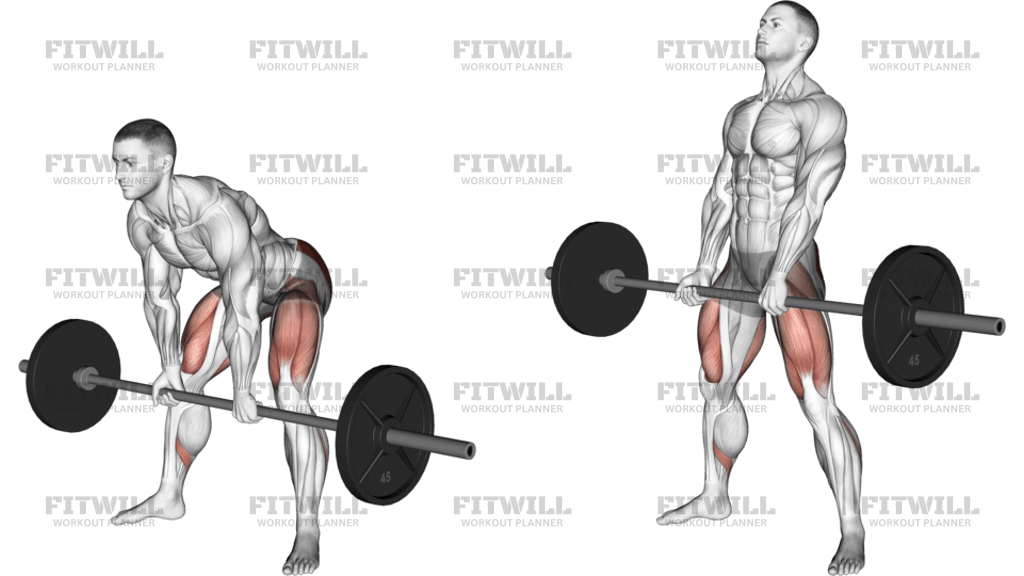
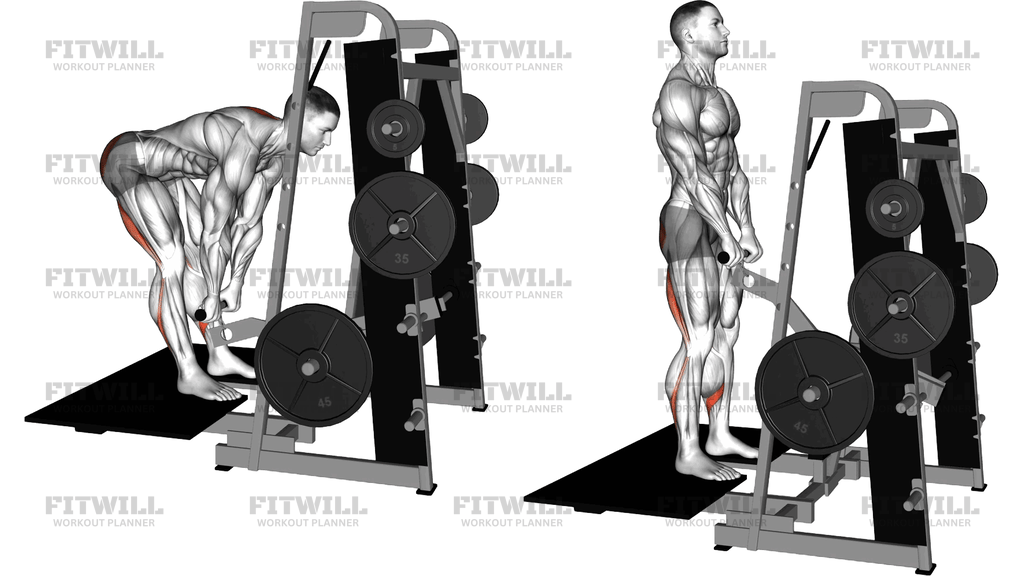
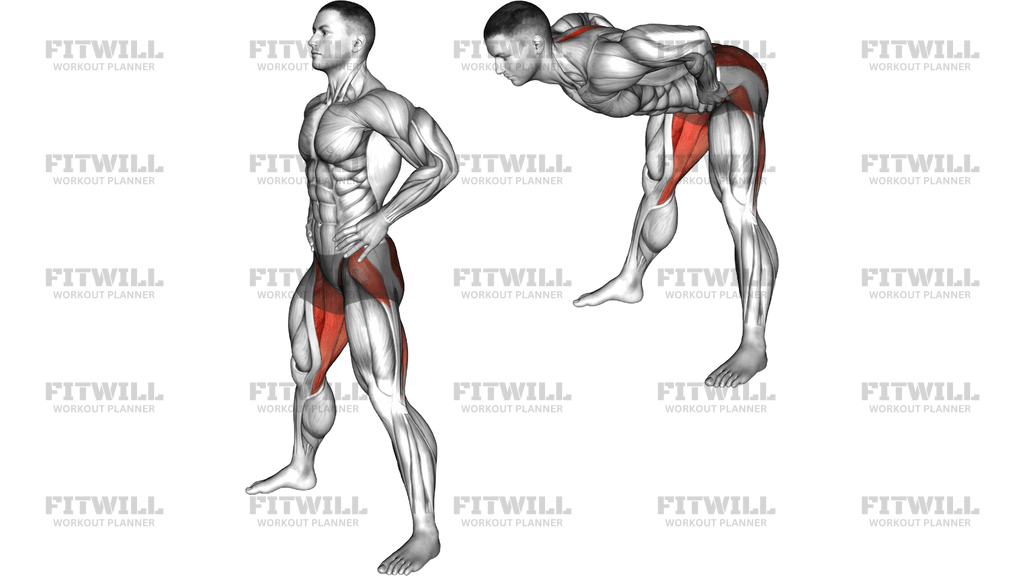
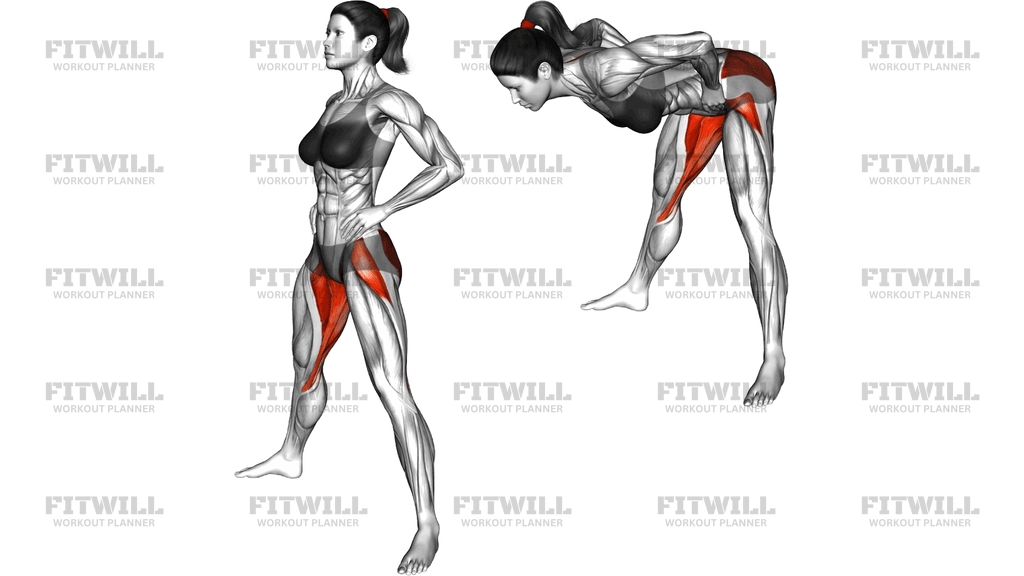
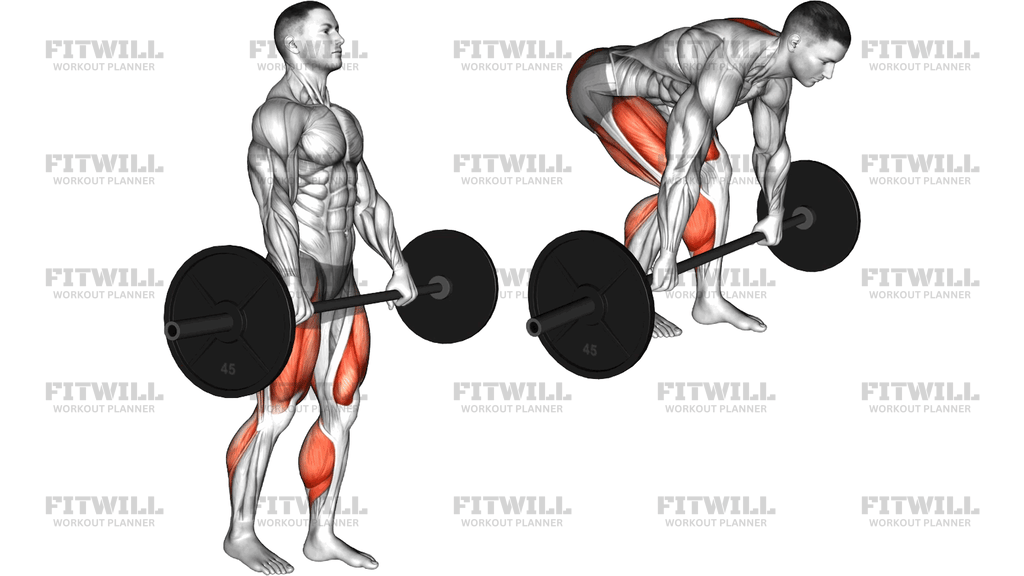
The Barbell Split Stance RDL is a hip hinge variation where one foot is staggered slightly behind the other instead of both feet sitting side by side. You hold a barbell in front of your thighs with a shoulder-width grip, then push your hips back and lower the bar along your legs until you feel a strong stretch in the hamstring of your front leg, before driving your hips forward to stand tall. The movement looks similar to a conventional Romanian deadlift, but the split stance shifts the demand toward the front leg and adds a balance and stability component that a standard two-legged hinge does not have.
This exercise is useful for lifters who want to load one leg at a time with a heavier implement than a dumbbell would allow. Because the rear foot only supports a portion of your weight, the front-leg hamstring and glute do most of the hip extension work, which helps expose and correct side-to-side differences. It also fits well into programs where you want the hinge pattern of an RDL but with less total spinal load than a heavy conventional deadlift, since the staggered position naturally limits how much weight you can or should use.
Muscularly, the primary work comes from the hamstrings of the front leg, which lengthen under load as the hips travel backward and contract to return you upright. The glute of the front leg drives the lockout, the erector spinae along the lower back holds the torso position isometrically, and the calf complex and foot of the front leg work continuously to keep you balanced over a narrower base. The grip and upper back also stay engaged to keep the bar close to the body throughout the descent.
Setup details matter a lot in this variation. A stance that is staggered too widely turns the movement into a single-leg exercise and makes balance the limiting factor, while a stance with almost no offset loses the point of the split position. Aim for a heel-to-toe offset of roughly one foot length, with your weight distributed mostly over the front heel and midfoot. Keep the bar against your legs for the entire rep; letting it drift forward is the most common fault and the fastest way to turn a hamstring exercise into a lower back strain.
In practice, the Barbell Split Stance RDL works well as an accessory movement after your main squat or deadlift work, typically for 2 to 4 sets of 6 to 12 reps per side. It is a natural bridge between bilateral RDLs and true single-leg RDLs: if a single-leg version wobbles too much to load meaningfully, the split stance gives you most of the unilateral benefit with far more stability. Complete all reps on one side before switching, and start lighter than your conventional RDL until the balance demand feels automatic.
[ Workout Log & Planner ]
Put your next workout in Fitwill
Keep your plan and training log ready when you are.


Instructions
- Set a barbell on the floor or in a low rack position and load it evenly on both sides.
- Stand behind the bar with your feet hip-width apart, then step one foot back so your heels are offset by roughly one foot length, keeping your hips square to the front.
- Hinge down with a flat back and grip the bar just outside your thighs with a shoulder-width overhand grip, then stand up so the bar hangs in front of your thighs with your arms straight.
- Brace your core, pull your shoulder blades back, and shift your weight toward the heel and midfoot of your front leg.
- Push your hips straight back and lower the bar along the front of your front leg, keeping your back flat and your front knee slightly bent.
- Descend until you feel a firm stretch in the hamstring of your front leg, usually when the bar passes just below the knee; do not force the bar lower by rounding your back.
- Drive your hips forward by squeezing the glute of your front leg to stand back up to the tall starting position.
- Exhale at the top of the rep, take a fresh breath, and re-brace before the next descent.
- Complete all reps on one leg, reset your stance, then perform the same number of reps with the opposite leg forward.
Tips & Tricks
- If you wobble on every rep, widen the split slightly rather than shortening it. A barely-staggered stance with a narrow side-to-side base is the least stable position; roughly a heel-to-toe offset gives the rear foot something to do.
- Keep the bar in light contact with your front shin and thigh. If you can see a gap between the bar and your leg in the bottom position, your hips drifted too far and the load transferred to your lower back.
- Point both hips straight ahead and avoid letting the rear hip open toward the back foot. A squared pelvis keeps the stretch on the front-leg hamstring instead of twisting the lower back.
- Keep the front knee softly bent and let it travel slightly forward as the hips go back. Locking the knee completely shortens the hamstring at the joint and reduces the stretch you are training.
- Control the lowering phase for 2 to 3 seconds. The eccentric is where the hamstring lengthens under load, and dropping the bar quickly removes most of the benefit of the split stance.
- Do not chase depth. Stopping just below the knee with a flat back beats reaching the floor with a rounded one; your hamstring flexibility, not the plate, decides the bottom position.
- Start with 20 to 30 percent less than your conventional RDL weight. The narrower base changes your balance long before it changes your strength.
- If your grip gives out before your hamstrings, use a mixed grip or lifting straps rather than cutting the set short, but only once your hinge pattern is solid.
- Work your weaker leg first and match the reps with the stronger side so the imbalance narrows instead of growing.
Frequently Asked Questions
Which muscles does the Barbell Split Stance RDL work the most?
The hamstring of the front leg is the primary mover, with strong assistance from the front-leg glute at lockout. The lower back erectors, the calf and foot of the front leg, and your grip work isometrically to hold position throughout.
How far apart should my feet be in the split stance?
A heel-to-toe offset of about one foot length works for most lifters, with the rear heel lifting naturally and your weight mostly over the front leg. If you feel unstable, widen the side-to-side width of your stance before changing the front-to-back offset.
Is the Barbell Split Stance RDL suitable for beginners?
Yes, provided you first own a competent bilateral hip hinge from conventional RDLs or deadlifts. Beginners should use a light bar or an unloaded barbell and prioritize keeping the bar against the leg over adding plates.
How is this different from a single-leg RDL?
In the split stance version, the rear foot stays on the floor and shares a small amount of your body weight, which makes balance much easier and lets you use more load. In a true single-leg RDL, the rear leg extends behind you as a counterweight and the balance demand is far higher.
Why does my lower back get sore instead of my hamstrings?
This usually means the bar drifted away from your leg or your back rounded at the bottom, shifting the load from the hamstrings to the spinal erectors. Reduce the range slightly, re-brace before each rep, and focus on dragging the bar down your front shin.
Should my rear knee bend during the rep?
It will bend slightly and that is fine, but the rear leg should act as a kickstand rather than push the floor. If you catch yourself driving through the back foot to finish reps, the load is too heavy or the stance is too wide.
What can I substitute if I do not have a barbell?
A pair of dumbbells or a single dumbbell held in the hand opposite the front leg reproduces the same pattern. The barbell version allows heavier loading, but the split stance hinge itself is identical with other equipment.
How deep should I lower the barbell?
Lower until you feel a strong hamstring stretch in the front leg, which for most people is when the bar reaches just below the knee. Stop at the point where your back would have to round or your hips would have to tuck to go further.
Is it safe for my lower back?
When performed with a neutral spine, a braced torso, and a bar path that stays against the leg, the hinge is a well-tolerated pattern for most lifters. Keep loads moderate, avoid jerking the bar off the floor between reps, and stop the set if your back position breaks down.