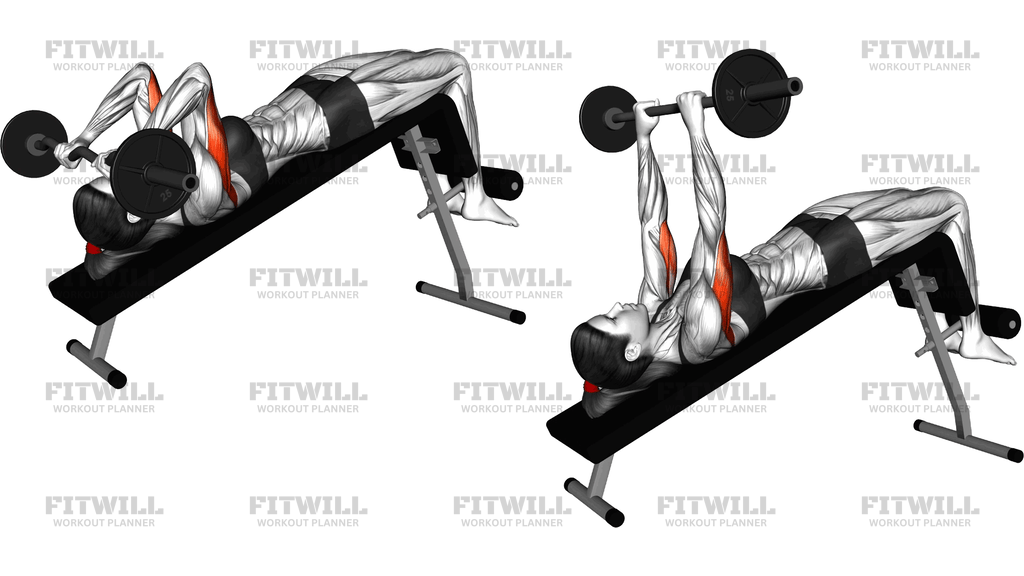
Barbell Decline Close Grip Press
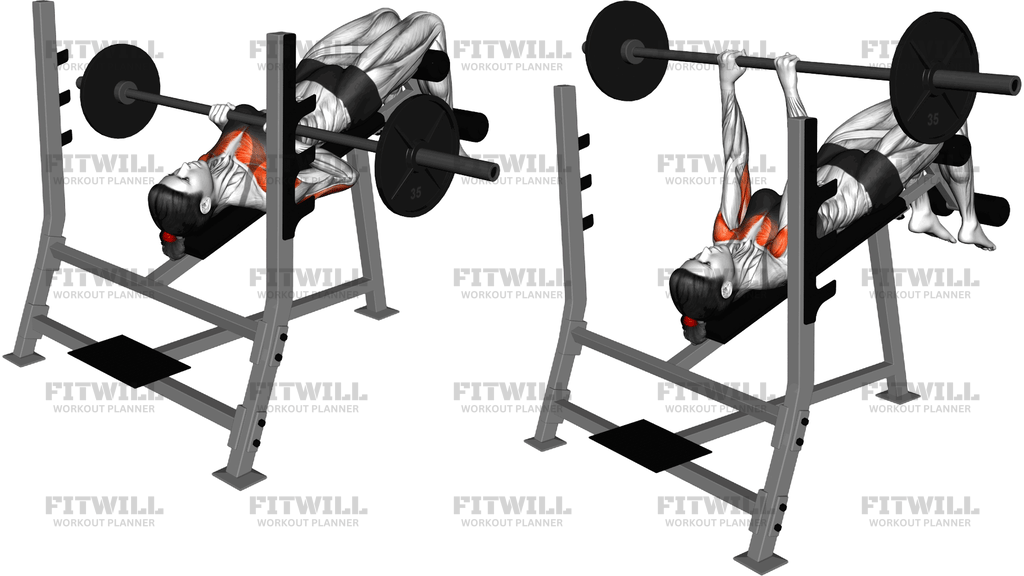
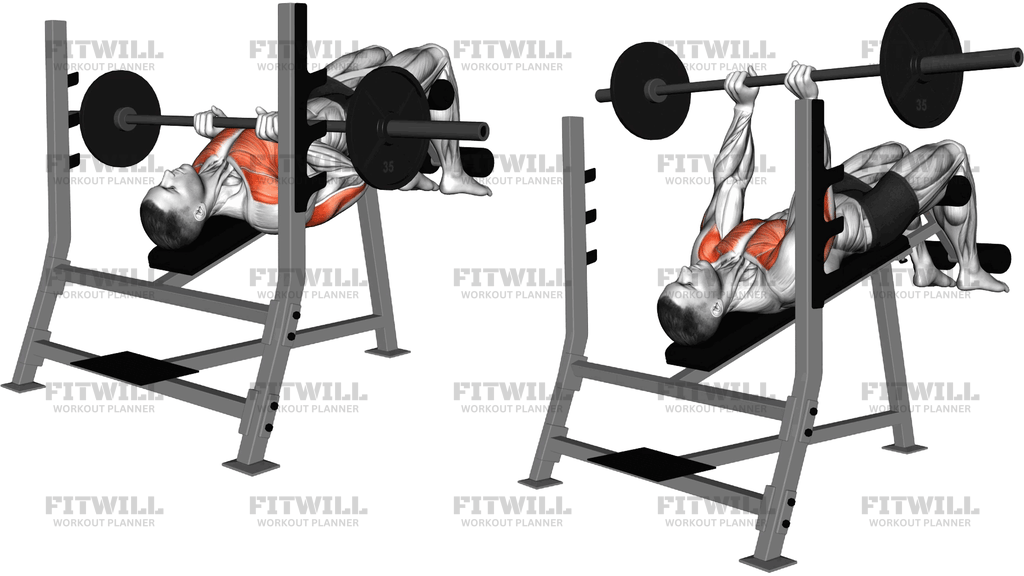
The Barbell Decline Close Grip Press combines two well-known pressing variations into one: the decline angle of the bench and a narrower-than-shoulder grip on the bar. You lie back on a decline bench with your knees hooked under the leg pads, unrack a loaded barbell, and press it over your lower chest with your hands set roughly 8 to 12 inches apart. The decline angle shifts the pressing arc toward the lower portion of the chest, while the narrow grip forces the triceps to do a much larger share of the work than they would in a standard bench press.
This movement is especially useful for lifters who want to build triceps strength that carries over to heavier pressing. Because the elbows stay close to the torso and the hands are drawn inward, the triceps extend the arms through most of the range, making this a staple in powerlifting-style training for lockout strength. At the same time, the decline position biases the lower chest fibers, so it serves as a solid compound option for anyone whose chest development is lagging in the lower region.
Setup matters more here than in most pressing variations. The decline angle means the bar travels over a lower point on your torso, so your grip width and elbow path must match that arc. A grip that is too narrow will strain the wrists and elbows, while one that is too wide turns the exercise back into a regular decline press. Hooking your legs securely under the pads is also essential, since the angle tends to slide your body toward the floor under load.
To execute the press well, lower the bar in a controlled line toward your lower chest, keeping your elbows tucked rather than flared wide. Touch lightly, drive the bar back up along the same path, and finish with your arms extended without snapping the elbows into lockout. Breathing should follow the usual pressing pattern: inhale as you lower, exhale as you press.
Common use cases include triceps-focused upper body days, bench press lockout work, and chest sessions that need a lower-chest emphasis without relying on dips. Because the decline position shortens the bar's travel over the face and throat, some lifters find it more comfortable than a close-grip flat press, but it still demands a spotter or safety rails when training close to failure.
[ Workout Log & Planner ]
Put your next workout in Fitwill
Keep your plan and training log ready when you are.


Instructions
- Set a decline bench at roughly a 15 to 30 degree downward angle and hook your lower legs securely under the leg pads so your body cannot slide toward the floor.
- Grip the barbell with an overhand, closed grip, hands about 8 to 12 inches apart, centered so the bar stays level.
- Lift the bar off the rack with straight arms and carry it over your lower chest, roughly in line with the bottom of your pecs.
- Brace your core, pull your shoulder blades down and back against the bench, and keep your head resting on the pad.
- Inhale and lower the bar along a controlled path toward your lower chest, keeping your elbows tucked at about a 20 to 40 degree angle to your torso.
- Touch the bar lightly to your lower chest or sternum area without bouncing it off the ribs.
- Exhale and press the bar back up along the same line, driving through until your elbows are extended but not jammed into a hard lockout.
- Pause briefly at the top with the bar balanced over your lower chest, then reset your brace before the next rep.
- After your final rep, guide the bar back to the rack hooks with straight arms and confirm it is seated before releasing your grip or unhooking your legs.
- Unhook your legs only after the bar is fully racked, then sit up carefully from the decline angle.
Tips & Tricks
- If your wrists bend backward at the bottom, your grip is too narrow; widen your hands by an inch or two until the bar can sit stacked over your forearms.
- Elbows flaring out to the sides turns this into a standard decline press and stresses the shoulders; consciously keep them tracking near your ribs.
- Do not bounce the bar off your lower chest. The decline angle places the bar directly over your ribcage, and a bounce there drives the bar toward your throat on the way up.
- Keep your glutes and upper back in contact with the bench. Arching up to shorten the range defeats the decline angle and makes the bar path unpredictable.
- Use a spotter or set the bar inside safety rails. Getting pinned on a decline bench is more awkward to escape than on a flat bench because you cannot easily slide out from under the bar.
- Start lighter than your flat close-grip press. The narrower stance over a decline arc is unfamiliar, and the first few sessions are for learning the path, not loading up.
- If the bar drifts toward your face as you press, your elbows are drifting back instead of staying stacked under the bar; cue yourself to press up and slightly toward your feet.
- Squeeze the bar hard with your whole hand. A loose close grip is the most common cause of the bar rolling or tilting during the set.
- Keep thumb wrapped around the bar rather than a thumbless grip; on a decline angle, an open grip leaves the bar resting over your face and neck.
Frequently Asked Questions
Which muscles does the Barbell Decline Close Grip Press work?
The triceps are the primary movers because the narrow grip makes elbow extension the limiting job, while the lower chest and front shoulders assist throughout the press. Grip and shoulder stabilizers also work to keep the bar level.
How wide should my grip be on the Barbell Decline Close Grip Press?
Start with hands about 8 to 12 inches apart, roughly shoulder-width or slightly inside. If your wrists collapse or your elbows feel pinched, widen slightly until the bar can sit directly over your forearms at the bottom.
Is the Barbell Decline Close Grip Press good for beginners?
It can be, but most beginners do better learning a flat close-grip press first because the decline angle adds a body-position challenge. If you start with this version, use a light weight and a spotter or safety rails until the bar path feels automatic.
Why use a decline bench instead of a flat bench for a close-grip press?
The decline angle shortens the bar's travel over your face and throat and shifts the pressing arc toward the lower chest, which many lifters find more shoulder-friendly. It also biases the lower pec fibers while still loading the triceps heavily.
What is the most common mistake on the Barbell Decline Close Grip Press?
The most frequent error is flaring the elbows wide, which turns it into a regular decline press and stresses the shoulder joints. A close second is bouncing the bar off the lower chest, which is risky given the bar sits over the ribcage and throat on this angle.
Can I substitute dips for the Barbell Decline Close Grip Press?
Weighted dips with a narrow torso lean are a decent substitute because they also train triceps and lower chest together. Close-grip push-ups with feet elevated are another option if you do not have a barbell and decline bench available.
Do I need a spotter for this exercise?
A spotter or safety rails are strongly recommended. If you fail a rep on a decline bench, sliding out from under the bar is harder than on a flat bench, so plan the escape route before you unrack.
Where should I lower the bar during the Barbell Decline Close Grip Press?
Lower it to your lower chest, around the bottom of the sternum, not to the upper chest or neck line. Touching higher on a decline angle pushes the elbows back and makes the bar drift toward your face on the press.
How should I breathe during the set?
Inhale as you lower the bar and exhale as you press up. For heavy singles, take a full breath and brace before the descent, then reset your breath at the top of each rep while the bar is balanced over your lower chest.