Weighted Plate Push Up
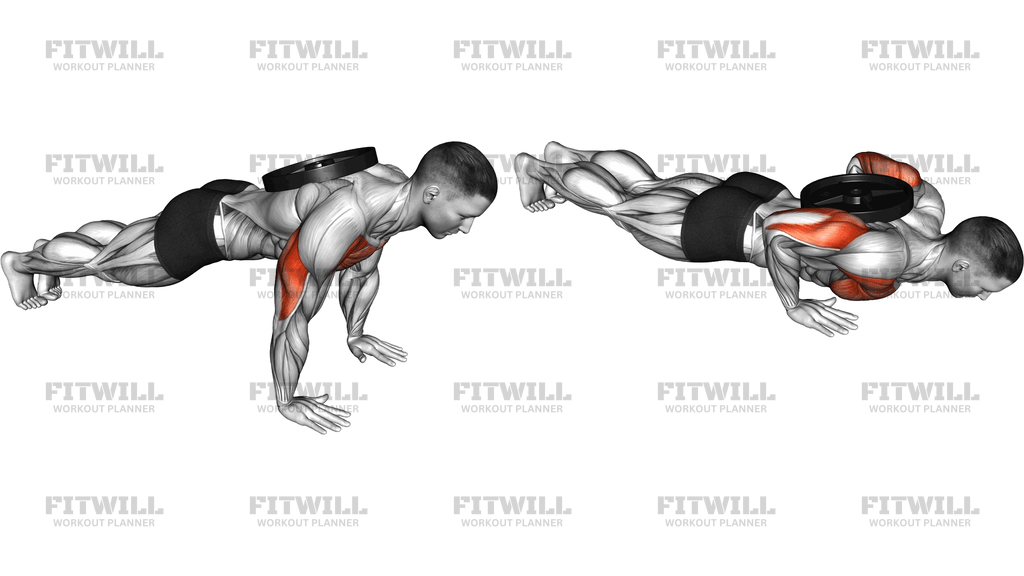
The Weighted Plate Push Up is a standard push-up with a weight plate resting on your upper back, typically between or just below the shoulder blades. The added load turns a bodyweight movement you may have outgrown into a genuine strength exercise, letting you keep pushing your chest, shoulders, and triceps harder without needing a bench, barbell, or machine.
This variation is most useful for intermediate and advanced lifters who can already perform 15-20 clean bodyweight push-ups and need more resistance to keep progressing. It is also a smart choice in minimal-equipment settings such as home gyms, hotel rooms, or small studio spaces, since a single plate provides all the loading you need. Because the plate sits high on the back, the demand on your core to hold a rigid plank position increases noticeably compared to an unweighted push-up.
The main muscles working are the pectorals, which drive the pressing motion, along with the front delts and triceps, which assist through the middle and lockout portions of each rep. Your abs, obliques, and lower back work isometrically the entire time to keep your hips from sagging under the extra weight. Grip, wrist stabilizers, and the muscles around the shoulder blade also contribute to keeping the press smooth and controlled.
Setup matters more here than in a regular push-up because the plate can slide or shift if your torso angle changes during the rep. Place the plate flat on your upper back before you begin, keep your body in one straight line from head to heels, and avoid letting your hips drop or spike upward as you fatigue. If the plate starts to slide mid-set, stop and reset rather than grinding through a rep with unstable loading.
To execute the movement well, lower your chest toward the floor with your elbows tracking at roughly a 45-degree angle to your torso, pause briefly at the bottom without collapsing, then press back up until your arms are straight. Breathe in on the way down and exhale as you press. Keep the tempo controlled, especially on the way down, since a fast descent makes the plate bounce and shifts load onto your spine rather than your chest.
Common use cases include building pressing strength past a bodyweight plateau, adding intensity to finisher sets, and progressing toward harder push-up variations like archer or one-arm push-ups by first building strength with added load. Start conservatively, usually with a 5-10 kg plate, and only add weight when you can complete all planned reps without your form breaking down.
[ Workout Log & Planner ]
Put your next workout in Fitwill
Keep your plan and training log ready when you are.


Instructions
- Place a weight plate on the floor within arm's reach of where you will set up for the push-up.
- Kneel down, set your hands slightly wider than shoulder width with fingers spread, then walk your legs back until your body forms one straight line from head to heels.
- Have a partner position the plate flat on your upper back between the shoulder blades, or carefully place it yourself by reaching back while kneeling before extending into the push-up position.
- Grip the floor with your fingertips, squeeze your glutes, brace your abs, and pull your shoulder blades slightly down and together before the first rep.
- Inhale, then bend your elbows to lower your chest toward the floor, keeping your elbows around a 45-degree angle to your ribs rather than flared wide.
- Lower until your chest is just above the floor or lightly touches, keeping your neck neutral and your whole body rigid under the plate.
- Exhale and press the floor away, driving up until your elbows are fully extended and your shoulder blades are spread around your ribcage.
- Repeat for the target number of reps, keeping the plate steady on your back the entire time.
- When finished, lower your knees to the floor first, then remove the plate before standing up.
- Increase the load only when you can finish every rep with the plate remaining flat and motionless on your back.
Tips & Tricks
- Position the plate on the upper back, not the lower back. Placing it too low tempts your lumbar spine to sag, while the shoulder-blade area keeps the load stacked over your pressing muscles.
- If the plate slides during the set, your hips are likely dropping or your chest is rising before your hips. Film yourself from the side and fix the body line before adding more weight.
- Use bumper plates or rubber-coated plates when possible. Thin metal plates sit flatter and are less likely to rock, but coated plates are more comfortable and quieter if they shift.
- Do not bounce out of the bottom. A fast rebound makes the plate momentarily float and crash down on the next rep, which is hard on the spine and robs the chest of tension.
- Keep your elbows at about 45 degrees to your torso. Fully flared elbows under load put extra stress on the shoulder joints, while elbows tucked completely to the ribs shifts work away from the chest.
- Start with a lighter plate than you think you need. The core demand is much higher than a regular push-up, and form usually breaks before pressing strength runs out.
- If you have no partner, place the plate while kneeling, then walk your legs back into position. Do not try to reach back and adjust a plate while holding a full plank, as this risks losing balance.
- Stack small plates and secure them together, or use a single thicker plate, instead of balancing several thin plates that can slide independently.
- Stop the set the moment your hips sag or your head drops toward the floor. Under added load, a collapsed plank trains poor position and strains the lower back.
Frequently Asked Questions
What muscles does the Weighted Plate Push Up work?
The chest is the primary mover, supported by the triceps and front delts. Your abs, obliques, and lower back also work hard to keep your torso rigid under the plate.
Where exactly should I place the weight plate on my back?
Rest it flat on your upper back, between or just below the shoulder blades. This keeps the load centered over your pressing muscles and away from your lumbar spine.
Is the Weighted Plate Push Up good for beginners?
Beginners are better off mastering bodyweight push-ups first. Once you can perform 15-20 solid reps, adding a small plate becomes a sensible progression.
How much weight should I add with the Weighted Plate Push Up?
Start with 5-10 kg and add weight only when every rep is clean and the plate stays flat on your back. Most lifters progress in small jumps of 2.5-5 kg.
Why does the plate slide off my back during the exercise?
Sliding almost always comes from a body-line problem, such as hips sagging, chest rising early, or an uneven descent. Slow the lowering phase and film yourself from the side to spot the cause.
Can I do the Weighted Plate Push Up without a partner?
Yes. Kneel down, place the plate on your upper back while your torso is nearly vertical, then walk your legs back into the plank before starting your reps.
What can I use instead of a weight plate?
A weighted vest distributes the load more evenly and is the best substitute. A sandbag or a dumbbell held flat across the upper back can also work, though both are harder to keep stable than a plate.
Is the Weighted Plate Push Up safe for the lower back?
It is safe when your torso stays in a straight line and the plate sits on the upper back. The risk comes from letting the hips sag under load, so end the set as soon as your plank position breaks down.
How does the Weighted Plate Push Up differ from a regular push-up?
The mechanics are identical, but the added plate increases resistance on the chest, shoulders, and triceps and makes the core work harder to hold position, which makes it a better strength builder once bodyweight reps feel easy.