Band Y-Raise
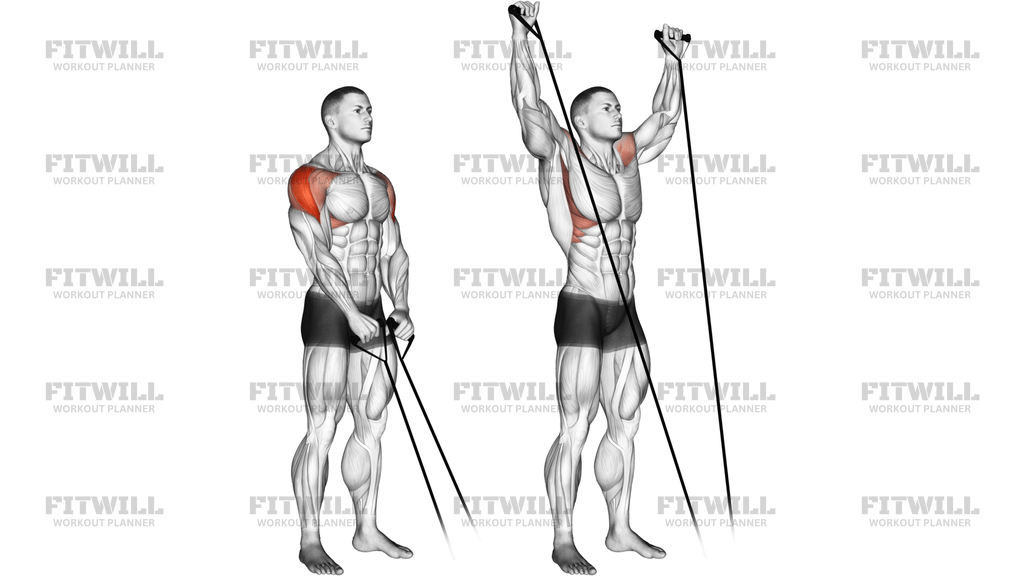
Band Y-Raise is a standing band exercise that trains the shoulders through an upward sweeping path from the thighs to an overhead Y position. The band is anchored under the feet, so the movement stays simple to set up but still demands control from the first inch off the body to the final lowering phase. It is useful when you want shoulder work that feels more precise than a press and more organized than a loose, momentum-driven raise.
The main emphasis is on the delts, with the upper back, traps, and arms assisting to keep the arms on path and the shoulder girdle stable. In anatomy terms, the main work centers on the Deltoids, with help from Trapezius, Rhomboids, and Triceps brachii. Because the arms travel in a wide diagonal rather than straight out to the side, the exercise also asks the shoulder blades to stay controlled instead of shrugging or flaring forward.
Setup matters here because the band tension changes quickly as the hands leave the thighs. Stand on the center of the band with feet about hip width, hold the ends or handles in front of the thighs, and keep the wrists neutral. A tall torso, soft knees, and quiet ribs make it easier to move the arms without turning the repetition into a back extension or a full-body heave. If the band is too short or too heavy, the start position becomes a fight instead of a clean rep.
On each rep, sweep the hands out and up in a wide Y until the arms finish overhead just in front of the ears. The elbows stay only slightly bent, the shoulders stay away from the ears, and the path should feel smooth rather than jerky. Lower along the same line with control, keeping tension on the band until the hands return near the thighs. Exhale as you lift and inhale on the way down, or use a steady breathing rhythm that does not disturb the torso.
This is a strong choice for warm-ups, shoulder-prep blocks, accessory work, or any session where you want better overhead control without heavy loading. It is especially useful when a lifter needs cleaner scapular motion, better upper-back engagement, or a light deltoid stimulus with little joint stress. The set should finish with the shoulders feeling worked and organized, not jammed upward or pulled into the low back.
Fitwill
Log Workouts, Track Progress & Build Strength.
Achieve more with Fitwill: explore over 9600 exercises with images and videos, access built-in and custom workouts, perfect for both gym and home sessions, and see real results.
Start your journey. Download today!




Instructions
- Stand on the middle of the band with feet about hip-width apart and hold the ends or handles in front of your thighs.
- Keep your wrists neutral, soften your knees, and stack your ribs over your pelvis before the first rep.
- Let the band start with light tension so the arms can leave the thighs without a jerk.
- Sweep your hands out and up in a wide arc, leading with the elbows just enough to keep the line smooth.
- Raise the arms until they form a Y overhead, finishing just in front of your ears.
- Keep your shoulders down away from your ears and avoid leaning back as the band gets lighter near the top.
- Pause briefly at the top if you can hold the position without shrugging or losing balance.
- Lower the band along the same path until your hands return to the thighs under control.
- Breathe out as you lift, breathe in as you lower, and reset your stance before the next rep.
Tips & Tricks
- If the band feels too heavy at the start, stand a little wider or use a lighter band so the first inch of the raise stays smooth.
- Keep the hands moving out and up instead of straight forward; that diagonal Y path is what makes this exercise different from a front raise.
- Stop the lift before your shoulders climb toward your ears, because shrugging shifts the work away from the delts and upper back.
- Use only a small bend in the elbows; if the elbows keep collapsing, the band is probably too heavy.
- Keep the chest tall without arching your low back when the arms reach overhead.
- A slow lowering phase helps the shoulders and upper back stay engaged through the whole repetition.
- If one side rises faster than the other, re-center your feet and check that both hands are starting from the same height.
- Choose a band that lets you reach the overhead Y without pain, pinching, or losing the line of the movement.
Frequently Asked Questions
What muscles does Band Y-Raise work most?
The delts do most of the work, with the upper traps, rhomboids, and triceps helping stabilize the arms and shoulder position.
Why do I stand on the band instead of anchoring it behind me?
Standing on the band creates the resistance directly under the body, which makes the upward Y path easy to set up and repeat with both arms.
How high should my hands go in the raise?
Finish with the arms in a Y overhead, just in front of the ears, but stop before your shoulders shrug or your ribs flare.
Should I keep my elbows straight the whole time?
Keep only a slight bend in the elbows. Locking them hard can make the movement feel stiff, while bending too much turns it into a different raise.
What is the biggest form mistake on this exercise?
The most common mistake is shrugging the shoulders or leaning back to finish the overhead position instead of keeping the torso stacked.
Is Band Y-Raise a good warm-up exercise?
Yes. The light band tension and overhead path make it useful for shoulder activation, scapular control, and upper-back preparation before heavier work.
What band resistance should I choose?
Use the lightest band that still gives clear tension through the full arc. If you have to yank the band off the thighs, it is too heavy.
Why does one side sometimes feel stronger than the other?
Uneven foot pressure or a crooked start position can shift the band tension. Re-center your stance and make sure both hands begin from the same height.