Kneeling Upper Back Rotation (Shoulder Touch)
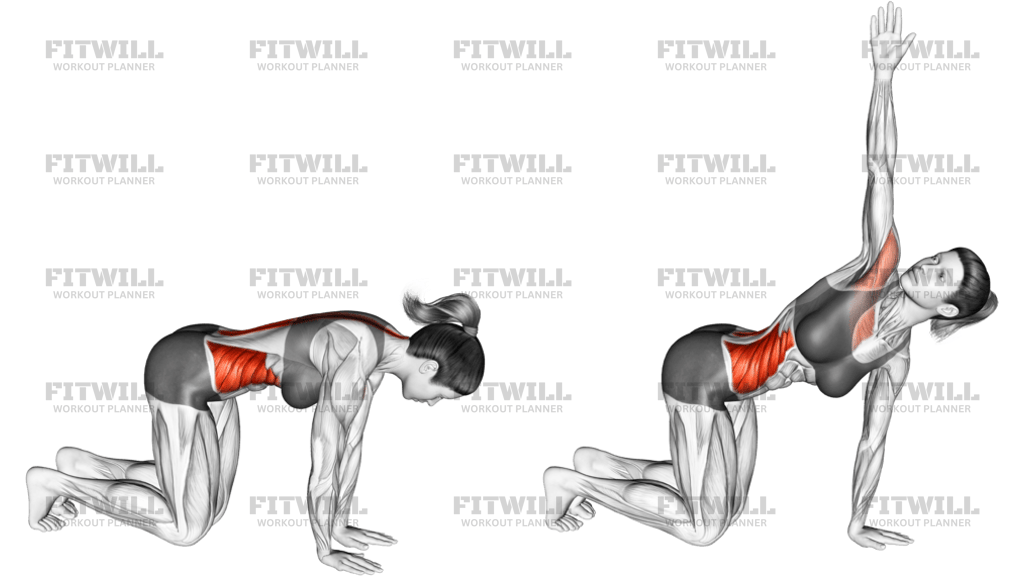
The Kneeling Upper Back Rotation (Shoulder Touch) is a bodyweight mobility drill performed from an all-fours position, with one hand planted on the floor and the other hand touching the opposite shoulder. From there, you rotate through the upper back, guiding the elbow down toward the supporting arm and then opening it up toward the ceiling. Because the hand stays anchored at the shoulder throughout, the movement is driven almost entirely by the thoracic spine rather than the arm swinging, which makes it a precise tool for teaching rotational control.
This exercise is especially useful for anyone whose upper back feels stiff from long hours of sitting, driving, or hunching over a desk. It is also a common warm-up choice before pressing, pulling, throwing, golf, tennis, or any sport that demands rotation. Lifters often use it between sets of bench presses or overhead work to keep the thoracic spine and shoulder blades moving well under load.
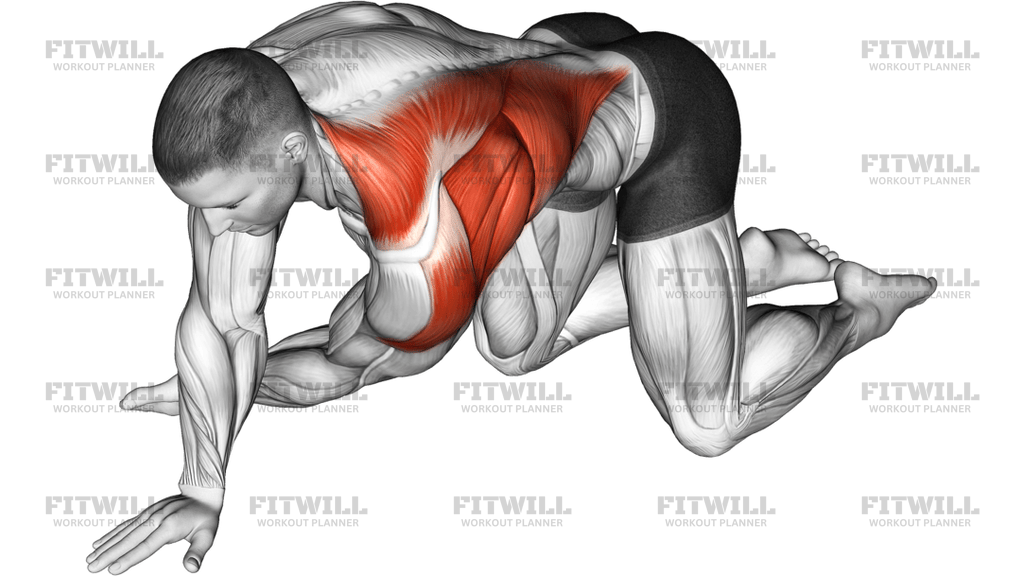
The main work comes from the muscles between and around the shoulder blades — the rhomboids, middle and upper traps, and the rear shoulders — along with the obliques, which help control the turn of the ribcage. The kneeling base removes the balance demands of a standing rotation, so you can focus purely on segmenting the rotation into the upper back instead of letting the lower back and hips do all the turning.
Setup matters more than most people expect. Kneel down and place one hand directly under the shoulder, then bring the other hand up to touch the opposite shoulder with the elbow held roughly at chest height. Keep your weight stacked over the supporting arm and your hips square toward the floor. If your support hand drifts forward or your hips collapse to one side, the rotation loses its target and the lower back starts compensating.
To execute the drill well, think of the elbow as the pointer. Draw it down and across your body, letting the upper back round and rotate as the shoulder dips toward the supporting arm, then reverse the arc and lift the elbow up toward the ceiling while your eyes follow it. The range does not need to be large — a smooth, controlled sweep with the ribcage actually turning beats a big jerky swing every time. Breathe steadily, exhaling as you rotate open.
A few practical points keep this safe and effective. Move slowly enough that you could stop at any point of the arc, and never force the end range by cranking the neck or bouncing the elbow. Keep the supporting elbow soft rather than locked, and if kneeling is uncomfortable on your knees, pad them or place a folded towel underneath. Two to three sets of five to eight controlled rotations per side works well as a warm-up or as a standalone mobility reset during the day.
[ Workout Log & Planner ]
Put your next workout in Fitwill
Keep your plan and training log ready when you are.


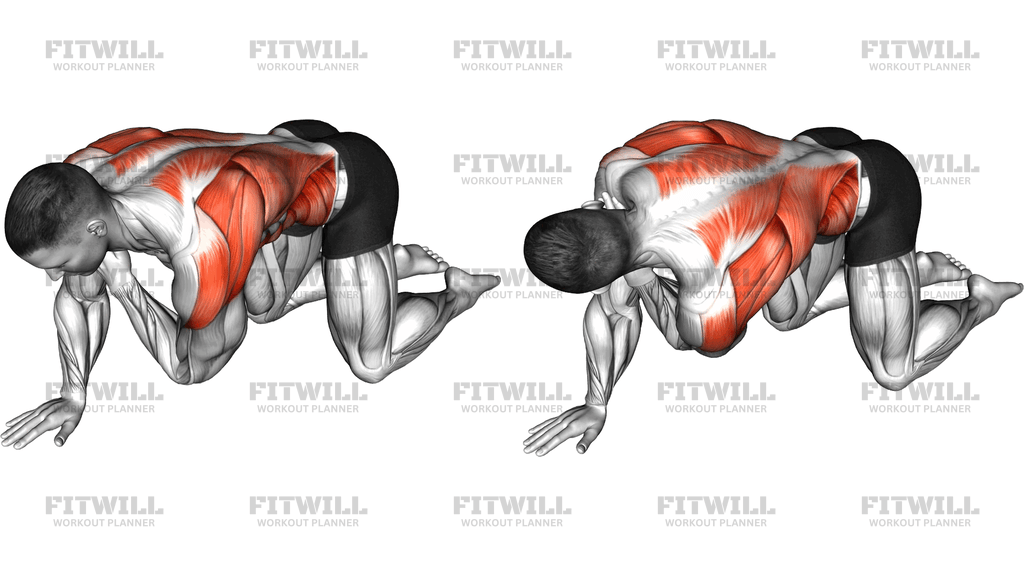
Instructions
- Kneel on an exercise mat and set up on all fours, then lower your hips back toward your heels so your knees stay grounded and your torso angles slightly forward.
- Plant your right hand flat on the floor directly under your right shoulder with a soft elbow, fingers spread for a stable base.
- Bring your left hand up to touch your right shoulder, holding it there for the entire set so the arm cannot swing freely.
- Brace your core lightly and keep your hips square to the floor, stacking your weight over the supporting arm.
- Inhale, then rotate through your upper back by drawing the left elbow down and across your body, letting the shoulder dip toward the space under your chest while your upper back rounds and turns.
- Reverse the arc smoothly and rotate open, lifting the left elbow up toward the ceiling as your eyes follow it and your ribcage turns over the stable base.
- Exhale as you rotate open, then inhale as you return down through the same controlled path toward the supporting arm.
- Complete 5-8 rotations in one continuous, deliberate arc, then switch the supporting hand to the left and repeat on the other side.
Tips & Tricks
- If your hand keeps sliding off the opposite shoulder, you are letting the arm drive the movement — press the hand firmly into the shoulder and think of rotating the ribcage around it instead.
- A common mistake is twisting from the lower back while the upper spine stays still. Keep your hips facing the floor and imagine the turn happening between your shoulder blades.
- Do not lock the elbow of the supporting arm; a locked arm pushes your shoulder up toward your ear and cuts off the rotation at the top.
- If your hips rock side to side as you rotate, widen your knees slightly and squeeze them inward to lock the pelvis in place.
- Resist the urge to chase a huge range on the opening side. A rotation where the ribcage visibly turns is worth more than a big swing with a still spine.
- Keep your neck relaxed and let your head travel with the elbow rather than cranking your chin toward the ceiling to fake extra range.
- Pad your knees with a folded towel or mat if the kneeling position is uncomfortable — discomfort there will quietly pull your attention away from the rotation.
- If you feel pinching at the front of the rotating shoulder, lower the elbow arc slightly and rotate within the range that stays comfortable rather than forcing the top position.
Frequently Asked Questions
Which muscles does the Kneeling Upper Back Rotation (Shoulder Touch) work?
It primarily targets the upper back muscles around the shoulder blades, including the rhomboids and middle traps, while the rear shoulders and obliques assist and control the rotation. The kneeling position also lightly challenges the core to keep the hips steady.
Why does one hand stay touching the opposite shoulder during the exercise?
Fixing the hand at the opposite shoulder shortens the free arm so it cannot swing and generate momentum. This forces the rotation to come from the thoracic spine, which is exactly what the drill is designed to improve.
Is the Kneeling Upper Back Rotation (Shoulder Touch) suitable for beginners?
Yes, it is very beginner friendly because the floor provides balance support and there is no external load. Beginners should simply use a smaller arc and prioritize smooth, controlled breathing over range of motion.
Why do my hips keep twisting when I rotate?
The pelvis usually rotates when the upper back cannot supply the full range being demanded, so the body borrows motion from below. Square your hips to the floor, narrow the rotation range slightly, and gently squeeze your knees together to lock the base.
Should I do the Kneeling Upper Back Rotation (Shoulder Touch) before or after my workout?
It works best as a warm-up before pressing, pulling, or rotational sports, when you want the upper back moving freely. You can also use it between heavy sets or during the day as a mobility reset.
How many reps and sets should I perform?
Two to three sets of five to eight slow rotations per side is a solid starting point. Because it is a control drill rather than a strength lift, quality of the arc matters far more than rep count.
What can I use instead if kneeling hurts my knees?
Place a folded towel or extra mat under your knees, or perform a standing version with one hand braced on a bench and the other touching the opposite shoulder. The key element to keep is the fixed hand and rotation driven from the upper back.
Is it normal to hear or feel cracking in my upper back during this exercise?
Occasional painless clicking or cracking in the thoracic spine is common during rotation and is usually nothing to worry about. If the movement causes pain, reduce the range and stop if discomfort persists.
How is this different from a standard open-book thoracic rotation?
The open-book rotation is done lying on your side with the arm sweeping open, while the Kneeling Upper Back Rotation (Shoulder Touch) is performed from all fours with the hand fixed at the opposite shoulder. The kneeling version adds a weight-bearing arm and more anti-rotation demand on the core.