Lying Floor Fly
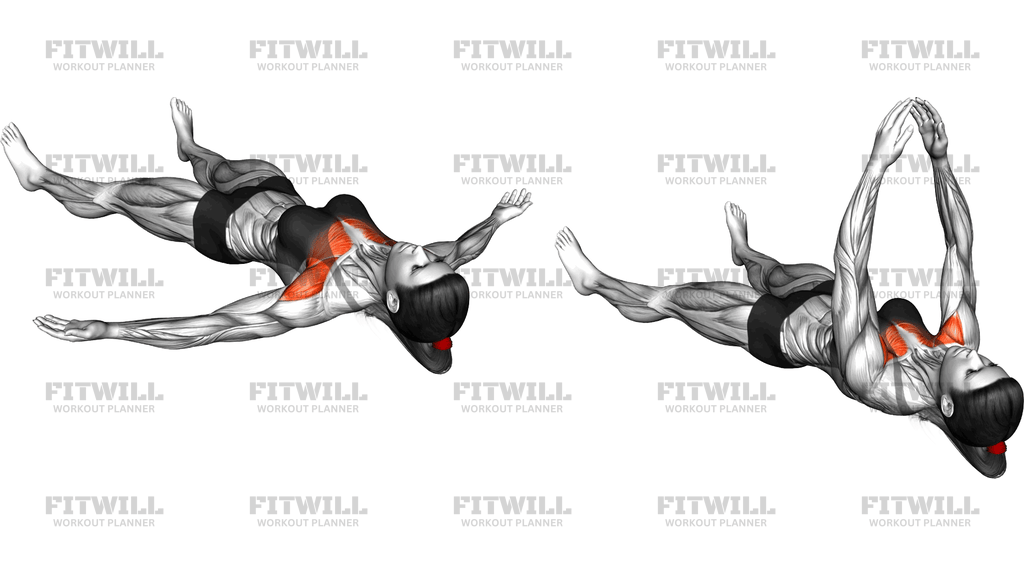
The Lying Floor Fly is a bodyweight chest exercise performed on the floor. You lie flat on your back with your arms extended out to the sides at shoulder height, then sweep both arms up and together above your chest until your hands meet, before lowering them back out in a wide arc. Because it uses no dumbbells, cables, or machines, the movement relies entirely on your own muscular control, which makes it one of the most accessible ways to learn what a proper fly pattern feels like.
The exercise primarily trains the chest, specifically the sternal head of the pectoralis major, which drives the horizontal adduction of the arms. The front shoulders assist throughout, and holding the arms nearly straight keeps the elbows, wrists, and stabilizing muscles lightly engaged as well. Since the floor limits how far your arms can travel behind your torso, the range at the bottom is naturally truncated, which makes this a joint-friendly option compared to a deep fly on a bench.
This version suits beginners who are learning the fly pattern before adding weight, people training at home with no equipment, and anyone who wants a controlled, low-load chest movement for warm-ups, recovery days, or high-repetition finishers. It is also a common choice in floor-based circuits and mobility-style workouts where getting down and up from a bench is impractical.
Setup matters more than it might seem. Lying flat with your head, upper back, and hips in contact with the floor keeps your ribcage from flaring and prevents your lower back from arching into the movement. Arms positioned level with your shoulders create the correct arc; letting them drift toward your hips or up toward your head changes which fibers do the work. A light bend in the elbows protects the joint without turning the fly into a press.
To execute the movement well, move your arms as if you were wrapping them around a large barrel. The palms can stay open and relaxed, facing up on the way out and turning slightly toward each other as the hands meet overhead. The contraction at the top should feel like a deliberate squeeze across the chest, not a clap. Lower the arms with the same control, resisting gravity rather than letting them drop to the floor.
Because resistance comes only from bodyweight and positional tension, the Lying Floor Fly rewards higher repetitions, slower tempos, and pauses at the top. Progress by slowing the lowering phase, adding a brief hold when the hands meet, or elevating the movement into a warm-up series before pressing work. If you feel it mostly in the front of the shoulders or the neck, reduce the range and refocus on drawing the arms together with the chest rather than lifting from the shoulders.
[ Workout Log & Planner ]
Put your next workout in Fitwill
Keep your plan and training log ready when you are.


Instructions
- Lie flat on your back on an exercise mat or clear floor space, with your head, upper back, and hips resting on the ground and your legs extended or knees bent for comfort.
- Extend both arms straight out to your sides so they form a T-shape with your torso, level with your shoulders, palms facing up and fingers relaxed.
- Press your lower back gently toward the floor and brace your core so your ribcage stays down throughout the set.
- Keep a very slight, fixed bend in both elbows and hold it for the entire movement.
- Sweep both arms up and inward in a wide arc above your chest, as if hugging a large barrel, until your hands come together over your upper chest.
- At the top, squeeze your chest for a moment with the palms touching or nearly touching, arms still mostly straight and elbows soft.
- Reverse the arc slowly, lowering your arms back out to the starting T-position under control without letting them slap down onto the floor.
- Exhale as you bring your arms together and inhale as you lower them back out.
- Complete your repetitions, then rest with your arms down by your sides before standing back up.
- Reset your back position and brace again before each set if you have been resting on the floor.
Tips & Tricks
- If your lower back arches and lifts off the floor as your arms come together, bend your knees and plant your feet flat to settle your pelvis before continuing.
- A common mistake is pressing the arms up like a push-up with straight vertical movement; the path should be a sideways arc, with the elbows staying wide and level with the shoulders at the bottom.
- Do not let the elbows bend more as the arms get heavy-feeling; a growing bend turns the fly into a floor press and takes work away from the chest.
- If your hands clap forcefully at the top, you are rushing the finish; touch lightly and hold the squeeze for one to two seconds instead.
- Keep your head resting on the floor rather than lifting it to watch your arms; craning the neck is a frequent source of tension in this position.
- Because there is no external load, the chest only stays challenged if you control the tempo; try a three-second lowering phase on each rep.
- Stop the arc at the point where your chest feels a comfortable stretch rather than forcing the arms to the floor; the floor sets a safe limit on the end range anyway.
- If you feel the work mostly in the front of your shoulders, lower the arms slightly below shoulder level at the start and think about squeezing the arms toward the midline of your body.
- Warm up the shoulder girdle with a few slow arm circles before starting, since the fly position places the arms at the outer edge of their comfortable range when cold.
Frequently Asked Questions
Which muscles does the Lying Floor Fly work?
The chest, especially the sternal portion of the pectoralis major, is the main muscle working as it draws the arms together. The front shoulders assist, and the muscles that hold your posture on the floor work lightly to keep you stable.
Is the Lying Floor Fly a good exercise for beginners?
Yes. With no external weight and a range of motion naturally limited by the floor, it is one of the safest ways to learn the fly pattern before progressing to dumbbell or cable flies on a bench.
How is the Lying Floor Fly different from a dumbbell fly on a bench?
On a bench, your arms can drop below torso level, which increases the stretch on the chest and the load you can use. On the floor, the ground stops the descent, so the range is shorter but the shoulder joint is protected from overstretching.
Should my elbows be bent or straight during the Lying Floor Fly?
Keep a small, fixed bend in the elbows throughout. Fully locked arms can strain the elbow joints, while bending further during the rep turns the movement into a press and reduces chest involvement.
How can I make the Lying Floor Fly harder without equipment?
Slow the lowering phase to three or four seconds, pause and squeeze for two seconds each time your hands meet, or add more repetitions. You can also do the fly while pressing your arms gently against light resistance from a band looped around your wrists.
Why do I feel this more in my shoulders than my chest?
This usually means the arms are moving with the shoulders rather than being squeezed toward the body's midline. Lower your arms slightly at the start, shorten the range a little, and focus on drawing the elbows and hands together across your chest.
Can I do the Lying Floor Fly every day?
Because the resistance is low, it can be used frequently as a warm-up or activation drill. If you train it to a point of muscular fatigue, treat it like any other chest exercise and allow a day of recovery between harder sessions.
What can I use instead of the Lying Floor Fly if I have no mat?
Any firm, comfortable surface such as carpet works fine. Avoid doing it on a hard floor if lying flat bothers your spine, and consider a folded towel under the head and hips.
How many repetitions should I do of the Lying Floor Fly?
Since the load is limited, higher repetitions in the range of 12 to 20 or more work best. Aim to stop when you feel a clear burn across the chest rather than counting to a fixed number regardless of quality.