Reverse Hyperextension On Box
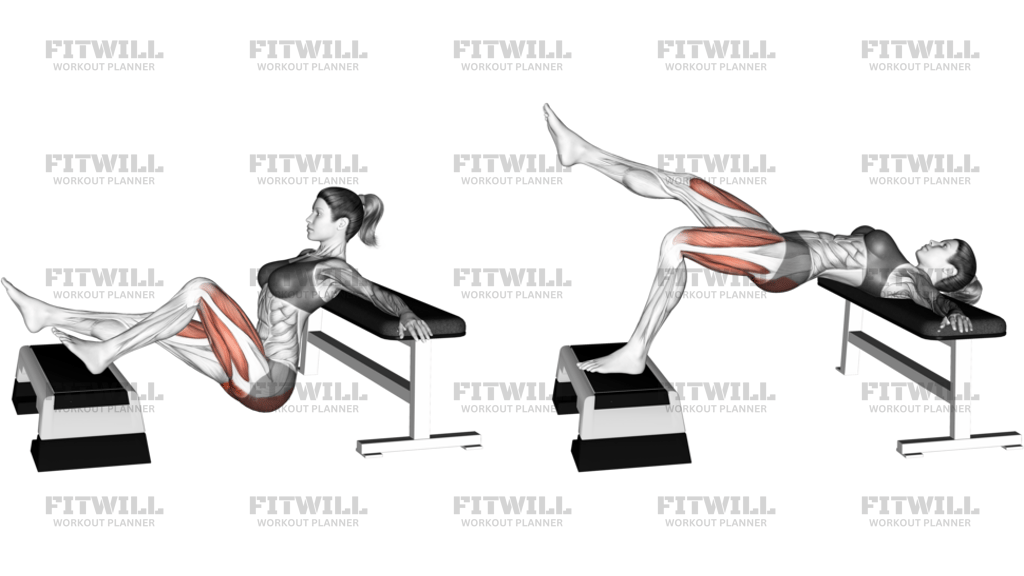
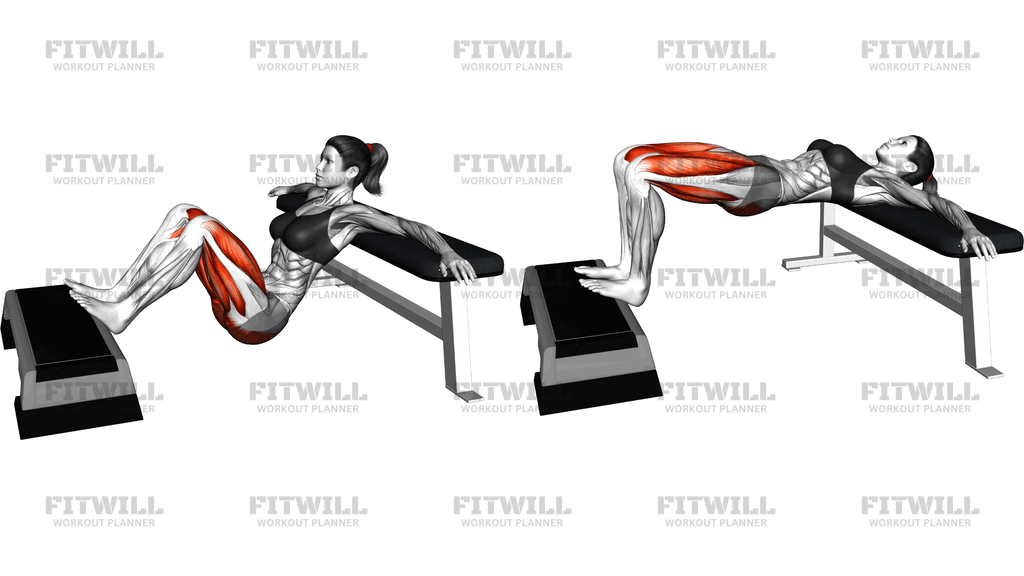
The Reverse Hyperextension On Box is a bodyweight hip extension exercise performed lying face down along a sturdy box or step platform. Your torso rests on the box with your hips right at the edge, arms reaching forward to hold on, and your legs hanging off the back. From there, you squeeze the glutes to lift your straightened legs up behind you until your body forms one long line or slightly more, then lower them back down under control. It is essentially the reverse of a sit-up motion: the torso stays fixed while the lower body moves.
This movement primarily trains the glutes, with strong help from the hamstrings as they assist in extending the hips. Because your torso is anchored and your legs act as the moving load, the erector spinae in the lower back also works hard to stabilize and slightly extend the spine as the legs rise. Unlike machine reverse hypers, there is no strap or pendulum involved, so the entire lift is driven purely by hip extension strength, which makes it a good teacher of glute control.
The box setup matters more than people expect. If your hips are too far forward on the box, your legs will scrape the floor and you will lose range of motion; too far back, and you lose the stable base under your torso, forcing your lower back to do more work holding you in place. Ideally your hip crease sits just off the edge so your legs can swing freely through their full arc while your chest and abdomen stay firmly supported. If the box is taller than your reach, grip its sides; if you can touch the floor comfortably, brace your hands against it or hold the far edge.
This exercise suits lifters who want to build glute and hip extension strength without loading a barbell, as well as anyone whose posterior chain work has been dominated by squats and hinges. Because the resistance is only your own legs, it scales naturally: beginners can bend the knees slightly or lift to a shorter range, while advanced trainees can add ankle weights or slow the tempo. It is commonly used as an accessory after deadlifts or hip thrusts, or as a warm-up to wake up the glutes before lower body training.
Execution quality comes down to three things. First, keep the lift coming from the hips rather than from an aggressive arch of the lower back — think about driving the heels toward the ceiling, not cranking the spine upward. Second, move with intent in both directions; swinging the legs up with momentum turns the exercise into a ballistic jerk that stresses the lumbar area without much glute benefit. Third, avoid holding your breath or tensing your neck and shoulders as the legs rise. Done well, this is a smooth, controlled exercise that leaves the glutes and hamstrings working and the lower back feeling supported rather than strained.
[ Workout Log & Planner ]
Put your next workout in Fitwill
Keep your plan and training log ready when you are.


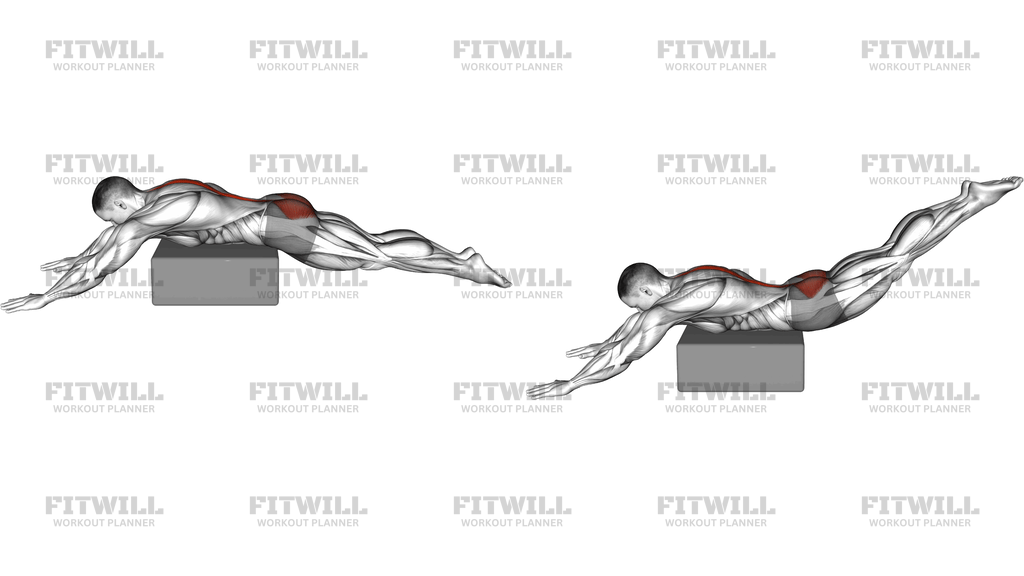
Instructions
- Set a sturdy box or step platform in open space and lie face down along it so your chest and abdomen are fully supported and your hip crease sits right at the far edge.
- Let your straightened legs hang off the back of the box with your feet close together and toes pointed; reach your arms forward and grip the sides or far edge of the box, or brace your hands on the floor if it is within reach.
- Rest your forehead toward the box and relax your neck so your head is a continuation of your spine, not tilted upward.
- Brace your abdominal muscles lightly and press your hips down into the box to create a stable base before moving.
- Exhale and squeeze your glutes to raise your straight legs up behind you until your thighs are level with or slightly above your torso and your body forms one long line.
- Pause for a beat at the top and feel the contraction in your glutes rather than forcing extra height by arching your lower back.
- Inhale and lower your legs back toward the floor slowly, taking two to three seconds so the glutes stay engaged through the descent.
- Stop briefly just above the floor to remove any bounce, then begin the next repetition.
- Complete your set, then carefully slide your torso back off the box and stand up, keeping your weight supported until both feet are planted.
Tips & Tricks
- The most common mistake is lifting with the lower back instead of the hips. If your mid-back arches hard and your ribcage flares as your legs rise, reduce the height of the lift and refocus on squeezing the glutes.
- If your feet touch the floor at the bottom of each rep, either shift your torso slightly forward on the box or use a taller box so your legs can swing freely through the full range.
- Point your toes and keep your legs close together — a wide, bent-knee leg position shortens the hamstring contribution and makes it easier to cheat the lift with momentum.
- Do not yank your head up to look forward. This arches the neck and encourages lumbar overextension; keep your gaze down at the box throughout.
- Slow the lowering phase deliberately. Letting the legs crash down between reps is where most people lose the benefit of this exercise, since the eccentric portion is where the glutes and hamstrings do significant work.
- Gripping the far edge of the box gives you something to pull against, which helps you keep your torso anchored when your legs are at their highest point.
- If your lower back feels pinched rather than worked, shorten the range so your legs stop at hip height instead of above it, and re-check that your hips are still pressed into the box.
- For added difficulty, hold a brief two-second pause at the top of each rep before adding ankle weights — the pause teaches glute control better than extra load does early on.
Frequently Asked Questions
Which muscles does the Reverse Hyperextension On Box work?
The glutes are the primary movers, with the hamstrings assisting in hip extension. The erector spinae of the lower back works isometrically to hold your torso steady as your legs rise.
How is the Reverse Hyperextension On Box different from a reverse hyper on a machine?
On a box you lift only the weight of your own legs with no strap or pendulum arm, so the resistance is lighter and the movement must be fully controlled by your own hip extension strength. It is a good bodyweight introduction before progressing to a loaded machine version.
Is this exercise safe for beginners?
Yes, as long as the range of motion matches your strength. Beginners should lift the legs only to hip height, keep the tempo slow, and focus on feeling the glutes rather than chasing maximum leg height.
How high should I raise my legs on the Reverse Hyperextension On Box?
Lift until your legs are roughly level with your torso, and only go slightly above that if you can do it by squeezing the glutes rather than arching the lower back. Height gained through lumbar extension is a sign the hips are no longer doing the work.
Why do my lower back muscles feel this more than my glutes?
This usually means the lift is coming from spinal extension rather than hip extension, or your hips have slid off their stable position on the box. Press your hip bones into the box, shorten the range slightly, and consciously drive the lift from the glutes.
Can I use a bench instead of a box for this exercise?
Yes, any stable surface that supports your torso from shoulders to hips and allows your legs to hang freely works — a flat bench, plyo box, or sturdy step platform are all common choices. Avoid soft or unstable surfaces, since your torso needs a firm anchor.
Should my legs stay straight during the movement?
Straight legs keep the hamstrings contributing and make momentum harder to use, which is the point of the exercise. Slightly bent knees are acceptable if your hamstrings are tight, but avoid actively kicking the knees to generate swing.
How can I make the Reverse Hyperextension On Box harder?
Add a two-second pause at the top of each rep, slow the lowering phase to three or four seconds, or wear ankle weights once you can control the bodyweight version cleanly across all sets.
How many reps and sets should I do?
Two to four sets of 10 to 15 controlled repetitions works well as an accessory or posterior chain finisher. Because the load is light, quality of contraction matters far more than chasing high rep numbers.
Is it normal to feel my hamstrings during this exercise?
Yes, the hamstrings assist in extending the hips, so some involvement is expected. If they cramp or dominate completely, keep the legs straighter, reduce the range slightly, and emphasize squeezing the glutes at the top.