Kettlebell Bulgarian Split Squat From Deficit
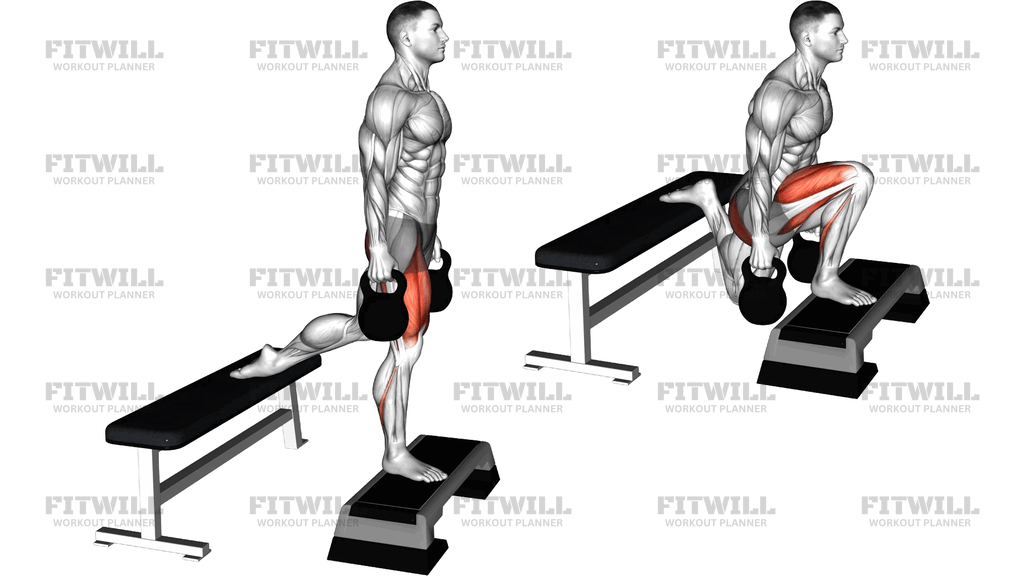
The Kettlebell Bulgarian Split Squat From Deficit is a rear-foot-elevated split squat performed with your front foot raised on a step platform, which increases the total range of motion at the hip and knee. You hold a kettlebell in each hand at your sides, place the top of one foot on a flat bench behind you, and lower straight down until your front thigh is level with or below parallel before driving back up. The deficit turns a demanding single-leg exercise into an even deeper stretch under load.
This movement is best known for how it loads the quadriceps of the front leg. Because the rear foot is anchored on the bench, the front leg carries nearly all of your body weight plus the kettlebells, and the extra drop from the step platform pushes the knee through a longer range. The glutes and hamstrings of the front leg work hard coming out of the bottom, while the elevated rear leg's hip flexors get a useful stretch. Holding kettlebells at your sides also challenges your grip and your ability to stay tall through the torso.
The setup matters more here than in most lower-body exercises. Your front foot should be far enough from the bench that your shin stays roughly vertical at the bottom, and the step platform must be stable and non-slip since you are stepping down into a deep single-leg position. A stance that is too short shifts stress forward onto the knee; one that is too long pulls you into a hamstring-dominant lunge pattern and makes balance harder. Take a moment to dial in the distance before you pick up the kettlebells.
To execute it well, keep the weight distributed across the whole front foot rather than dumping onto the toes, and let the back knee travel down toward the floor rather than forward. Brace your trunk, keep your ribs stacked over your pelvis, and descend under control instead of dropping into the hole. Pause briefly at the bottom, then push the floor away through the front leg to stand tall. Breathe in on the way down and exhale as you drive up.
This exercise suits lifters who have already mastered a flat-ground Bulgarian split squat and want more range, better hip mobility under load, and a stronger stimulus for the quads and glutes without heavy barbell loading. It is common in lower-body hypertrophy blocks, in rehab-informed strength work where both legs need equal attention, and for athletes who want single-leg strength that carries over to sprinting and changing direction.
Because the deficit adds depth and instability, start with lighter kettlebells than you would use for a standard Bulgarian split squat and keep a handrail or wall nearby until your balance is solid. Stop the set when your front knee starts drifting inward or your torso begins collapsing — those are the signals that control has gone, and pushing past them is where most knee and lower-back complaints with this pattern begin.
[ Workout Log & Planner ]
Put your next workout in Fitwill
Keep your plan and training log ready when you are.


Instructions
- Place a step platform roughly two to three feet in front of a flat bench, and rest the top of one foot on the bench with the laces down so the ankle can move freely.
- Hold a kettlebell in each hand with a straight arm at each side, shoulders back and down, and step your front foot squarely onto the step platform.
- Adjust your front foot position until your shin can stay close to vertical at the bottom of the rep; shift slightly forward or back before loading up if the knee juts out over the toes.
- Brace your abs, lift your chest, and look at a fixed point ahead of you to lock in balance before descending.
- Bend the front knee and hip together, lowering straight down until the back knee hovers just above the floor and your front thigh reaches at least parallel.
- Keep the weight spread across the whole front foot, with the heel in contact with the platform, and let the back knee travel downward rather than forward.
- Pause for a beat at the bottom, then press through the front leg to extend the knee and hip and return to the top with the front leg nearly straight.
- Inhale as you lower and exhale as you drive up, keeping the kettlebells hanging still at your sides throughout.
- Complete all repetitions on one leg, then set the kettlebells down, switch which foot is on the bench, and repeat on the other side.
Tips & Tricks
- Set the bench-to-platform distance once and mark it — even a couple of inches changes whether the front knee or the hips absorb most of the load.
- If your front heel lifts off the step platform at the bottom, you are going deeper than your ankle mobility allows; reduce depth or add a small wedge rather than tipping onto the toes.
- A common failure point is gripping the kettlebells with bent elbows and letting the shoulders ride up; keep the arms long so the weights hang like dead weight.
- Do not push off the rear leg. If you feel the bench foot driving the ascent, consciously think about the front leg doing all the work.
- Control the descent to about two seconds. Dropping quickly into a deficit-depth split squat puts a hard brake on the knee that adds risk without adding growth.
- If you lose balance, set the back foot down rather than twisting to save the rep — twisting under load while one foot is on a bench is how ankle and knee tweaks happen.
- When your torso leans far forward at the bottom, the weight is usually too heavy; lighter kettlebells let you stay upright and keep tension on the quads.
- Chalk or dry your hands and check that the kettlebell handles are dry — a slipping grip at the bottom of a deep single-leg rep is distracting and unsafe.
- Track the front knee over the second and third toes instead of letting it cave inward, especially as fatigue builds on the final reps of a set.
Frequently Asked Questions
What muscles does the Kettlebell Bulgarian Split Squat From Deficit work?
The quadriceps of the front leg do most of the work, with strong contributions from the glutes and hamstrings as you stand out of the deep bottom position. The adductors stabilize the front hip, the calves handle the extra ankle range from the step, and the core stays active to keep you upright with the kettlebells at your sides.
Why use a deficit instead of a regular Bulgarian split squat?
Raising the front foot on a step platform lets both the front knee and hip travel through a longer range, which increases the depth of the stretch at the bottom. That added range makes the movement harder at the same weight and places greater demand on ankle and hip mobility.
Should beginners do the Kettlebell Bulgarian Split Squat From Deficit?
It is usually better to first become comfortable with a standard Bulgarian split squat on flat ground, then try the deficit with only body weight. Once you can control the deeper range without wobbling, add a light kettlebell in each hand.
How far should my front foot be from the bench?
A practical starting point is a distance that lets your front shin stay close to vertical when the back knee is near the floor. If your knee slides well past your toes, move the front foot forward; if you feel it mostly in the hamstring of the back leg, move it closer.
Why does my front heel lift off the step platform?
That usually means the deficit plus your stance length exceeds your ankle mobility, or you are leaning too far forward. Shorten the depth slightly, check that your shin is vertical, and keep the weight over the midfoot rather than the toes.
How heavy should the kettlebells be?
Choose a weight you can lower slowly and lift back up without the torso collapsing, the knee caving in, or the heel rising. Single-leg deficit work punishes ego loading, so most people need noticeably less weight here than in a barbell split squat.
Can I hold one kettlebell instead of two?
Yes. A single kettlebell held in the hand opposite the working leg can help with balance and adds an oblique challenge, but holding one in each hand keeps the load symmetrical and is easier to control for this deficit version.
What can I substitute if I don't have a step platform?
Any stable, low, non-slip surface such as a sturdy weight plate or a low box works for the front foot. If nothing suitable is available, perform a standard Kettlebell Bulgarian Split Squat with the front foot on the floor and still get most of the benefit.
Is it safe for my knees?
For healthy knees, the movement is generally well tolerated when you keep the shin near vertical, control the descent, and stop before form breaks down. If you have a current knee issue or pain during the movement, reduce the depth or range and get guidance from a qualified professional first.
How many sets and reps should I do?
Two to four sets of six to ten repetitions per leg works well for strength, while eight to twelve per leg suits muscle-building focus. Because balance degrades with fatigue, prioritize clean reps over squeezing out extra ones.