Elevated Legs Hip Thrust
The Elevated Legs Hip Thrust is a bodyweight hip extension exercise where you rest your upper back on a flat bench, place both feet on a step platform or similar elevated surface in front of you, and drive your hips upward until your torso and thighs form a straight line. Because the feet sit on a raised platform rather than the floor, your knees stay bent at a sharper angle at the bottom, which lengthens the range your hips travel through and places a strong, continuous demand on the glutes and hamstrings.
This setup works well for anyone who wants a challenging glute exercise without loading a barbell. It is a common choice in home and gym settings where a bench and an aerobic step are available, and it suits lifters who want a strict hip-dominant movement before adding weight, or who find floor-based glute bridges too easy once they have trained for a while. The elevation also lets you fine-tune difficulty simply by adjusting the height of the platform.
The primary muscles working here are the glutes, which extend the hips to lift your pelvis. The hamstrings assist through the drive, the quadriceps hold the knee position on the step, and the core stabilizes the ribcage and pelvis so the movement comes from the hips rather than the lower back. Your upper back stays in contact with the bench, and your hands rest on the edge of the bench for balance and a little support.
Setup matters more than most people expect. The bench should support you just below the shoulder blades, the step should be positioned so your shins end up close to vertical at the top, and your feet should stay flat and fully in contact with the platform. If the step sits too far away, your hips drop too low and the exercise turns into a hamstring-dominant pull; if it sits too close, your knees drift over your toes and the top position feels cramped.
To perform it well, exhale, brace your trunk, and push the floor of the step away through your whole foot as you squeeze the glutes to lift. Pause briefly at the top with hips fully extended, ribs down, then lower under control until your hips approach the floor without touching. That controlled lower is where much of the benefit lives, so resist the urge to bounce.
Because it requires no external load, the Elevated Legs Hip Thrust is easy to program for higher reps, as a warm-up activation before squats or deadlifts, or as a finisher at the end of a lower body session. Keep your neck relaxed and avoid letting your lower back arch past neutral at the top, since the goal is hip extension driven by the glutes, not a back-bending contest.
[ Workout Log & Planner ]
Put your next workout in Fitwill
Keep your plan and training log ready when you are.


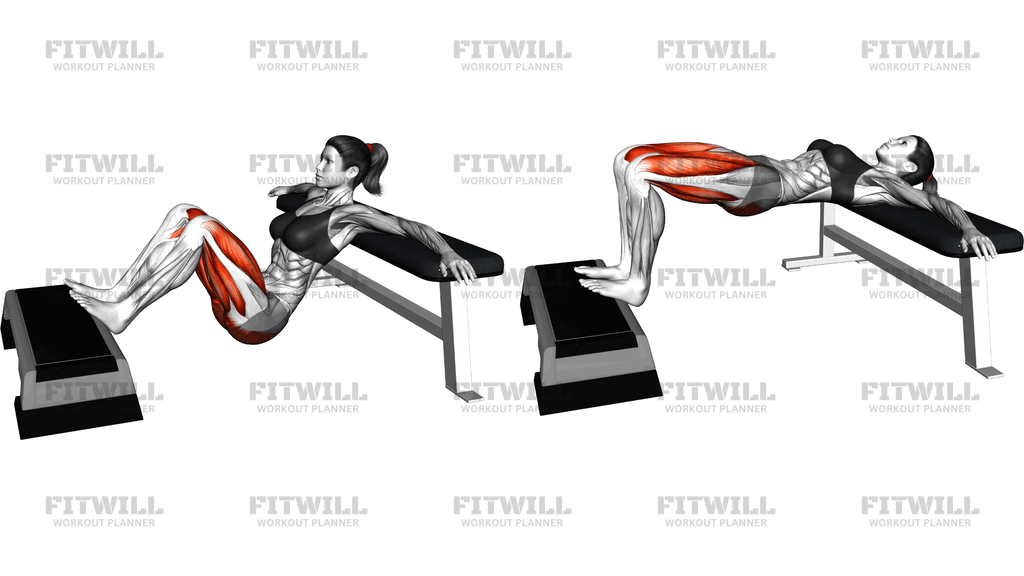
Instructions
- Place a flat bench behind you and position a step platform roughly two feet in front of it, leaving room for your hips to hang between the two.
- Sit on the floor in front of the bench, lean back so your upper back rests against the edge of the bench just below the shoulder blades, and place both feet flat on top of the step platform with knees bent.
- Grip the sides of the bench with your hands and let your head rest back on the bench so your neck stays relaxed.
- Take a breath, brace your abdominal muscles, and set your ribs down over your pelvis so your lower back is in a neutral position before you lift.
- Drive through your heels and the balls of your feet into the step while squeezing your glutes to raise your hips until your shoulders, hips, and knees form a straight line.
- At the top, hold for a beat, keeping your chin tucked and making sure the lift is coming from your hips, not an arch in your lower back.
- Lower your hips slowly and under control until they hover just above the floor, keeping tension in the glutes and hamstrings instead of collapsing.
- Exhale as you push up and inhale as you lower, keeping the breath steady through each rep.
- Complete your set, then sit forward off the bench carefully, stepping down from the platform before standing up.
Tips & Tricks
- If your heels press into the very edge of the step or slip off, move the platform an inch or two closer so your whole foot sits securely on the surface.
- Shins close to vertical at the top is your target; if your knees travel well past your toes, the step is too close, and if your hips cannot reach full extension, it is too far away.
- A common mistake is pushing the hips up with the lower back instead of the glutes. Fix it by keeping the ribs down and thinking about tucking the pelvis slightly at the top rather than arching.
- Do not let your knees cave inward as you drive up; consciously press them slightly outward so the glutes, not the outer hips, control the path.
- Keep some of your weight in your hands on the bench edge, but do not push yourself upward with your arms, or you will turn it into a pressing movement.
- Pause for a full second at the top of each rep. The elevated foot position makes this lockout the most valuable part of the exercise.
- If the bench slides on a smooth floor, brace it against a wall or rack upright so it cannot shift while your shoulders press into it.
- Start with your bodyweight only and master the hip path before placing a dumbbell or plate across your hips, because added load on an unstable setup invites back arching.
- A mat under your hips on a hard floor keeps the bottom position comfortable, which makes it easier to lower fully instead of stopping short.
Frequently Asked Questions
What muscles does the Elevated Legs Hip Thrust work?
The glutes are the primary movers, extending your hips to lift the pelvis. The hamstrings assist the drive, the quads hold your knees steady on the step, and your core stabilizes your trunk throughout.
Why are the feet elevated on a step instead of on the floor?
Elevating the feet increases the knee bend at the bottom, which lets your hips travel through a longer range and keeps tension on the glutes and hamstrings where a floor glute bridge would lose it.
Is the Elevated Legs Hip Thrust good for beginners?
Yes, because it uses only bodyweight and requires no load. Beginners should start with feet flat on the floor to learn the hip hinge pattern first, then progress to the elevated version once the movement feels controlled.
How high should the step platform be?
A standard aerobic step height works for most people, but the exact height matters less than the outcome: at the top of the rep your shins should be close to vertical and you should be able to fully extend your hips without discomfort.
What is the most common mistake in this exercise?
Arching the lower back at the top instead of squeezing the glutes. The fix is to keep your ribs down and stop the lift as soon as your shoulders, hips, and knees line up, rather than pushing into a backbend.
How many reps should I do?
Since it is bodyweight, work in the 10 to 20 rep range for 2 to 4 sets, slowing the lowering phase if the reps start feeling too easy before you add external weight.
Can I add weight to the Elevated Legs Hip Thrust?
Yes, once the bodyweight version is smooth and stable you can hold a dumbbell or plate on your hips. Make sure your foot placement and control stay exactly the same before increasing the load.
What can I use if I don't have a step platform?
Any stable, low elevated surface works, such as a second flat bench, a sturdy low box, or stacked stable platforms. Avoid anything that can slide or tip while your feet press into it.
Is it safe for my lower back?
When performed with a braced trunk and hips driven to a neutral, fully extended position, it is a joint-friendly exercise. Discomfort usually signals over-arching at the top or a step position that forces your hips too low at the bottom.
Should my shoulders be fully on the bench?
Only your upper back, roughly just below the shoulder blades, should rest on the bench edge. Your head can lean back against the bench so your neck stays relaxed, and your shoulders themselves hang slightly off the pad.