Elevated Single Leg Hip Thrust
Elevated Single Leg Hip Thrust is a body-weight hip extension exercise built around one working leg and a raised support surface. With your upper back anchored on a bench and the working foot elevated on a step or box, the movement asks the glutes to drive the pelvis upward while the pelvis stays level and the trunk stays controlled. It is a practical choice when you want a unilateral glute exercise that also challenges balance, hip stability, and core control.
Because one leg does the work, the setup matters more than on a two-legged bridge. The bench should support the shoulder blades, not the neck, and the elevated foot needs a stable surface so you can drive through the heel without wobbling. The free leg should stay lifted so the pelvis does not twist toward the working side. That makes the exercise useful for lifters who need more single-leg strength carryover, runners who want cleaner hip extension, and anyone who needs glute work without loading a barbell.
The top of the rep should look like a straight line from the shoulders through the hips to the knee of the working leg, not a high arch through the lower back. Push the floor or step away through the heel, squeeze the glute to finish hip extension, and keep the ribs down so the lumbar spine does not take over. On the way down, lower under control until the hips nearly touch the floor and the working hamstring and glute stay loaded rather than bouncing off the bottom.
Elevated Single Leg Hip Thrust is effective as an accessory lift, warm-up primer, or home exercise because it does not need a machine or heavy external load. It is also a useful regression or progression tool: you can shorten the range, slow the tempo, add a pause at the top, or hold a dumbbell across the hips once body weight becomes too easy. The movement should feel centered in the working glute and hamstring, with the torso stable and the pelvis square throughout the set.
If the rep turns into a lower-back bridge, the step is usually too high, the foot is too far away, or the pelvis is rotating as the leg drives up. A cleaner version uses a firm bench, a steady elevated foot, and a controlled finish that you can repeat for every rep. Stop the set when you can no longer keep the hips level or the foot planted firmly on the platform.
[ Workout Log & Planner ]
Put your next workout in Fitwill
Keep your plan and training log ready when you are.


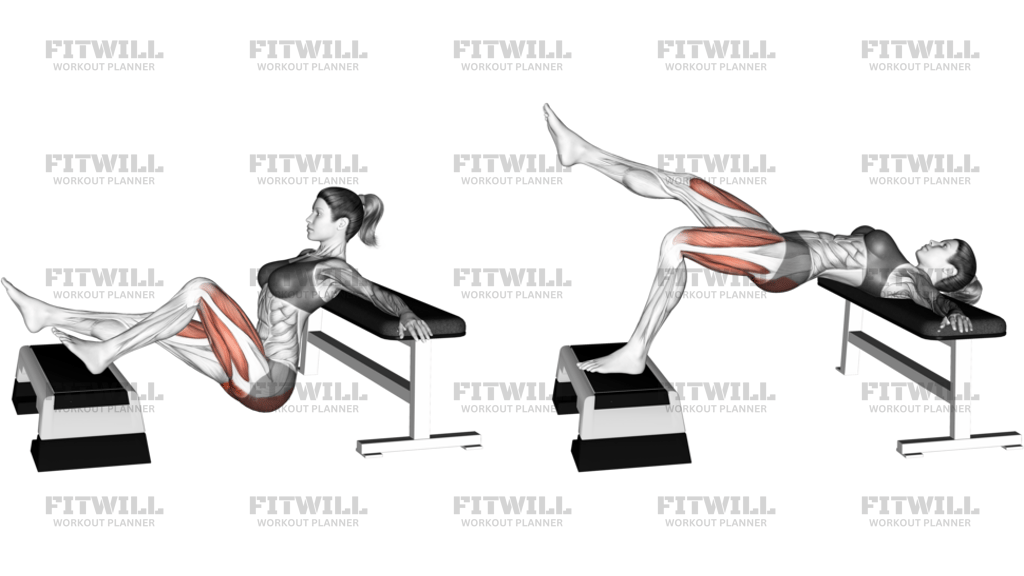
Instructions
- Sit on the floor with your upper back against the edge of a flat bench and place one foot on a low box or step in front of you.
- Bend the working knee so the shin is close to vertical at the bottom, then lift the other leg off the floor and keep it bent or extended without letting the pelvis rotate.
- Plant the heel of the working foot firmly on the elevated surface and keep your shoulders anchored on the bench.
- Brace your torso, tuck the ribs slightly down, and start with the hips low without relaxing onto the bench.
- Drive through the heel and press the hips upward until the torso and working thigh form a strong line.
- Squeeze the glute at the top without overextending the lower back or shifting into the planted shoulder.
- Lower the hips under control until you feel the glute and hamstring lengthen, then pause briefly before the next rep.
- Keep the free leg lifted the whole time and use it only for balance, not for pushing off.
- Breathe in on the way down and exhale as you drive up through the top of the rep.
- Reset your foot and pelvis position between sides before starting the next set.
Tips & Tricks
- Use a bench height that lets your shoulders stay supported without forcing your neck into extension.
- Keep the working shin nearly vertical near the bottom; if the foot is too far away, the glute loses tension and the hamstring takes over.
- Press through the heel and midfoot of the elevated leg instead of letting the toes dominate the drive.
- Think about keeping both front hip points level so the pelvis does not open toward the lifted leg.
- Pause for a second at lockout to make each rep come from the glute instead of a bounce off the floor.
- Stop the ascent when your ribs start flaring; a taller hip line is not better if it comes from lumbar extension.
- If the planted foot slips on the step, switch to a grippier surface before adding more reps or load.
- Use a slower lowering phase to keep tension on the working glute and avoid dropping straight into the bottom.
- A dumbbell or plate across the hips can make the movement harder once body-weight reps stay perfectly clean.
- Keep the free leg quiet; if it swings for momentum, shorten the set or reduce the range.
Frequently Asked Questions
What muscles does Elevated Single Leg Hip Thrust work?
It mainly targets the glutes on the working side, with the hamstrings and core helping stabilize the pelvis and torso.
Why is the foot elevated on a box or step in Elevated Single Leg Hip Thrust?
The elevated foot changes the angle of hip extension and makes it easier to feel the working glute through a longer, more controlled range.
How high should the bench be for Elevated Single Leg Hip Thrust?
The bench should support the shoulder blades comfortably, usually around mid-back height, so you can hinge without the neck or lower back taking over.
How do I know if my working foot is in the right spot?
At the bottom, the working shin should be close to vertical and you should still feel tension in the glute, not a jammed knee or a stretched lower back.
Can beginners do Elevated Single Leg Hip Thrust?
Yes. Start with body weight, a low step, and a short controlled range until you can keep the hips level on every rep.
What is the most common mistake in Elevated Single Leg Hip Thrust?
Most people either twist the pelvis toward the lifted leg or finish by arching the lower back instead of squeezing the glute.
Should I keep the non-working leg bent or straight?
Either can work, but the key is to keep it lifted and quiet so it does not help drive the rep or rotate the pelvis.
What can I use instead of Elevated Single Leg Hip Thrust?
A single-leg hip bridge on the floor is a simpler option, while a weighted single-leg hip thrust is a harder progression once body weight is easy.
How should I breathe during Elevated Single Leg Hip Thrust?
Inhale as you lower into the stretched position, then exhale as you drive the hips up and finish the rep.
Is Elevated Single Leg Hip Thrust safe for the lower back?
It usually is when the ribs stay down and the lift comes from the hip, but the set should stop if you feel the lower back doing the work.