Resistance Band Sitting Floor Tibialis Press
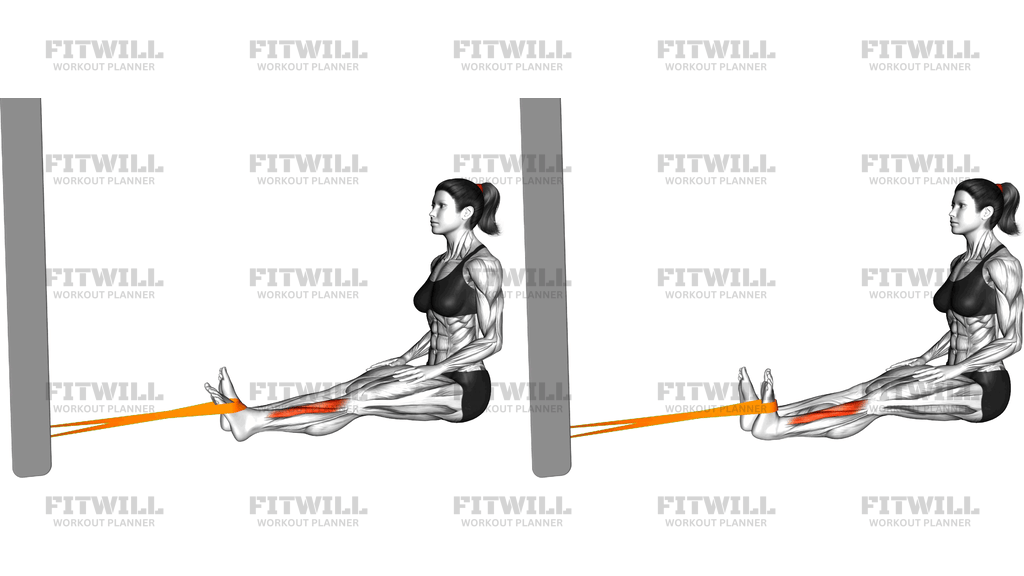
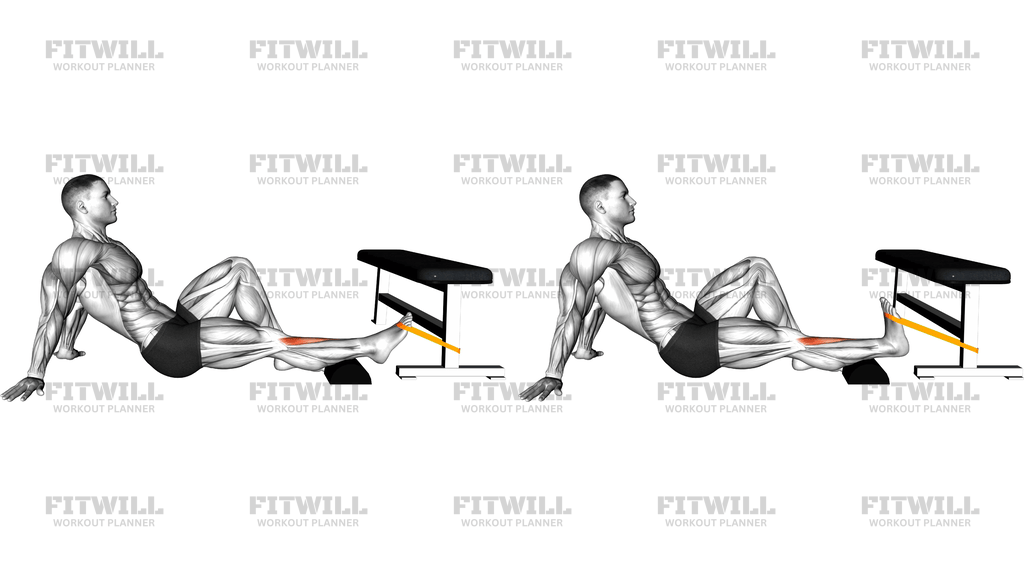
The Resistance Band Sitting Floor Tibialis Press is a seated ankle exercise that targets the tibialis anterior, the muscle running along the front of your shin. You sit on the floor with one leg extended, loop a resistance band around your forefoot, and anchor the other end to a stable object such as the leg of a bench. From there, you pull your toes back toward your shin against the band's pull and control the return, working the ankle through dorsiflexion in a slow, deliberate range.
This movement fills a gap that most lower body training leaves wide open. Calves get plenty of work from walking, standing, and pressing movements, but the muscles on the front of the shin are rarely trained directly. That imbalance can show up as tight shins, poor ankle control during running and jumping, and difficulty keeping the foot stable during squats or lunges. Runners, hikers, basketball and volleyball players, and anyone recovering from long periods in stiff shoes tend to benefit from dedicated tibialis work like this.
The seated floor setup is what makes this exercise easy to control. Supporting yourself on your hands behind you with the torso leaned back lets you keep the working knee nearly straight, which isolates the ankle joint and removes any help from the hip or quad. Keeping the heel in contact with the floor throughout the set anchors the movement so the foot pivots at the ankle rather than the whole leg sliding forward. A small roller or pad under the calf can improve comfort and help the heel stay planted.
Execution is simple but demands attention to tempo. The band pulls your toes away from you, so the working phase is the pull of the toes back toward the shin, and the return happens as you slowly let the band draw the foot back down. Because the tibialis anterior is a relatively small muscle, light resistance and higher repetitions work better than heavy tension. A band that lets you complete 12 to 20 smooth reps with a brief pause at the top is usually the right starting point.
For safety, the main things to watch are band security and ankle comfort. Make sure the band is firmly anchored and seated low on the forefoot across the base of the toes, so it cannot slip off mid-rep. Keep the motion at the ankle only, and stop if you feel pinching at the front of the ankle or sharp discomfort along the shin. This is a light-load exercise by design, so there is no reason to rush the reps or fight excessive band tension.
[ Workout Log & Planner ]
Put your next workout in Fitwill
Keep your plan and training log ready when you are.


Instructions
- Sit on the floor and extend your working leg straight out in front of you, bending your other knee and placing that foot flat on the floor for support.
- Loop a resistance band around your forefoot, just across the base of the toes, and anchor the opposite end securely around the base of a bench leg or another sturdy object in line with your foot.
- Place your hands on the floor slightly behind your hips and lean your torso back until your arms support part of your weight, keeping the working knee almost straight.
- Let the band pull your foot gently downward and slightly away from you to reach the starting position, keeping your heel in contact with the floor.
- Brace your torso lightly and keep your kneecap pointing toward the ceiling so the leg does not rotate during the rep.
- Pull your toes up toward your shin against the band, moving only at the ankle, until you feel a firm contraction along the front of your shin.
- Pause for a second at the top with the toes pulled back, keeping tension in the band rather than letting it go slack.
- Slowly lower your toes back down, resisting the band's pull until your foot returns to the starting position.
- Breathe out as you pull your toes up and breathe in as you lower them back down under control.
- Complete all repetitions on one leg, then re-anchor the band on the other foot and repeat.
Tips & Tricks
- If the band slips off your foot during the set, it is seated too far back on the arch; move it forward so it sits across the base of the toes where it cannot roll off.
- A lifting heel is the most common fault here, because it turns the exercise into a leg pull instead of an ankle press; press the heel into the floor for every rep and shorten the range if you cannot keep it down.
- If the band goes slack at the top of the rep, the tension is too light or the anchor is too close; step the anchor back or use a stiffer band so the tibialis stays loaded through the full pull.
- Keep the working knee soft but nearly straight, since bending it lets the calf lengthen and steals tension away from the front of the shin.
- Do not crank the toes back as far as possible; a controlled pull to a firm contraction along the shin does more for this muscle than forcing end-range motion.
- Lean back enough that your arms take some of your weight, because a tall upright torso makes the hip flexors and quads want to assist and pulls the heel off the floor.
- If your calf presses uncomfortably into the floor, place a small roller or folded towel under it so the heel can stay planted without pressure building up.
- Use slow tempos, around two to three seconds per rep, since fast bouncy reps let momentum do the work this small muscle needs to do itself.
Frequently Asked Questions
What muscles does the Resistance Band Sitting Floor Tibialis Press work?
The primary muscle is the tibialis anterior on the front of the shin, which lifts the foot toward the shin. Smaller stabilizing muscles around the ankle assist throughout the movement.
Why should I train the tibialis anterior at all if I already train calves?
The muscles on the front and back of the lower leg work as a pair to control the ankle, and most training loads only the back side. Balancing them supports better foot and ankle control during running, jumping, and squatting.
Is this exercise suitable for beginners?
Yes. The seated floor position is stable, the load is light, and the movement only involves the ankle joint, which makes it easy to learn. Start with a light band and 12 to 15 controlled reps per side.
How tight should the band be before I start each rep?
There should be light tension at the starting position, with your toes already pulled slightly away from your shin. If the band is fully slack at the start, the first part of each rep is wasted movement.
Why do I sit on the floor with my hands behind me instead of sitting on a bench?
The leaned-back floor position lets you keep the working knee nearly straight and the heel planted, which isolates the ankle. A bench seat would angle the hip and knee and make it easier for the leg to assist.
What is the most common mistake with this movement?
Letting the heel lift off the floor so the whole leg pulls back instead of the ankle moving. Keep the heel in contact with the floor and move only at the foot for every repetition.
Can I do the Resistance Band Sitting Floor Tibialis Press without a bench to anchor the band?
Yes, any stable low anchor works, such as a heavy dumbbell, a couch leg, or a partner holding the band. The anchor just needs to hold firm while the band pulls your toes downward.
How many reps and sets should I use?
Because the tibialis anterior is a small endurance-oriented muscle, 2 to 3 sets of 12 to 20 slow reps per side works well. Increase band tension gradually rather than adding heavy resistance early.
Is it safe if I feel tightness along my shin during the exercise?
A working sensation in the front of the shin is expected, but sharp pain or pinching at the ankle is not. Reduce the band tension or the range of motion, and stop if discomfort persists.