Resistance Band Sitting Knee Flexion On A Chair
Resistance Band Sitting Knee Flexion On A Chair is a seated hamstring exercise where you bend one knee against band resistance that pulls your ankle forward. You sit upright on a sturdy chair with a resistance band anchored to a low, fixed point in front of you, looped around one ankle. From there, you pull your heel back under the chair by bending your knee, then slowly let the band draw your foot forward again. It is essentially a knee flexion curl for the back of the thigh, done from a chair instead of a machine.
The muscles doing the work are the hamstrings, the group on the back of the thigh that crosses both the hip and the knee. In this seated position the hip stays bent and still, so the hamstrings are challenged almost purely as knee flexors, which is a role that exercises like deadlifts and hip hinges never isolate. The calf muscles, particularly the gastrocnemius, assist in bending the knee, and the stabilizers around the hip and trunk keep you from being pulled forward by the band.
This is a particularly useful exercise for people rebuilding knee strength after time off, older adults who want a safe way to load the hamstrings without lying on the floor, and anyone training at home with minimal equipment. Because the load is light and the movement is small and controlled, it also fits well into warm-ups before squats, hinges, or running. If a standing or prone hamstring curl feels awkward or aggravates a knee, the seated version often feels far more comfortable.
Setup matters more here than it looks. The band needs to be anchored at roughly floor level directly in front of your foot so the pull runs backward toward your heel, not sideways or up at an angle. Sit far enough back on the chair that your thigh is supported, but stay tall through your spine. If the anchor is too far away the band goes slack at the start, and if it is too close you lose tension at the end of the pull, so adjust your distance until the band is taut with your shin vertical.
Execution is simple but easy to rush. Bend the working knee and drag your heel back toward the chair leg, feeling the back of the thigh tighten, pause briefly, then resist the band as it pulls your foot forward again. The return is where most of the value lives, so lower your leg over two to three seconds rather than letting the band snap it back. Keep the working foot relaxed, the thigh still on the chair, and your hands resting on your thighs rather than gripping the seat.
Complete all repetitions on one side, then re-anchor the band around the other ankle. Expect a modest burn in the hamstrings rather than a heavy grind, and scale with a lighter or heavier band rather than by adding body English.
[ Workout Log & Planner ]
Put your next workout in Fitwill
Keep your plan and training log ready when you are.


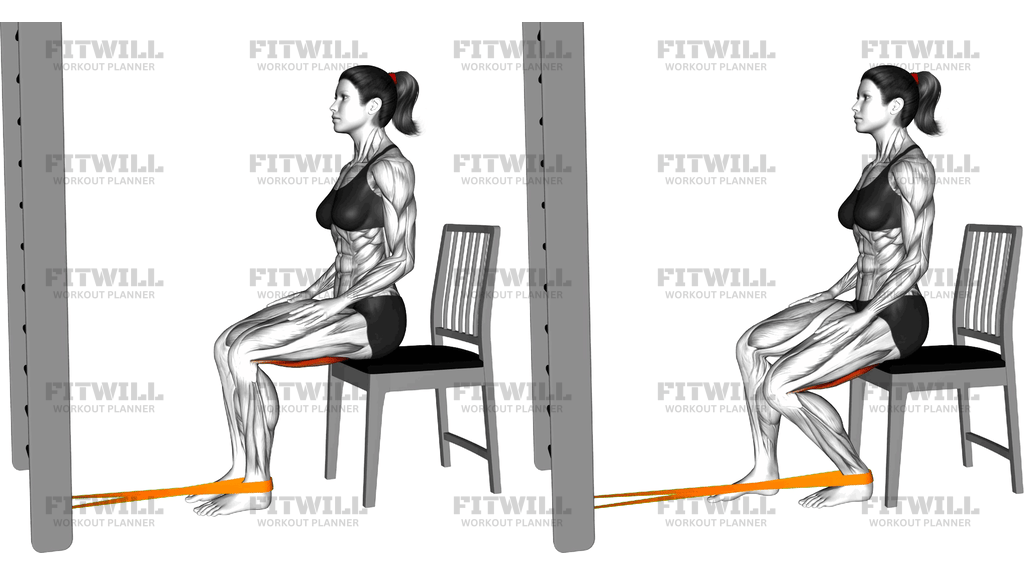
Instructions
- Sit upright on a sturdy chair with your thighs fully supported and your spine tall, hands resting on your thighs.
- Anchor a resistance band to a fixed point at floor level in front of you, such as a rack upright, and loop the other end around one ankle so the band pulls your foot forward.
- Slide back or forward until the band is taut with your shin vertical and your foot flat on the floor; there should be light tension before you move.
- Brace your trunk lightly and keep your weight even across both hips so the band cannot tip you forward.
- Exhale and bend the working knee, pulling your heel back under the chair toward the chair leg while keeping your thigh still on the seat.
- Pause for a beat when your knee is as bent as it comfortably goes and the hamstring squeeze is strongest.
- Inhale and extend the knee slowly over two to three seconds, resisting the band as it pulls your foot back to the starting shin position.
- Keep the sole of the working foot relaxed and in light contact with the floor as it slides backward and forward.
- Finish all repetitions on that side, unhook the band, loop it around the other ankle, and repeat for the same number of reps.
Tips & Tricks
- If the band drags you forward at the start of the set, you are sitting too far forward on the chair; move back until your sit bones are planted on the seat.
- A common mistake is letting the working thigh slide forward off the chair as you pull, which turns it into a hip movement; press that thigh down into the seat throughout each rep.
- Avoid curling the foot hard or pointing the toes as you bend the knee, since this shifts effort toward the calf; keep the ankle relaxed so the hamstrings do the work.
- If your heel catches on the floor, lift the heel just off the ground slightly so the foot glides freely under the chair.
- Do not let the band snap your leg back on the return; a two to three second extension keeps tension on the hamstrings instead of dumping it.
- If you feel the work mostly behind the knee rather than through the thigh, the band is likely too light or the range too short; use slightly more tension and bend fully.
- Keep your head and shoulders back over your hips rather than craning forward toward the anchor point.
- Choose a band tension you can bend through the full range for all reps; if you stall halfway through the pull, drop to a lighter band.
- Set the anchor as close to floor level as possible so the pull is horizontal; a high anchor changes the angle and pulls your foot upward.
Frequently Asked Questions
Which muscles does Resistance Band Sitting Knee Flexion On A Chair work?
The hamstrings on the back of the thigh are the prime movers, working as knee flexors. The gastrocnemius in the calf assists with bending the knee, and your trunk works lightly to resist the band's forward pull.
Is this exercise suitable for beginners?
Yes. It is one of the easiest hamstring exercises to learn because you are seated, the load is light, and the movement path is short and guided by the band.
How do I anchor the band for Resistance Band Sitting Knee Flexion On A Chair?
Attach it to a low, stable object at floor level directly in front of your working foot, such as a rack upright or heavy furniture. Loop the other end around your ankle and adjust your distance so the band is taut before you start bending.
Why do I feel this more in my calf than my hamstrings?
You are likely pointing or curling your foot as you bend the knee, which recruits the gastrocnemius. Keep the ankle relaxed and think about dragging your heel backward instead of curling the foot.
Can I do Resistance Band Sitting Knee Flexion On A Chair with both legs at once?
It is best done one leg at a time, since the band must be looped around a single ankle and pulling both feet together makes the anchor setup awkward and the tension uneven.
What can I use if I do not have a rack or anchor point?
Any heavy, immovable object at floor level works, such as a sofa leg or table leg. You can also loop the band around your front foot and curl the other leg against it, though a fixed anchor gives cleaner tension.
How many reps and sets should I do?
For general strength and endurance, 2 to 3 sets of 12 to 20 reps per leg works well. Use a band tension that lets you bend fully with a controlled return on every rep.
Is it safe to do this exercise with knee discomfort?
The seated, light-load setup is generally gentle on the knee, but stop if you feel sharp pain, swelling, or catching in the joint, and clear any rehab plan with a qualified professional first.
How is this different from a lying or standing hamstring curl?
Sitting keeps the hip bent and fixed, so the hamstrings work only as knee flexors with no hip extension involved. That makes the role of the hamstrings clearer and the setup simpler than machine or standing variations.
Should my foot stay on the floor during the movement?
Keep the ball of the foot in light contact with the floor so it slides back and forward freely. Lifting the whole foot changes the angle and lets the hip drift, which takes work away from the hamstrings.