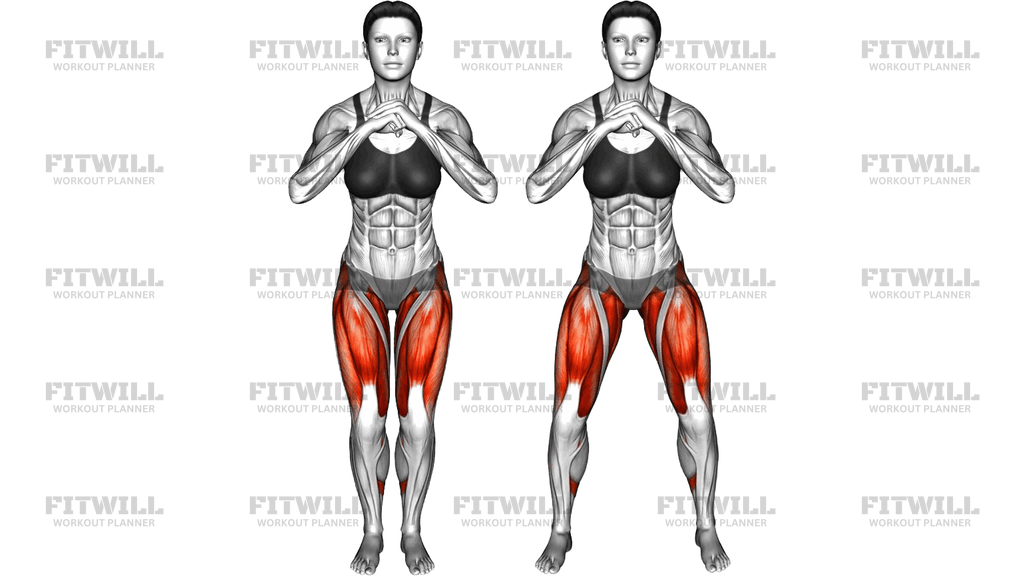
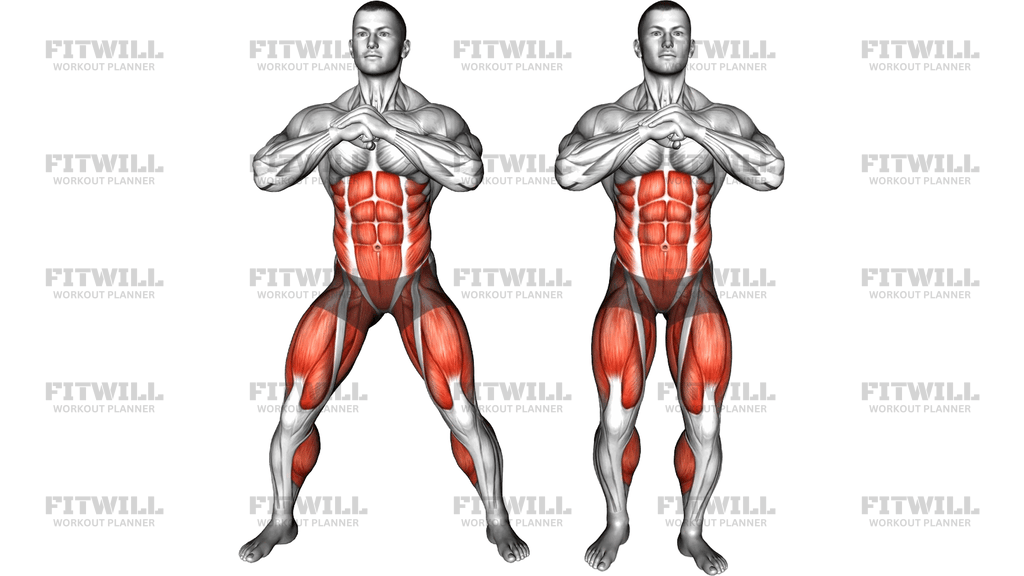
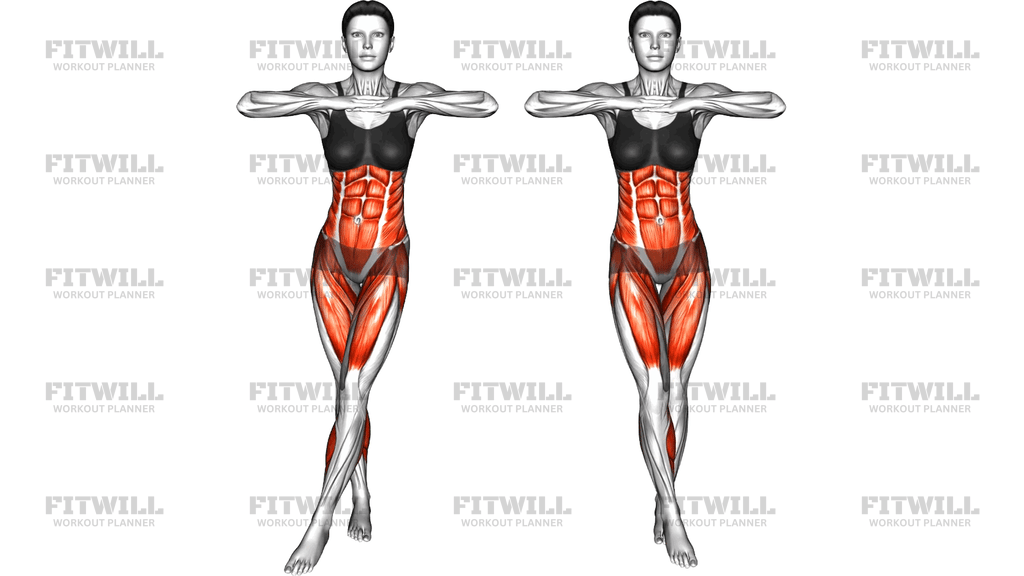
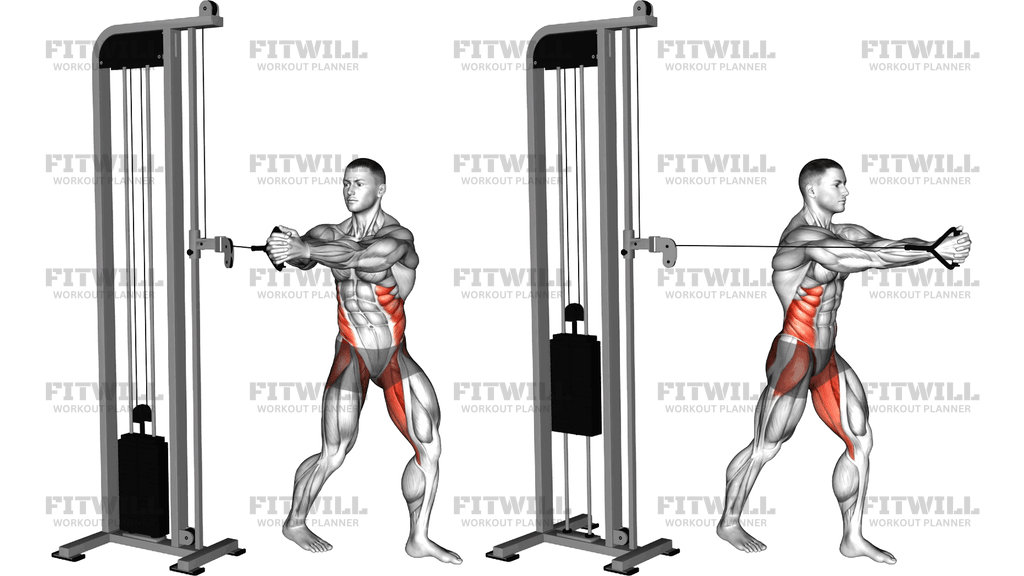
Plie Squat Knee Tap
The Plie Squat Knee Tap is a bodyweight lower-body exercise that combines a wide-stance sumo-style squat with a alternating knee tap at the bottom of each rep. You start with your feet spread well beyond shoulder width and toes turned out, sink into a deep plie position, then lower one knee toward the floor while keeping the opposite side loaded, rise back to the center, and repeat on the other side. The hands stay clasped in front of the chest for balance, which keeps the torso tall and the weight distributed over the whole foot.
This movement is especially useful for anyone who wants to target the inner thighs and hip muscles without equipment. The wide, externally rotated stance places a strong emphasis on the adductors along the inner thigh, while the knee tap shifts extra load onto one leg at a time, increasing the demand on the glutes and quads of the working side. Because you hold the deep squat position between taps, your hip stabilizers and core also work continuously to keep your pelvis level and your spine neutral.
The setup matters more here than in a standard squat. The wide angle of the feet and the outward knee travel only stay safe when your knees track in the same direction as your toes and your torso remains upright. If your stance is too narrow or your heels lift, the knees collapse inward and the inner-thigh emphasis turns into unwanted knee stress. Take a moment to find a stance where you can squat fully with your whole foot flat before adding the knee taps.
To execute it well, think of the squat as the home base and the tap as a controlled pulse. Sink down until your thighs are roughly parallel or slightly below, pause, then fold one knee inward and down until it lightly touches or hovers just above the floor. Press through the floor to bring that knee back up to the shared plie position, re-center, and tap the other knee. The tempo should stay deliberate; dropping quickly into the tap is the most common way this exercise loses both its effectiveness and its joint-friendly nature.
You will see this exercise in warm-ups for leg day, in glute and inner-thigh focused circuits, and in home workouts where no equipment is available. It also works well as a mobility primer for the hips before heavier squatting, since the deep externally rotated position gently opens the groin and hip capsules. Start with fewer reps on each side and build up as your hip flexibility and single-leg control improve.
From a safety standpoint, the main points to respect are knee tracking, heel contact, and torso position. If you feel pinching at the front of the knee or strain in the groin, reduce your range, shorten your stance slightly, or elevate your heels on a folded mat. Anyone with a history of knee or hip issues should work within a pain-free range and progress gradually.
[ Workout Log & Planner ]
Put your next workout in Fitwill
Keep your plan and training log ready when you are.


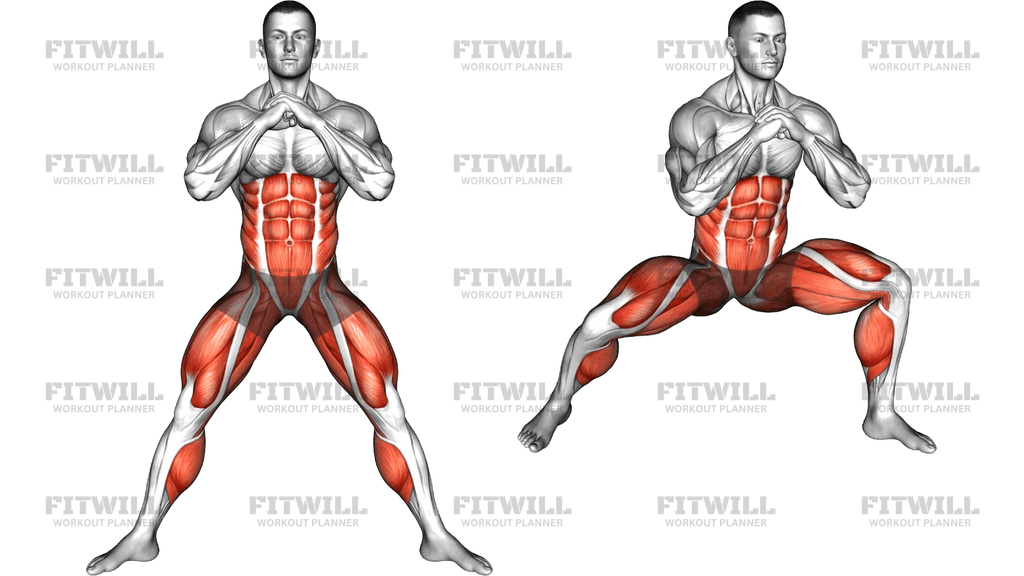
Instructions
- Stand with your feet roughly one and a half shoulder widths apart, toes turned out at about 45 degrees, and clasp your hands together in front of your chest with elbows tucked slightly down.
- Brace your abdominal muscles and pull your shoulders back so your chest stays tall and your spine is neutral before you move.
- Push your hips back and bend your knees out over your toes, lowering into a deep plie squat with your weight spread across your whole foot and heels firmly down.
- From the bottom of the squat, shift slightly toward your left leg and fold your right knee inward and down until it lightly taps the floor or comes just above it.
- Press through the left foot to lift the right knee back up to the shared plie position, keeping both hips square to the front.
- Briefly re-center in the squat, feeling both legs share the load again before switching sides.
- Tap the left knee down the same way, controlling the descent rather than dropping into the floor.
- Exhale as you tap and rise, and inhale as you hold the deep squat and reset your position between sides.
- Continue alternating knee taps for the desired number of reps, then drive through both feet to stand fully upright and release the clasp.
- Reset your stance and brace before the next set if you feel your knees drifting inward or your heels lifting.
Tips & Tricks
- Keep your heels glued to the floor throughout; if they lift during the knee tap, your stance is too wide or your ankle mobility needs work, so narrow the stance slightly or place a thin folded mat under the heels.
- Do not let the tapping leg collapse lazily toward the floor; actively fold the knee down so the inner thigh of that leg controls the descent.
- Avoid leaning the torso toward the working side during each tap; imagine a string holding the crown of your head directly over your pelvis.
- The knee should tap inside the line of your foot, not outside it, otherwise the groin is loaded at a vulnerable angle.
- Keep the clasp at chest height rather than letting your hands drop; a falling chest usually means your core has disengaged and your lower back is rounding.
- If the floor tap irritates your knee, stop just above the floor instead; the muscle benefit comes from the controlled shift, not the contact.
- Warm up the hips with a few bodyweight plie squats without taps first, since going straight into deep taps with cold adductors is a common cause of groin strain.
- Watch for knee cave on the standing leg as you fatigue; once you cannot keep the knee tracking over the toes, end the set rather than forcing extra reps.
- Pause for a full second in the centered squat between taps if you find yourself rushing; this keeps the tension on the thighs instead of momentum.
Frequently Asked Questions
What muscles does the Plie Squat Knee Tap work?
The primary targets are the inner thighs (adductors), with strong support from the glutes and quads of the standing leg. The core and outer hip muscles work throughout to keep your pelvis level as you shift from side to side.
Is the Plie Squat Knee Tap suitable for beginners?
Yes, because it uses only bodyweight and the range can be scaled easily. Beginners can start by tapping the knee just above the floor and using a slightly narrower stance until their hip mobility and balance improve.
How wide should my stance be for the Plie Squat Knee Tap?
Your feet should be about one and a half shoulder widths apart with toes turned out roughly 45 degrees. If your heels lift or your knees collapse inward at the bottom, the stance is too wide for your current mobility.
Why does my knee hurt when I tap the floor?
Pain at the knee usually means the knee is tracking outside the line of the toes or descending too fast. Slow the tempo, make sure the knee folds inward toward the opposite foot, and hover above the floor instead of making contact until the movement feels comfortable.
Can I do the Plie Squat Knee Tap every day?
Since it is a low-load bodyweight movement, most people can perform it frequently, including as a warm-up. Still, treat it like any strength exercise and allow normal recovery if you train it at a high volume or to fatigue.
What can I use instead of the knee tap if the floor is uncomfortable?
Simply hover the knee a few centimeters above the floor, or place a folded mat or soft pad down to tap. The training effect comes from the controlled side-to-side shift in the deep squat, not from the floor contact itself.
How is the Plie Squat Knee Tap different from a regular sumo squat?
A sumo squat trains both legs symmetrically, while the knee tap alternately loads one leg and adds a deeper fold through the inner thigh. This makes it more demanding on single-leg control and hip stability.
Should my heels stay down during the knee tap?
Yes, both heels should remain flat on the floor for the entire set. A lifting heel signals that the stance is too wide or ankle mobility is limiting you, and correcting it protects the knees from inward collapse.
How many reps should I do of the Plie Squat Knee Tap?
Start with 6 to 10 taps per side for 2 to 3 sets, resting as needed. Prioritize smooth, controlled transitions over rep count, since rushing is the most common form breakdown in this exercise.