Cable Oblique Twist
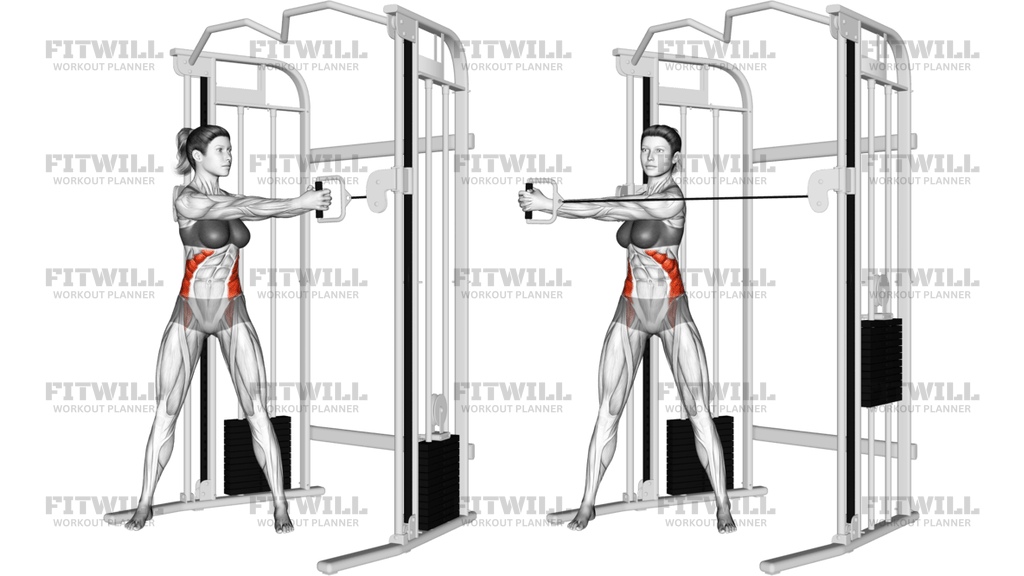
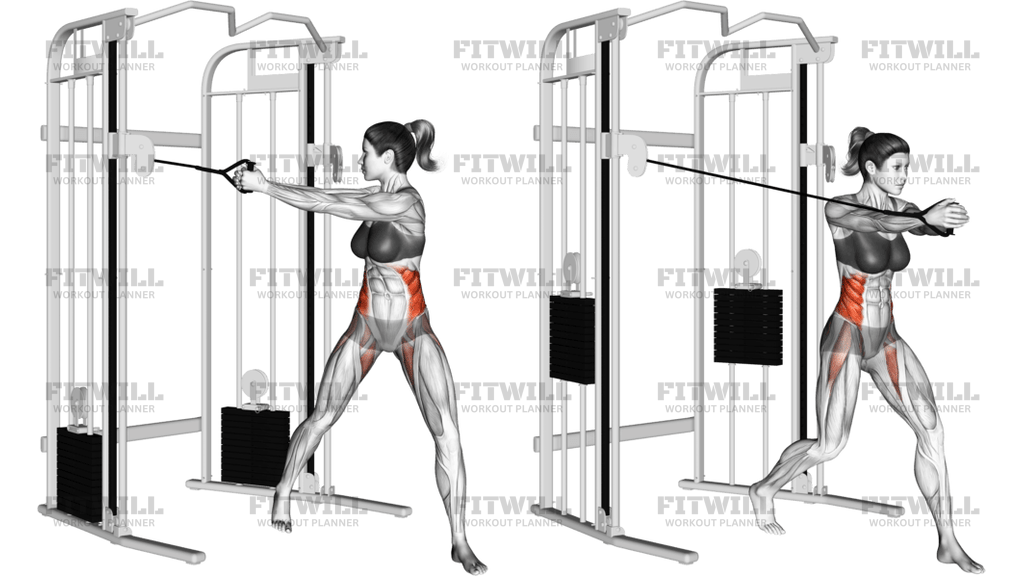
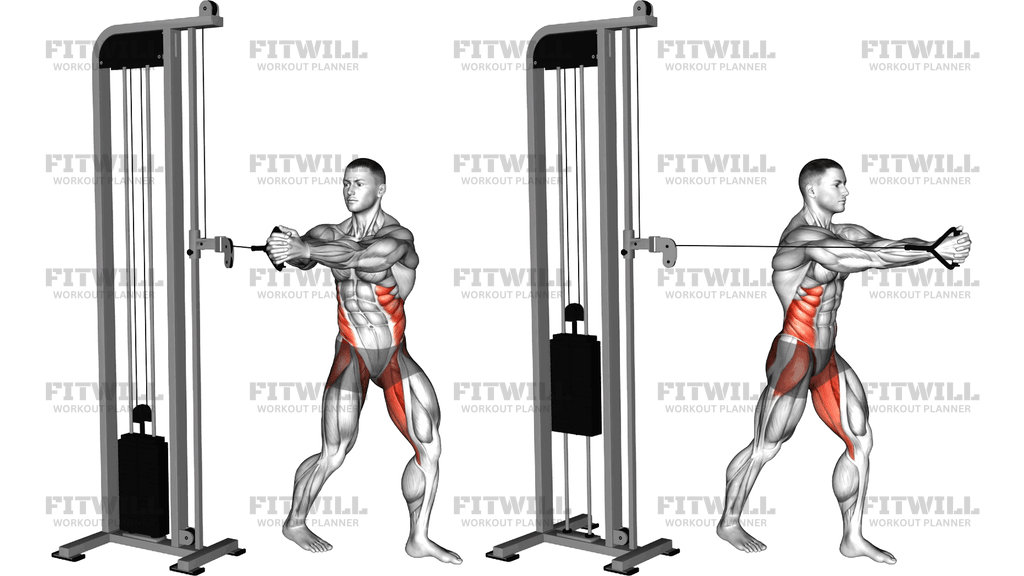
The Cable Oblique Twist is a standing rotational core exercise performed with a single handle attached to a cable machine set at roughly chest height. You stand sideways to the stack, grip the handle with both hands, and rotate your torso away from the machine so the handle travels across the front of your body in a controlled arc. Because the cable provides constant resistance through the entire turn, the obliques stay loaded from the first degree of rotation to the last, which is hard to achieve with bodyweight twists or medicine ball throws.
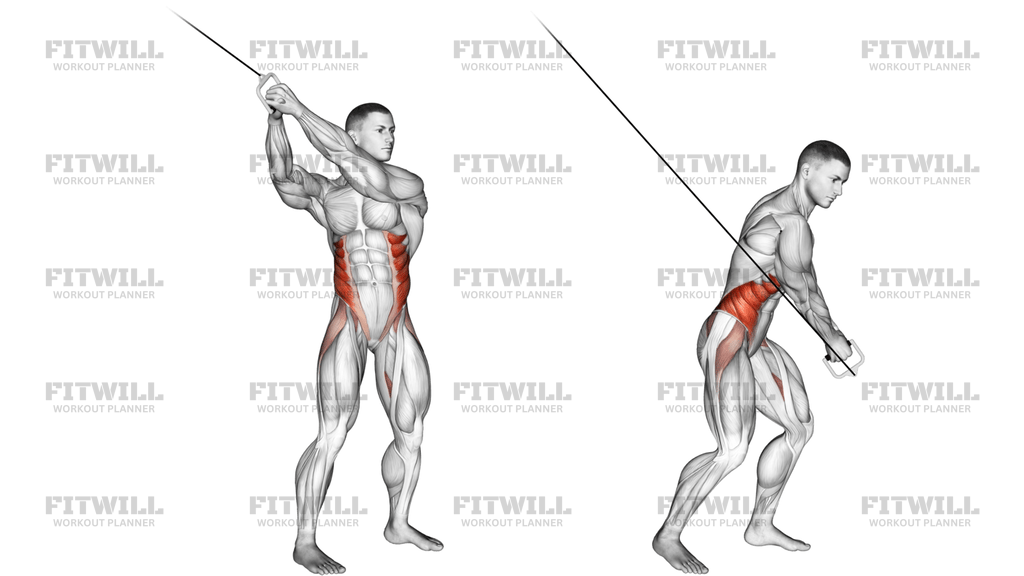
This movement is especially useful for anyone who wants rotational strength that carries over to real activities: swinging a racket or bat, throwing, changing direction on the field, or simply bracing against uneven loads at work. The highlighted musculature tells the story clearly — the obliques on the working side drive the rotation, while the rectus abdominis and deeper core muscles stabilize the trunk, and the hips and inner thighs help anchor the lower body so the twist comes from the waist rather than the feet.
Setup matters more here than in most ab exercises. The cable should exit the machine at about mid-torso height, and you need enough room to rotate through a full, comfortable arc without the handle hitting the stack or your own body. Standing a step or two away from the machine keeps constant tension on the cable even at the start position; stand too close and the slack lets your obliques off the hook during the first half of the rep.
Execution should feel like a turning motion, not a pulling motion. The arms stay long and mostly serve as connective tissue between the cable and your trunk — if your shoulders and elbows do the work, the core never gets properly challenged. Think about rotating from the ribcage while your hips stay pointed mostly forward, then let the handle drift back with control instead of letting the weight stack yank you into the return.
Athletes commonly pair this exercise with the opposite-side set or alternate it with a cable woodchop to cover both diagonal and horizontal rotational patterns. It fits well at the end of a strength session, where moderate weight and higher reps build trunk endurance, or early in a power-focused workout with heavier loads and fewer, sharper reps.
A few safety points are worth committing to. Keep the spine tall and rotate through a pain-free range rather than forcing extra turn at the end. Move deliberately on the way back — the eccentric portion is where most people lose tension and strain the lower back. And if you feel the movement in your shoulders or arms, reduce the weight until the twist clearly originates from your trunk.
[ Workout Log & Planner ]
Put your next workout in Fitwill
Keep your plan and training log ready when you are.


Instructions
- Attach a single handle to the cable pulley and set it at chest height, then select a light weight for your first set.
- Stand sideways to the machine about an arm's length away, with your feet roughly shoulder-width apart and a slight bend in both knees.
- Grip the handle with both hands, interlacing your fingers or stacking one hand over the other, and hold it at mid-torso height with your arms extended toward the machine.
- Step slightly away from the stack so the cable is taut before the twist begins, and brace your core as if preparing for a light push to the stomach.
- Rotate your torso away from the machine, sweeping the handle across the front of your body in a smooth horizontal arc while keeping your arms long.
- Finish the turn with your chest facing away from the stack, the handle held outside your far shoulder, and your hips staying mostly square to the starting direction.
- Pause briefly at the end of the rotation, then resist the cable as you rotate back to face the machine, keeping the return just as slow as the pull.
- Exhale as you twist away from the machine and inhale as you return under control.
- Complete all reps on one side, then reposition and work the other side so both obliques get equal volume.
- Reset your stance and brace between sets, adjusting the weight only when the rotation stays smooth and trunk-driven.
Tips & Tricks
- A common mistake is letting the elbows bend and the shoulders do the pulling — lock your arms into a long, extended position and imagine the handle is welded to your ribcage.
- If the cable goes slack at the start of each rep, you are standing too close to the machine; take a half step back so tension exists before the twist begins.
- Avoid whipping the handle through the turn with momentum — if the weight stack slams down on the return, drop the load and slow the eccentric phase.
- Keep your knees soft and your weight balanced over both feet; locking the knees shifts stress into the lower back and reduces how well the hips can anchor the twist.
- Rotate from the ribcage, not the head — leading with your eyes and neck is a sign the obliques aren't generating the turn.
- Stop the rotation at a range where your hips and lower back feel comfortable; forcing extra twist past that point trades oblique work for spinal strain.
- Keep your shoulders down and away from your ears as the cable pulls, since shrugging turns the movement into a partial side raise rather than a trunk rotation.
- When you switch sides, walk to the other side of the machine rather than twisting from the same stance — your setup should mirror perfectly on each side.
- For a sport-specific challenge, perform the twist slightly faster on the concentric part while still controlling the return, but only once the slow version feels solid.
Frequently Asked Questions
What muscles does the Cable Oblique Twist work?
The obliques on the working side are the primary movers, rotating the trunk against the cable's resistance. The rectus abdominis and deeper core muscles stabilize the spine, while the hips and inner thighs anchor the lower body during the turn.
How high should I set the cable for the Cable Oblique Twist?
Chest or mid-torso height is standard and keeps the resistance path horizontal through the rotation. Lower pulley setups change the movement into more of a woodchop pattern and load the twist on a diagonal.
Is the Cable Oblique Twist suitable for beginners?
Yes, as long as the weight starts light and the emphasis stays on a smooth, controlled arc. Beginners often benefit most from this exercise because the cable limits the range to what they can actually control.
Why do I feel the Cable Oblique Twist in my arms and shoulders?
That usually means the arms are bending and pulling instead of staying extended as levers. Straighten the elbows, lighten the load, and focus on turning the ribcage so the trunk moves the handle rather than the shoulders.
Should my hips rotate during the Cable Oblique Twist?
The hips can contribute slightly at the end of the turn, but they should stay mostly square to the machine. If your whole lower body pivots with every rep, the exercise becomes a leg rotation and the obliques lose tension.
How heavy should I go on the Cable Oblique Twist?
Choose a weight that lets you complete every rep without the stack slamming on the return or your torso leaning sideways. Rotational exercises reward control, so most lifters get better results with moderate loads than with maximal ones.
Can I substitute anything for the Cable Oblique Twist?
A cable woodchop at the same station is the closest alternative, since it trains rotation with the same equipment. Band-resisted twists and medicine ball rotational throws also work, though they change the resistance profile slightly.
How many sets and reps should I do for the Cable Oblique Twist?
Two to four sets of 10 to 15 controlled reps per side works well for most goals. If you are training it for rotational power, drop to 5 to 8 crisp reps per side with a heavier load and full recovery between sets.
Do I need to train both sides of the Cable Oblique Twist?
Yes, always complete equal work on both sides of the machine. Training only one direction builds uneven rotational strength, which can show up as imbalances in sport and daily movement.
Is it safe to twist with added resistance if I have back issues?
Keep the spine tall, rotate only through a comfortable range, and avoid forcing the end of the turn. If any position causes discomfort in your lower back, reduce the range or weight and consult a qualified professional before continuing.