Weighted Sandbag Carry (Bear Hug)
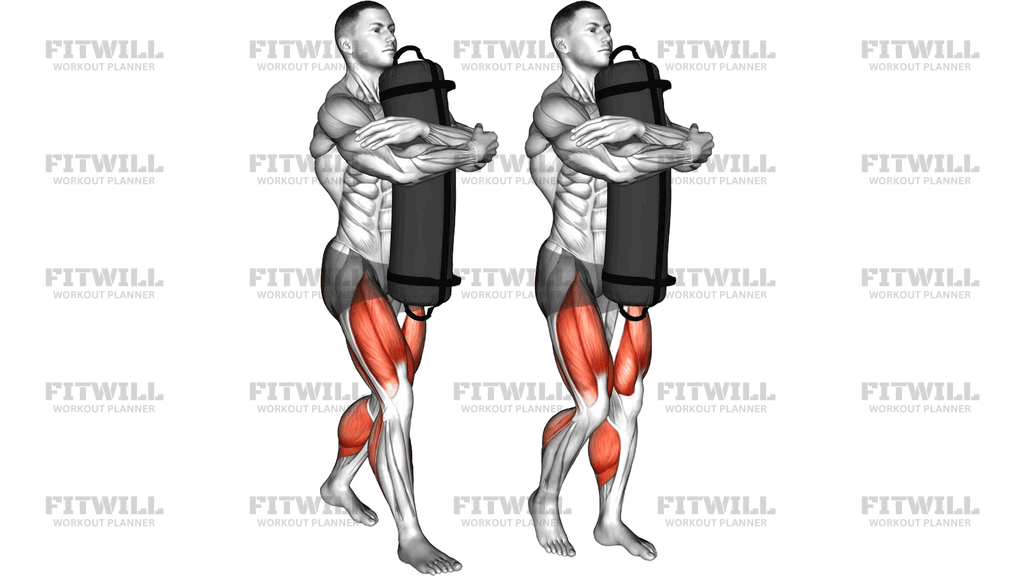
The Weighted Sandbag Carry (Bear Hug) is a loaded carry in which you wrap both arms around a sandbag held vertically against your chest and walk with it. Unlike a suitcase or farmer's carry, where the load hangs at your sides, the bear hug position pins the weight directly against your torso, forcing your arms, chest, and entire trunk to squeeze continuously just to keep the bag from sliding away. The result is one of the simplest and most demanding full-body pressing-and-holding positions you can train.
This movement is especially useful for anyone who wants a strong, resilient midsection without doing dozens of crunch variations. Because the bag pushes outward and downward into your ribs and belly, your deep core has to brace hard the entire time you are moving. Your legs do the locomotion work, your upper arms and forearms fight to maintain the hug, and your upper back and shoulders stabilize the whole structure. It also transfers well to real-world tasks like carrying a heavy box, a child, or a large bag of feed, where the load is awkward rather than neatly handled.
Setup matters more than people expect. The bag should sit high on your chest, roughly from mid-chest to upper abdomen, with your forearms wrapped as far around it as your arm length allows. If the bag rides too low, your lower back takes the strain instead of your trunk; if it sits too high and presses into your throat, breathing becomes difficult. The straps or handles of the bag should be positioned so they do not dig into your arms or face during the walk.
To execute the carry well, squat down to the bag, hug it into your chest, and stand up by driving through your mid-foot with a braced spine. Once upright, take shorter steps than normal, keep your torso tall, and avoid leaning backward to counterbalance the weight. Your breathing will be partially restricted by the bag, which is part of the challenge, so use short, controlled breaths behind a tight brace rather than letting your ribcage flare open.
Common use cases include finishers at the end of a strength session, conditioning circuits, strongman-style training blocks, and low-skill core work for athletes who carry loads in their sport. Because the movement is a hold-and-walk rather than a lift through a range of motion, most people can train it frequently without excessive soreness.
For safety, the main risks are dropping the bag on your feet, rounding your lower back on the pickup, and pushing a set so long that your grip or posture collapses. Choose a bag weight you can hold for a planned distance or time with good positioning, clear the walking path first, and set the bag down by squatting rather than bending over.
[ Workout Log & Planner ]
Put your next workout in Fitwill
Keep your plan and training log ready when you are.


Instructions
- Place a filled sandbag upright on the floor, straps facing outward, and stand close behind it with your feet about hip-width apart.
- Hinge at the hips and bend your knees to squat down, keeping your chest up, then wrap both arms around the bag so your forearms and hands grip as far around the opposite side as possible.
- Squeeze the bag into your mid-to-upper chest, pull it slightly off your thighs, and take a breath into your belly to brace your trunk before standing.
- Stand up by pushing through your mid-foot and extending your hips and knees together, keeping the bag tight against you the entire way.
- Once upright, hold your torso tall with your ears over your shoulders and your shoulders over your hips; do not lean back to counterbalance the bag.
- Walk forward with short, controlled steps, keeping your gaze ahead and your hips level so the bag does not sway side to side.
- Breathe in short, shallow breaths behind the brace rather than fully relaxing your trunk between breaths, and re-squeeze the bag every few steps.
- Continue for a set distance or time, ending the set when your posture, grip, or brace starts to break down rather than holding to failure.
- To finish, stop with feet staggered for stability, squat down by bending your knees and hips, release your arms only once the bag is resting on the floor, and stand back up before resetting.
- Rest, then repeat for the desired number of carries, adjusting bag weight or distance before adjusting anything about your posture.
Tips & Tricks
- If the bag constantly slides down during the walk, the problem is usually a loose hug rather than a weak grip; squeeze the bag into your chest with your forearms before you even stand up.
- Rounded shoulders are a common giveaway of a bag that is too heavy. If you cannot keep your chest proud for the first several steps, reduce the weight instead of fighting it for the whole distance.
- Leaning back into the bag turns the carry into a lower-back strain. Correct it by gently tucking your ribs and thinking about staying tall over your hips.
- Taking long, lurching steps makes the bag bounce and shifts the load unpredictably. Shorter steps keep the weight settled against your chest and make the carry far more controlled.
- Sand shifts during the walk, so the bag may feel heavier on one side by the end. Pause briefly, reposition it to center, and continue rather than compensating with a sideways lean.
- Do not pick the bag up with straight legs and a rounded back; the squat-style pickup is where most lower-back issues with this exercise actually happen, not during the carry itself.
- If your forearms burn out before your core feels worked, try hugging the bag slightly higher and tighter so more of the load rests on your chest instead of hanging in your hands.
- Clear your walking route of obstacles and pets before starting, because your vision is partially blocked by the bag and you cannot catch yourself well with both arms occupied.
- Time your sets instead of guessing. A bag held for thirty to sixty seconds at a time lets you compare progress between sessions more reliably than eyeballing distance.
Frequently Asked Questions
What muscles does the Weighted Sandbag Carry (Bear Hug) work?
The primary work comes from the core, especially the deep trunk muscles that brace against the outward pressure of the bag. Your quads, glutes, calves, forearms, upper back, and shoulders all contribute as they support the load and handle the walking.
How heavy should the sandbag be for the Bear Hug Carry?
Pick a weight you can hold and walk with for your target time or distance while keeping your chest tall and your grip secure. A good starting point is a bag that feels challenging by the halfway point rather than one you can barely lift off the floor.
Why is the bear hug position harder than carrying weights at my sides?
With the bag pressed against your chest, nothing passively supports it, so your arms must squeeze continuously and your trunk must resist the constant outward and downward push. At your sides, the load hangs from relatively passive structures instead.
Can beginners do the Weighted Sandbag Carry (Bear Hug)?
Yes, and it is actually a beginner-friendly carry because there is no complex range of motion to learn. Start with a light bag for short twenty-to-thirty-second walks and focus entirely on posture and breathing before adding weight.
Should my breathing change because the bag is pressed against my chest?
Yes, the bag partially restricts normal breathing, which is part of the training effect. Take short breaths into your upper chest and behind your brace instead of letting your ribcage collapse or fully relaxing between breaths.
What is the most common mistake in the Bear Hug Carry?
The most common mistake is leaning backward or flaring the ribs to make room for the bag, which shifts the strain to the lower back. Stay tall over your hips and let the brace, not a lean, handle the load.
What can I use if I do not have a sandbag?
A heavy medicine ball, a dumbbell hugged to the chest with both arms, or a weight plate clamped to the chest can all work. A soft, flexible sandbag is ideal because it conforms to your torso and cannot be rested on any bony ledge.
How far or how long should I walk for each set?
Twenty to forty meters or thirty to sixty seconds per carry works well for most goals, repeated for three to five sets. End the set when your posture or grip starts to slip rather than holding until the bag drops.
Is the Weighted Sandbag Carry (Bear Hug) safe for the lower back?
It is generally back-friendly when you squat down to pick the bag up and keep your trunk braced while standing and walking. The risk comes from rounding over to lift the bag or leaning back under load, so treat the pickup and set-down as part of the exercise.
How is the Bear Hug Carry different from a farmer's carry?
The farmer's carry loads you front-to-back with weight in each hand and stresses grip heavily, while the bear hug position loads you from the front and stresses trunk bracing and squeezing strength. The two complement each other well in the same program.