Triceps Press Bench Supported
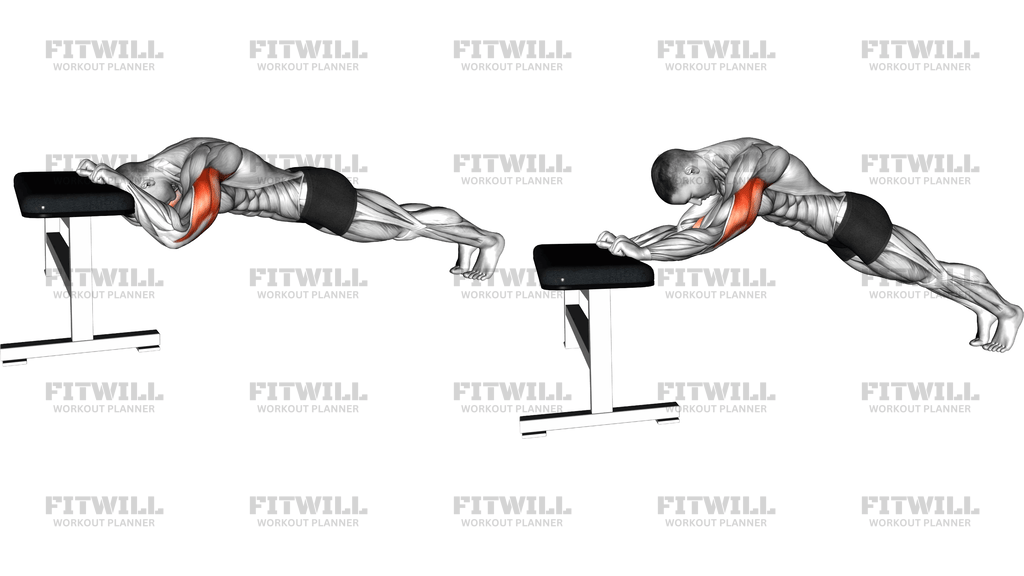
The Triceps Press Bench Supported is a bodyweight pressing movement performed with your forearms planted on a flat bench and your body held in a straight, plank-like line from head to heels. From that position you press forcefully through your forearms to straighten your elbows, which drives your torso up and back, then lower yourself under control by bending the elbows again. The triceps do most of the work here because the elbows start deeply flexed and must extend against a meaningful share of your bodyweight.
Because the bench supports your forearms, your shoulders and chest assist the press without having to stabilize a free weight, which makes this a useful option for people who want heavy triceps work without loading the elbows with dumbbells or a bar. It suits lifters who have outgrown floor push-up variations, gym-goers rehabbing around irritable shoulder pressing patterns, or anyone training at home with nothing more than a sturdy bench.
The setup matters more than it looks. The height of the bench relative to your body determines how much of your weight sits over your forearms: the more horizontal your torso, the harder the press; a more upright angle makes it easier. Keeping your body rigid from shoulders to ankles is equally important. If your hips sag or your lower back arches, you lose the shared bracing from your core and turn the movement into something sloppier and less effective.
To execute it well, plant your forearms firmly on the pad with your hands relaxed or loosely fisted, walk your feet back until your body forms one long line, and let your head drop between your arms so your elbows end up close to your ears in the bottom position. From there, drive your forearms down into the bench as your elbows extend and your torso rises. Lower yourself slowly rather than dropping into the stretch, keeping tension in the triceps the whole way.
In practice, this movement works well as a finishing exercise on arm or pressing days, or as a stepping stone toward harder bodyweight triceps work like ring or bar triceps extensions. The main safety points are simple: keep the bench stable and against a wall if it tends to slide, control the eccentric instead of collapsing into it, and stop short of any pinching sensation at the back of the elbow.
[ Workout Log & Planner ]
Put your next workout in Fitwill
Keep your plan and training log ready when you are.


Instructions
- Place a flat bench against a wall or on a non-slip surface so it cannot slide forward during the press.
- Set your forearms on the pad, shoulder-width apart, with your hands loosely fisted and your elbows bent so your head hangs down between your upper arms.
- Walk your feet back until your body forms a straight line from head to heels, with only your forearms and toes touching the floor; the more level your torso, the harder the exercise.
- Brace your abdominals and squeeze your glutes so your hips do not sag and your lower back does not arch.
- Press your forearms down hard into the bench and extend your elbows to push your torso up and back until your arms are nearly straight.
- Pause briefly at the top with elbows extended and triceps fully contracted, keeping your shoulders from shrugging up around your ears.
- Bend your elbows slowly to lower your body back down, letting your head travel between your arms until it is just above or beside the bench edge.
- Exhale as you press up and inhale on the way down, keeping your breathing steady throughout the set.
- Complete your reps, then step your feet forward and stand up out of the position rather than collapsing off the bench.
Tips & Tricks
- Adjust the difficulty with foot position: stepping your feet further back loads the press more, while keeping them closer to the bench keeps it manageable when you are learning the movement.
- If your elbows ache at the bottom, shorten the range slightly instead of forcing the head all the way to the bench; the triceps still work hard in the mid-range.
- A common mistake is pushing the body forward over the bench instead of up; think about driving your torso up and slightly back so your weight stays stacked over your forearms.
- Watch for hips dropping as fatigue sets in. Once you cannot hold a straight body line, end the set, because sagging hips shift stress away from the triceps and toward your lower back.
- Keep your neck relaxed and let your head hang between your arms; craning to look forward is unnecessary and tightens the upper traps.
- Do not lock out violently at the top. Extend firmly but smoothly so the elbow joint is not slammed into full extension under load.
- Grip the far edge of the bench lightly with your fingers or curl your hands into loose fists; actively pulling the bench toward you can help keep it from sliding.
- Move the bench against a wall if the legs slide on smooth flooring, especially on hard efforts.
- Pair this with a smaller-range variation first if bodyweight pressing is new to you, and progress to the full horizontal position over a few weeks.
Frequently Asked Questions
Which muscles does the Triceps Press Bench Supported work?
The triceps are the primary movers since they extend the elbows against your bodyweight. The chest, front shoulders, and core contribute as supporting muscles to hold the plank position and assist the press.
Is the Triceps Press Bench Supported suitable for beginners?
Yes, if the angle is regressed. Beginners can keep their feet closer to the bench so the torso is more upright, which reduces the load on the triceps before progressing to a more horizontal position.
Why does my head need to drop between my arms in the bottom position?
Letting the head travel between your arms allows the elbows to reach a deeply flexed position, which puts the triceps under a full stretch and gives the press a longer working range. Keeping the head up shortens the range and reduces the triceps involvement.
How is this different from a regular push-up?
In a push-up your hands are flat and your elbows stay in front of your shoulders. Here your forearms are supported on the bench and the elbows end up beside your head, so the triceps extend the arms from a much more stretched position and take on a larger share of the work.
My bench slides forward during the exercise. What should I do?
Set the bench against a wall or use one with rubber feet on a textured floor. You can also lightly pull the bench toward you with your fingers as you press, which helps keep it anchored.
Can I substitute another exercise if I do not have a bench?
A sturdy chair, the edge of a couch, or parallettes with a pad can work, as long as the surface is stable and at roughly knee height. Skull crushers or cable triceps extensions with a rope or handle are good weighted alternatives.
Why do my lower back and hips feel this exercise?
Your body is held in a plank for the entire set, so the core works isometrically to keep the line straight. If your lower back strains, your hips are likely sagging; squeeze your glutes and reset your position before continuing.
How many reps and sets should I do?
Because the load is your own bodyweight, sets in the range of 8 to 15 controlled reps work well for most people. Add difficulty by walking your feet further back rather than rushing the reps.
Is it safe to fully lock out the elbows at the top?
Extending fully is fine for most people, but do it under control rather than snapping into the lockout, especially if the backs of your elbows are sensitive. A firm, smooth extension still gives you full triceps contraction.