Weighted Plate Lying Bench Side Oblique Crunch
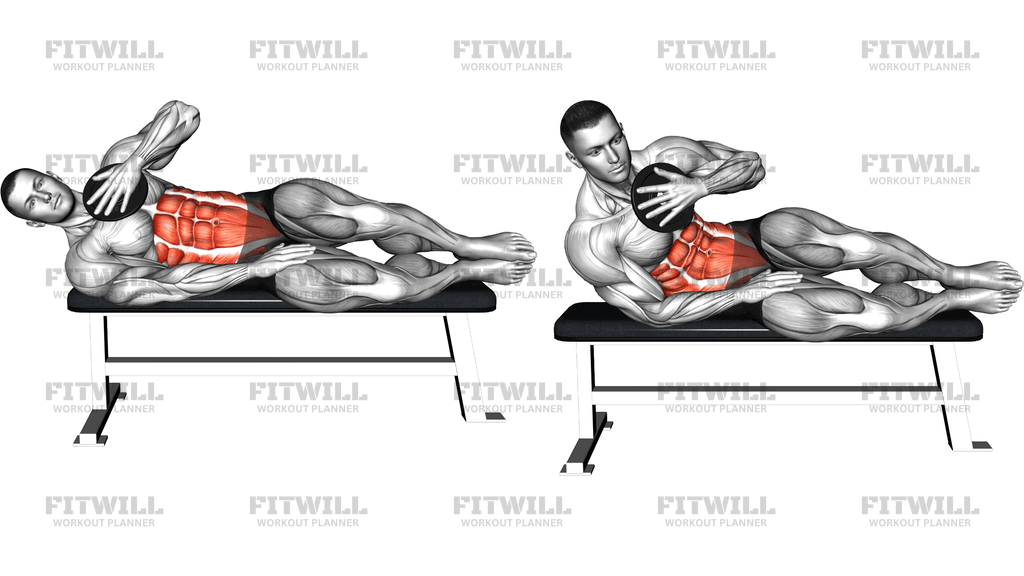
The Weighted Plate Lying Bench Side Oblique Crunch is a side-lying lateral flexion exercise performed on a flat bench while holding a weight plate against your chest. You lie on your side with your body stacked and legs extended, then crunch your upper body up toward the ceiling by bending sideways through the waist. Because you work one side at a time with your lower body anchored to the bench, the movement isolates the obliques on your top side more directly than most standing or twisting core exercises.
The main work comes from the internal and external obliques of the side you are crunching, with the quadratus lumborum and the rectus abdominis assisting as you pull the ribcage toward the hip. Holding the plate flat on your upper chest adds load to the lever, which is what separates this from the bodyweight version. The straight, stacked legs give you a stable base so the rotation happens purely through the spine and waist rather than through the hips.
The setup matters more than it might seem. Lying sideways on a bench elevates your working side slightly above the floor, which gives you room to let the trunk sink down before the crunch and increases the range of motion at the top. Keeping the hips and legs in contact with the bench prevents you from rolling backward or forward and turning the movement into a partial sit-up. If the hips drift, the obliques stop controlling the motion and the load shifts to the lower back.
To execute it well, hold the plate flat against your chest with the hand of your top arm, let your other arm rest over your legs for stability, and think of shortening the distance between your ribs and your hip. Crunch up sideways until you feel a strong squeeze along your waist, pause briefly, then lower back down with control until your side stretches slightly. Exhale as you crunch, inhale as you lower.
This exercise suits lifters who want direct, progressive loading for the obliques once bodyweight side crunches have become easy. It fits well at the end of a core session or on a dedicated ab day, typically for moderate reps in the 10 to 20 range per side. Work both sides evenly, and start with a light plate until you can feel the correct muscles doing the work rather than your neck or arms.
A few practical points will keep it safe and effective. Keep the plate snug against your chest so it never swings or drags the shoulder forward, and keep your neck neutral rather than cranking your head toward the ceiling. Move through a range you can own from start to finish; a slow, shorter crunch beats a fast, large one done with momentum. If you feel it in your lower back or hip rather than your waist, reset your hip alignment before continuing.
[ Workout Log & Planner ]
Put your next workout in Fitwill
Keep your plan and training log ready when you are.


Instructions
- Place a flat bench in an open area and lie on it sideways, resting on one hip with your body in a straight line and your legs extended and stacked.
- Hold a weight plate flat against your upper chest with the hand of your top arm, keeping your elbow bent and the plate snug to your torso; rest your lower arm over the top of your legs.
- Line up your hips squarely so they stay in contact with the bench, and brace your core before you start the first rep.
- Let your upper body sink slightly toward the floor until you feel a mild stretch along the top side of your waist.
- Crunch your upper body up and sideways toward the ceiling by pulling your ribcage toward your hip, keeping your hips and legs pinned to the bench.
- Squeeze your obliques hard at the top and hold the contraction for a beat before lowering.
- Lower your torso back down slowly under control until your side lengthens again, resisting the weight on the way down.
- Exhale as you crunch up and inhale as you lower back to the starting stretch.
- Complete all reps on one side, then switch sides so your other oblique faces up and repeat for the same number of reps.
- Set the plate down carefully before standing up, and reset your hip and leg alignment if your position slips mid-set.
Tips & Tricks
- The most common mistake is rolling backward off the hip as you crunch, which turns the side bend into a half sit-up; keep the bottom hip pressed into the bench for every rep.
- Do not let the plate drift away from your chest. If the plate starts to tilt or slide, the weight is too heavy or your top arm is doing the stabilizing instead of your waist.
- Aim for a shortening of the space between ribs and hip rather than trying to lift your shoulders as high as possible; height means little if the waist is not doing the work.
- Keep your head in line with your spine. Cranking the chin toward the ceiling is a sign you are leading with the neck instead of the obliques.
- Slightly bend your bottom knee if the bench edge digs into your hip, but keep both legs aligned so the pelvis cannot rotate.
- Lower for a two to three count. Dropping back to the stretch position wastes half the exercise and makes the lighter plates feel pointless.
- If your bottom arm slides off your legs, use it to lightly pin your top thigh to keep the lower body quiet through the set.
- Start with a 2.5 to 5 kg plate. Because you are bending sideways under load, the obliques tire quickly and form breaks down faster than in a standard crunch.
Frequently Asked Questions
Which muscles does the Weighted Plate Lying Bench Side Oblique Crunch work?
The internal and external obliques on your top side do most of the work as they pull your ribcage toward your hip. The rectus abdominis and quadratus lumborum assist, and your lower body stays active just to hold the stacked position on the bench.
How is this different from a regular floor side crunch?
The bench lifts your working side off the floor, giving you a deeper stretch at the bottom and more room to crunch at the top. Holding a plate on your chest also adds external load, which bodyweight floor side crunches lack.
Is the Weighted Plate Lying Bench Side Oblique Crunch suitable for beginners?
Yes, but beginners should start with a very light plate or no plate at all until they can feel the obliques working and keep their hips glued to the bench. Once the bodyweight version is controlled for 15 or more reps per side, adding a small plate is a sensible next step.
Why do I feel this in my lower back instead of my waist?
This usually means your hips have rotated so the bend is happening at the lumbar spine in the wrong plane, or you are arching back instead of bending sideways. Reset so both hips stay stacked on the bench and refocus on pulling the ribs toward the hip.
How heavy should the plate be?
Choose a weight you can hold flat against your chest without it sliding or pulling your shoulder forward, usually allowing 10 to 20 clean reps per side. The obliques fatigue quickly in this side-lying position, so heavy plates often lead to hip rolling before the muscles actually fail.
Should I do both sides in the same set or one side at a time?
Finish all reps on one side, then roll over and match the number on the other side. Doing all reps per side before switching also lets you notice any strength difference between sides and address it directly.
What can I use if I do not have a weight plate?
A dumbbell held in both hands against the chest works, or you can perform the same side crunch on the bench with no weight and add load later. A kettlebell is less ideal because its shape is harder to hold flat and stable against the chest.
Is it safe to bend sideways while holding a plate?
For most healthy trainees, yes, as long as the weight is modest, the hips stay fixed on the bench, and the movement stays a controlled side bend rather than a twisting or jerking motion. If you have a history of back issues, keep the range short and stop if the movement provokes discomfort.
How many sets and reps should I do of the Weighted Plate Lying Bench Side Oblique Crunch?
Two to four sets of 10 to 20 reps per side works well, usually at the end of a core or ab session. Keep the rep count equal on both sides so you do not build a side-to-side imbalance.