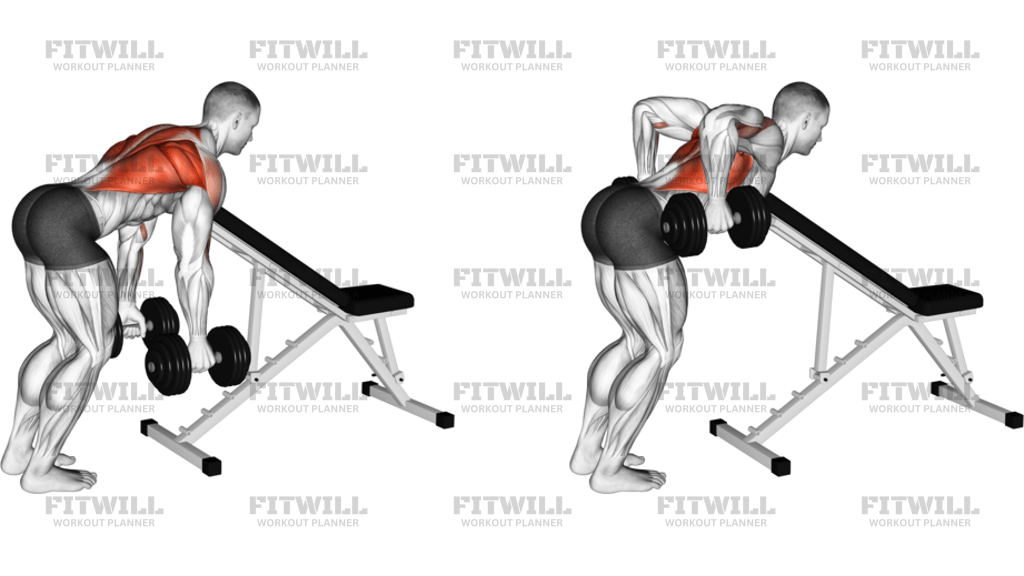
Dumbbell Underhand Renegade Row
The Dumbbell Underhand Renegade Row is a plank-based rowing exercise performed from a high plank position with each hand gripping a dumbbell. Instead of the neutral or overhand grip used in a standard renegade row, the palms face forward toward you as you pull, which shifts more of the work toward the lats and biceps while still demanding a rigid plank from the rest of your body. You row one dumbbell up toward the side of your ribs, lower it back to the floor, and repeat on the other side.
This movement earns its place in a program because it trains two things at once: upper-body pulling strength and full-body anti-rotation control. Every rep forces your shoulders, hips, and legs to hold a straight line while one arm leaves the floor, which challenges the obliques and deep core far more than a bench-supported row ever will. The underhand grip also gives lifters who struggle to feel their lats in neutral-grip rows a version where the pulling muscles engage more naturally.
Setup matters more here than in most rows. The dumbbells need to sit directly under your shoulders so your wrists stay stacked over your elbows, and your feet should be set wide enough to give you a stable base. Hex-style dumbbells or weights with flat, stable sides are strongly preferred, since round plates will roll and dump you sideways mid-rep. If you cannot hold a solid high plank for thirty seconds or more, build that base first before adding rows to it.
To execute well, think of pulling the dumbbell to your lower ribs rather than dragging it up casually, and keep the rowing elbow close to your body. The most common error is letting the hips and shoulders twist as one arm pulls; fight that by gripping the supporting dumbbell hard and keeping both feet planted. Move with intent: a strong pull, a brief pause at the top, and a slow, quiet return of the weight to the floor.
The Dumbbell Underhand Renegade Row fits well as a finisher after heavy pulling work, a core-stability slot in a full-body session, or a conditioning choice in circuit training. Because the plank position caps how much load you can row safely, treat it as a control and coordination exercise rather than a max-strength row. Start light, prioritize a motionless torso, and only add weight once every rep looks identical to the first.
[ Workout Log & Planner ]
Put your next workout in Fitwill
Keep your plan and training log ready when you are.


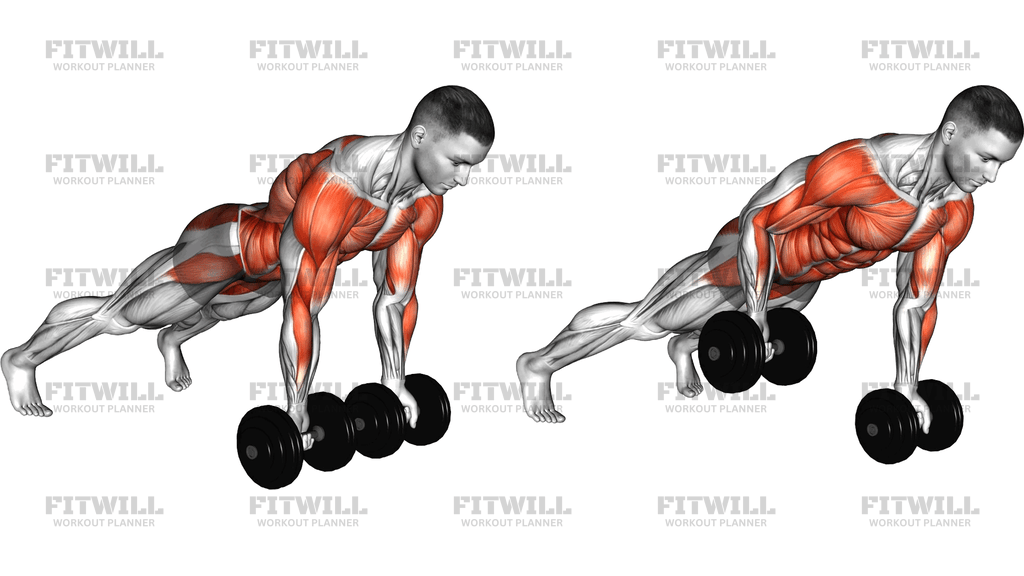
Instructions
- Place two dumbbells on the floor roughly shoulder-width apart, choosing weights with flat sides or hex heads so they cannot roll.
- Grip each dumbbell handle with your palm facing forward (underhand) and walk your feet back into a high plank, hands directly under your shoulders and feet set wider than hip width.
- Straighten your body into one line from head to heels: squeeze your glutes, brace your abs, and pull your shoulder blades down away from your ears.
- Shift your weight slightly toward the left arm, then pull the right dumbbell up toward the side of your lower ribs, keeping the elbow close to your torso and pointing back.
- Pause for a moment at the top with the dumbbell near your ribs and your shoulder blade drawn back.
- Lower the dumbbell to the floor under control, placing it back down directly under your shoulder rather than letting it drift outward.
- Repeat the row with the left dumbbell while the right hand stays planted and grips firmly.
- Exhale as you pull the weight up and inhale as you lower it, keeping your breathing steady through the plank.
- Alternate sides for the desired number of reps, resetting your plank position and foot width any time your hips begin to sag or rotate.
Tips & Tricks
- Set your feet wider than you think you need. A narrow foot stance is the number one cause of hip rotation in this exercise, and widening the base instantly stabilizes your torso.
- Grip the stationary dumbbell as hard as you can before you row the other one. A firm grip on the planted side is what keeps your shoulder from collapsing toward the floor.
- If your hips rise into a pike or sag toward the floor, the weight is too heavy or your plank endurance is the limiting factor. Drop the load and treat the set as a core exercise.
- Pull toward your lower ribs, not your armpit. The underhand grip tempts lifters to curl the weight up with the biceps, which shortens the lat pull and turns the rep into a partial arm row.
- Keep the rowing elbow tracking backward, not flaring out to the side. A flared elbow shifts stress toward the shoulder joint and away from the lats.
- Place the dumbbell back down deliberately instead of dropping it. Slamming the weight into the floor jolts your shoulder and usually signals that fatigue has broken your form.
- Round plates on the dumbbells will roll under load. If hex dumbbells are not available, set the weights on a rubber mat or use kettlebells so the handles stay fixed in place.
- Start with your weaker side first and match the reps with your stronger side, since the plank position makes small side-to-side strength differences very visible.
Frequently Asked Questions
What muscles does the Dumbbell Underhand Renegade Row work?
The primary movers are the lats, with the biceps assisting more than in a neutral-grip row because of the underhand grip. Your rhomboids, rear delts, forearms, obliques, and lower back all work hard to stabilize the plank and control the pull.
Why use an underhand grip instead of a regular renegade row grip?
The underhand, palms-forward grip changes the pulling angle so the lats and biceps do more of the work, which many lifters find easier to feel. It also places the wrist in a slightly different position, so pick the grip that keeps your wrist straight and pain-free.
Is the Dumbbell Underhand Renegade Row suitable for beginners?
It can be, if the weight is light and the focus stays on holding a stable plank. Beginners who cannot yet hold a solid high plank for about thirty seconds should build that first, or start with a renegade row variation performed with hands on a bench to reduce the load on the core.
How heavy should the dumbbells be for this exercise?
Choose a weight you can row cleanly while keeping your hips perfectly level, which is usually lighter than what you would use on a bench-supported dumbbell row. If your torso twists or your feet slide, the dumbbells are too heavy for this position.
Why do my hips keep rotating during the Dumbbell Underhand Renegade Row?
Hip rotation usually comes from a base that is too narrow or from pulling the weight too far up the body. Widen your feet, lighten the load, and pull the dumbbell only to your lower ribs while squeezing the glutes to lock the pelvis in place.
Can I do this exercise with kettlebells instead of dumbbells?
Yes, kettlebells work well because their flat, wide bases sit securely on the floor and the raised handle gives your wrist clearance. The pulling mechanics stay the same as long as the kettlebell cannot tip over mid-rep.
How does the Dumbbell Underhand Renegade Row differ from a regular dumbbell row?
A regular row is usually supported by a bench or a bent-over stance, so you can load it heavy and focus purely on the pull. The renegade row removes that support, so a large share of the effort goes into stabilizing your plank, which limits the load but adds a significant core challenge.
Is it safe for the lower back?
It is generally well tolerated when you keep your body in a straight plank line and avoid twisting under load. If your hips sag or rotate during the set, your lower back takes on stress it should not, so stop the set, reset your position, or reduce the weight.
Where should I place this exercise in my workout?
It works best as a secondary pulling exercise or core finisher after your main heavy rows or presses, or as a station in a conditioning circuit. Because the plank position limits how much weight you can handle, it is not the best choice as your primary heavy rowing movement.