Stick Seated Twist
The Stick Seated Twist is a rotational core exercise performed sitting on a flat bench with a light stick or broom handle resting across the back of your shoulders, gripped as you would hold a barbell in a back squat. From that position, you rotate your torso from side to side, turning from the waist while keeping your head, chest, and the stick moving together as one unit. The seated position removes your legs from the equation, which forces the obliques and deep abdominal wall to do the rotating work without help from hip momentum.
This movement is especially useful for people who want to train rotation without loading the spine with a heavy barbell. Because the stick weighs almost nothing, the exercise is easy to regulate and suits beginners learning what a proper torso rotation feels like, as well as lifters using it as a higher-rep finishing movement after heavier core work. It is also a common warm-up drill before squats or rotational sports, since it mobilizes the thoracic spine and wakes up the waist musculature.
The primary muscles working are the obliques on both sides of your waist, with the external obliques and internal obliques alternating as you twist in each direction. The rectus abdominis and deeper transverse abdominis work isometrically to keep your trunk braced, and the muscles of the upper back and shoulders hold the stick steady across your shoulders. Your hip flexors and thighs stabilize you on the bench throughout.
Setup matters here more than most people expect. Sitting tall on a flat bench with feet planted flat and knees bent roughly 90 degrees gives you a stable base so the rotation happens at your trunk, not at your hips. The stick should rest across the rear deltoids at the base of your neck, held with a relaxed overhand grip slightly wider than shoulder width. If your torso drifts or your knees swing with each turn, the twist loses most of its value for the waist.
Execute the movement by rotating smoothly to one side, pausing briefly when you reach a comfortable end range, then rotating all the way to the other side without bouncing. Keep the movement under control in both directions rather than whipping the stick around. Breathe steadily, exhaling as you twist. Avoid forcing range; your rotation will improve as your thoracic spine and waist loosen up over weeks of practice.
The Stick Seated Twist fits well at the end of a core session, as active recovery between heavier lifts, or as part of a general mobility routine. It is not a heavy strength builder on its own, but it trains rotational control and endurance in the waist, which carries over to throwing, swinging, and changing direction in sport.
[ Workout Log & Planner ]
Put your next workout in Fitwill
Keep your plan and training log ready when you are.


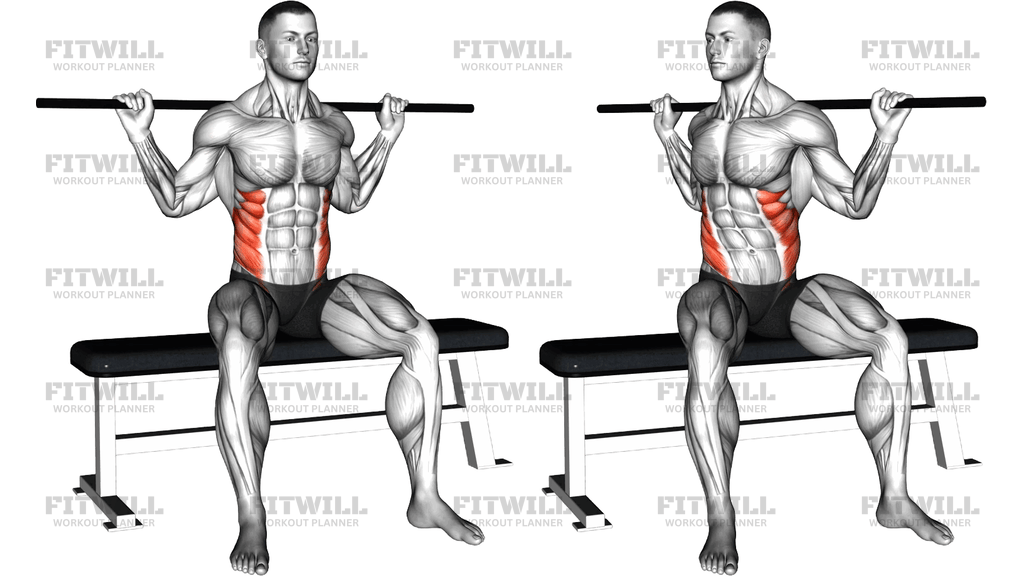
Instructions
- Sit on the middle of a flat bench with your feet flat on the floor, knees bent about 90 degrees, and your torso sitting tall.
- Place a light stick across the back of your shoulders at the base of your neck and hold it with an overhand grip slightly wider than shoulder width, as you would position a bar in a back squat.
- Lift your chest, draw your shoulder blades gently back so the stick sits securely, and brace your abdominal wall like you are about to be lightly tapped in the stomach.
- Point your eyes forward and keep your hips square on the bench; your legs should not move during the set.
- Rotate your upper body to the right, turning from the waist and chest together until you reach a comfortable end range, keeping the stick level with the floor.
- Pause for a moment at the rotated position, then rotate smoothly all the way to the left, passing through center without stopping.
- Continue twisting side to side in a slow, controlled rhythm, treating each pass through the middle as part of the repetition.
- Exhale as you rotate into each twist and inhale as you come back through center; do not hold your breath.
- Complete your planned repetitions or time, then carefully lift the stick overhead or forward off your shoulders to finish the set.
- Reset your posture before the next set, making sure your sitting position has not drifted toward the edge of the bench.
Tips & Tricks
- The most common fault is turning from the hips instead of the waist. If your knees and thighs swing with each twist, exaggerate pressing your feet into the floor and squeezing your thighs against the bench to lock your lower body in place.
- Do not whip the stick around using momentum. A slow tempo with a one-second pause at each end of the range keeps the obliques under tension and stops the stick from pulling your shoulders out of position.
- Keep the stick level. If one end dips as you rotate, it usually means your chest is collapsing or you are leading the turn with your arms; drive the rotation from your ribcage instead.
- Never twist hard to a range that causes pinching or discomfort in your lower back. Rotation should feel like it comes from the trunk and upper back, not a grinding sensation at the spine.
- If you cannot keep your chest upright, shorten the range of rotation. A controlled half turn with good posture trains the waist better than a full turn performed slumped.
- Use a genuine light stick, PVC pipe, or broom handle rather than a loaded barbell. This exercise works through repetition and control, and added weight on a rotating spine offers no benefit here.
- Warm up your midsection with a few gentle standing rotations before sitting down, especially in cold sessions or early mornings when the waist feels tight.
- Keep your neck relaxed and your gaze forward. The head should travel with the torso as one block; craning the chin ahead of the rotation strains the neck.
- If sitting on a bench bothers your lower back, try the same rotation sitting on the floor with legs crossed, or standing with knees slightly bent, until seated control improves.
Frequently Asked Questions
What muscles does the Stick Seated Twist work?
The obliques on each side of your waist do most of the rotating, with the external and internal obliques alternating as you change direction. Your rectus abdominis and deeper core muscles hold the trunk braced while your upper back and shoulders stabilize the stick.
Is the Stick Seated Twist good for beginners?
Yes, it is one of the friendliest ways to learn rotational core control because the stick adds no real load. Beginners should focus on slow tempo and modest range rather than trying to twist as far as possible.
Why hold the stick across the back of the shoulders instead of in front of the chest?
The behind-the-neck placement, like a back squat bar position, forces the shoulders to stay open and the chest tall, which keeps the rotation happening at the trunk. Holding the stick in front also works, but it makes it easier to cheat by swinging the arms.
How many repetitions should I do?
Because the load is minimal, this exercise responds well to higher reps or timed sets. Somewhere between 20 and 40 total alternating twists, or 30 to 60 seconds of continuous controlled rotation, is a practical working set.
Can I add weight to make the Stick Seated Twist harder?
It is not recommended to load a bar for this movement, since rotation under heavy load stresses the spine significantly. To progress, slow the tempo, extend the pause at each end of the twist, or increase total reps before considering any added resistance.
Should my hips and knees move during the twist?
No. Your feet stay flat and your hips stay square on the bench so the rotation comes from your waist and upper back. If your knees swing side to side, the work is shifting away from the obliques.
What is a good substitute if I do not have a bench?
You can sit sideways on a sturdy chair or on the floor with legs crossed, or perform the same twist standing with knees slightly bent. The key points remain the same: stick across the shoulders, tall posture, controlled rotation.
Will the Stick Seated Twist reduce fat around my waist?
Spot reduction is not something any exercise can deliver. This movement builds rotational strength and endurance in the obliques, while overall fat loss depends on diet and total activity.
Is it safe for people with lower back issues?
Anyone with a current or recurring back problem should check with a qualified professional before adding rotational work. Keep the range small, avoid any twisting that produces pain, and stop if symptoms appear.