Deep Push Up Between Dumbbells
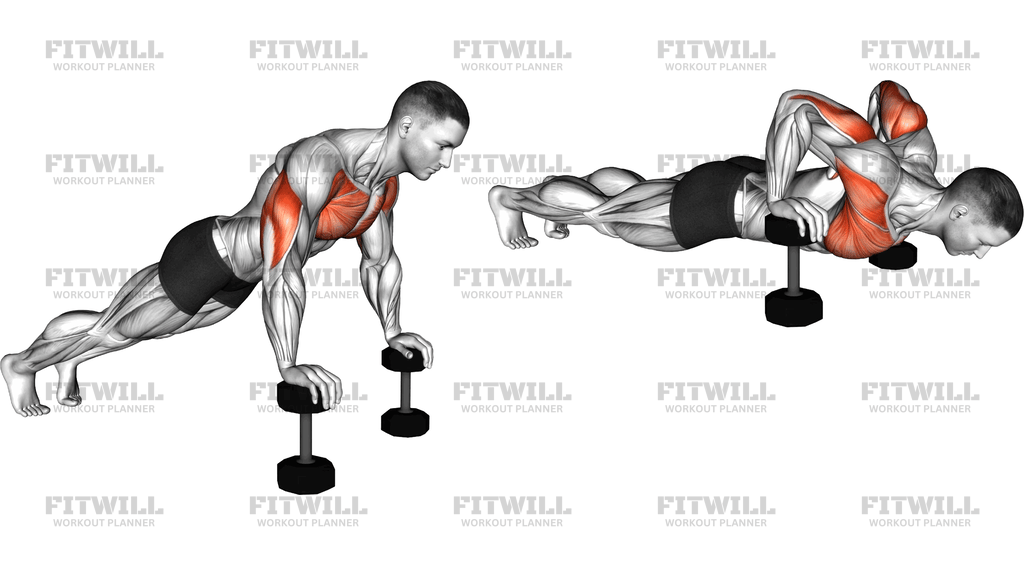
The Deep Push Up Between Dumbbells is a push-up variation performed with a dumbbell under each hand, allowing your chest to sink noticeably lower than it could if your palms were flat on the floor. Because the dumbbells elevate your hands and clear your shoulders of floor contact, you can drop your torso between your arms at the bottom, which places the chest through a longer range of motion and a deeper stretch than a standard push-up allows.
This movement is a solid choice for anyone training chest at home with minimal equipment. The elevated handle position also takes pressure off the wrists, since you grip the handles with relatively straight wrists instead of bending them back to 90 degrees on the floor. If flat push-ups have started to feel easy, or your chest stops progressing because the range is too short, this is one of the simplest progressions available.
The main work is done by the chest, with the triceps extending the elbows and the front of the shoulders assisting on the press. Holding a rigid plank position from head to heels means the core, glutes, and even the legs stay under tension for the whole set, so you get trunk stability work for free. The deeper bottom position also challenges the shoulder stabilizers more than a shallow push-up.
Setup details matter more here than in a regular push-up. Use hex dumbbells or dumbbells with flat, stable heads so they cannot roll out from under you, and place them slightly wider than shoulder width. A dumbbell that shifts at the bottom of a deep rep is the main safety risk in this exercise, so test the set-up with a partial rep before committing to full depth.
To execute well, lower under control until your chest travels between and slightly below your hands, keep your elbows at roughly 45 degrees to your torso rather than flared straight out, and drive the floor away without letting your hips sag or your head lead the movement. Expect the deep range to cut your rep count significantly compared to standard push-ups at first, which is normal and part of the point.
Use this exercise as a main chest builder in home workouts, as a push-up progression once body-weight reps feel comfortable, or as a finisher after pressing work when you want to fatigue the chest through a long range with no additional load.
[ Workout Log & Planner ]
Put your next workout in Fitwill
Keep your plan and training log ready when you are.


Instructions
- Place two hex dumbbells on the floor about shoulder width apart, slightly wider than your usual push-up hand position, with the handles running parallel to your body.
- Grip each dumbbell handle firmly and walk your feet back until your body forms a straight line from head to heels, arms fully extended under your shoulders.
- Set your feet roughly hip width apart and squeeze your glutes and abs so your hips do not sag or pike before you start moving.
- Take a breath into your belly and brace your core as if preparing for a light plank hold.
- Bend your elbows to lower your chest in a controlled line between and slightly below your hands, keeping elbows around 45 degrees from your torso.
- Pause briefly at the bottom with a noticeable stretch across your chest, making sure the dumbbells stay planted and your shoulders stay packed down.
- Press firmly through the handles to straighten your elbows, exhaling as you push, until your arms are extended and your shoulder blades are spread naturally.
- Reset your brace at the top, then repeat for reps, keeping the descent slow on every rep rather than dropping into the deep position.
Tips & Tricks
- Check that your dumbbells have flat, hexagonal heads before trying deep reps; round plates can roll and drop your shoulder to the floor at the worst moment.
- If your hips sag as you descend, shorten the depth slightly and think about pulling your ribs down toward your hips; depth you cannot hold a plank through is not productive depth.
- Elbows shooting straight out to the sides is the most common fault on this variation, and it strains the shoulders at the deep bottom, so cue your elbows toward your back pockets.
- Do not chase floor contact with your chest at the cost of shoulder position; lower only as far as you can keep your shoulder blades from collapsing together.
- Because the deep range loads the chest in a stretched position, start with fewer reps than your standard push-up max, roughly half, and build from there.
- If your wrists feel unstable gripping the handles, wrap your thumbs around the handle rather than resting your palms on top of it.
- Place the dumbbells on a non-slip surface or against a wall if they slide on smooth flooring, especially at the bottom of the rep.
- Keep your neck long by looking at a spot on the floor about a foot ahead of your hands instead of craning up to watch the descent.
Frequently Asked Questions
Which muscles does the Deep Push Up Between Dumbbells work?
The chest is the prime mover, with the triceps and front shoulders assisting on the press. Your core, glutes, and shoulder stabilizers work isometrically to hold the plank position throughout.
Why go between dumbbells instead of doing a normal push-up on the floor?
Flat palms on the floor stop your chest at floor level, but elevated handles let your torso drop below your hands. That deeper stretch lengthens the range of motion and makes each rep harder for the chest.
Is the Deep Push Up Between Dumbbells safe for beginners?
Beginners can do it, but only after standard push-ups are solid and only with a partial range at first. The deep bottom position demands more shoulder control, so build up depth gradually.
What kind of dumbbells should I use for this exercise?
Hex dumbbells are strongly preferred because their flat heads stay planted. Round-plate dumbbells can roll out from under your hands during a deep rep, which is the biggest safety risk here.
How do I keep my wrists comfortable while gripping the dumbbells?
Wrap your fingers and thumb fully around each handle so your wrist stays stacked over it, rather than letting your hand splay over the top. The neutral grip is usually easier on the wrists than flat-floor push-ups.
My dumbbells slide apart at the bottom of the rep. What should I do?
Place them on a rubber mat or position them so the outer heads press against a wall. Sliding equipment at full depth can drop you unexpectedly, so fix the surface before continuing.
How deep should I lower in the Deep Push Up Between Dumbbells?
Lower until your chest is roughly level with or slightly below your hands, as long as your shoulders stay controlled and your torso keeps a straight line. Depth that costs you body position is not worth taking.
What can I substitute if I do not have dumbbells?
Push-up handles or parallettes on a non-slip floor give the same elevated, deep-range effect. A set of two sturdy books or yoga blocks can work in a pinch, but test their stability with a partial rep first.
Should my elbows flare fully out to the sides at the bottom?
No. Keep your elbows at roughly 45 degrees to your torso; full flare plus the deep stretch concentrates stress on the shoulder joint rather than the chest.
How does this compare to a deficit push-up done on blocks or books?
The mechanics are similar, but the dumbbell handle gives you a neutral grip that is friendlier to the wrists and lets you press through a firm grip. Blocks with palms flat on them lose that wrist advantage.