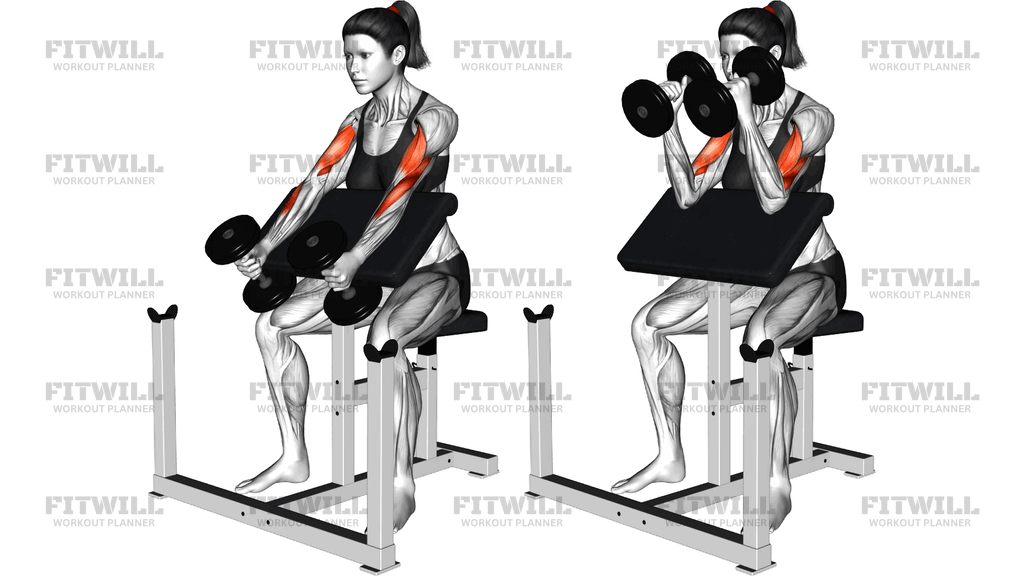
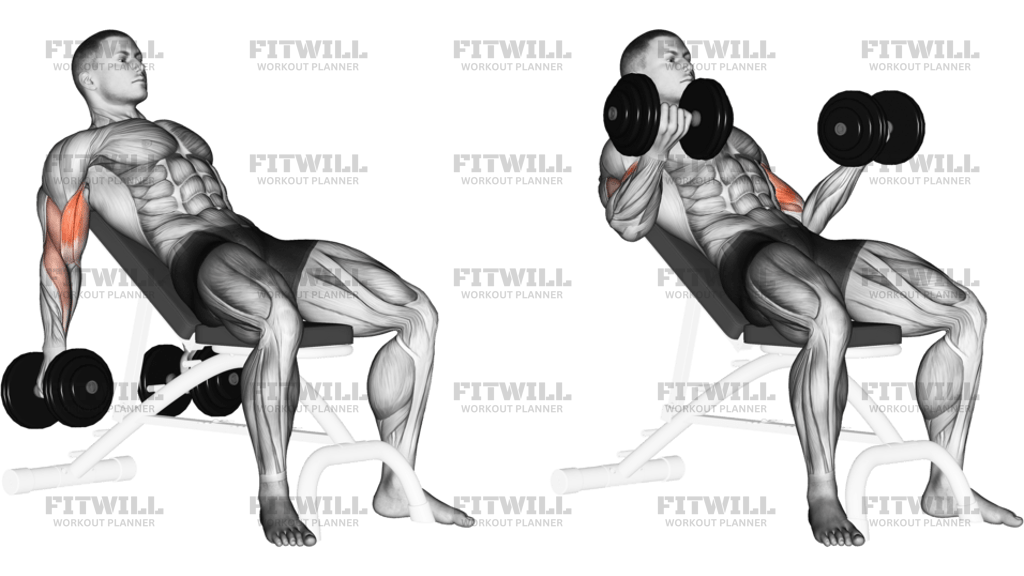
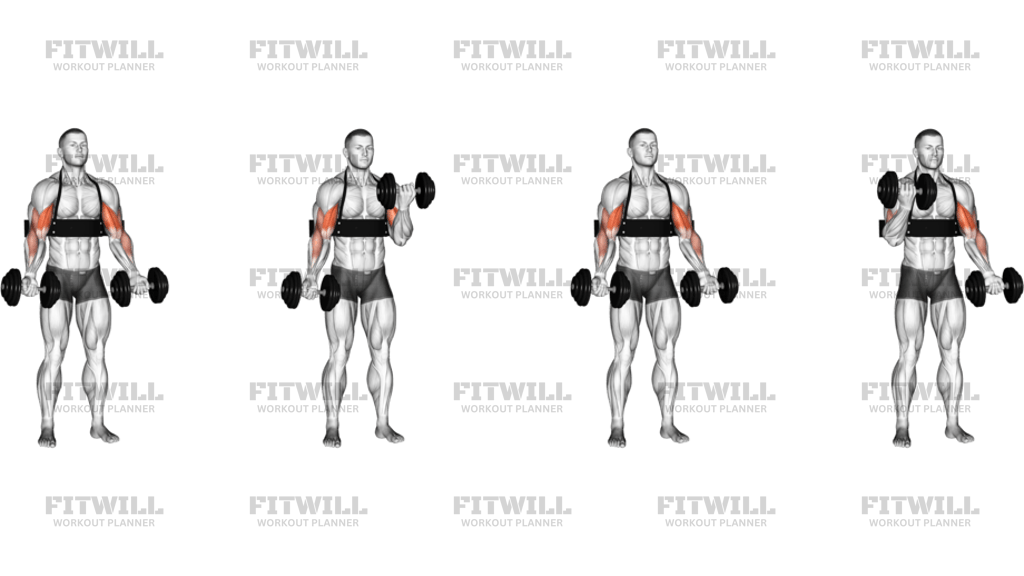
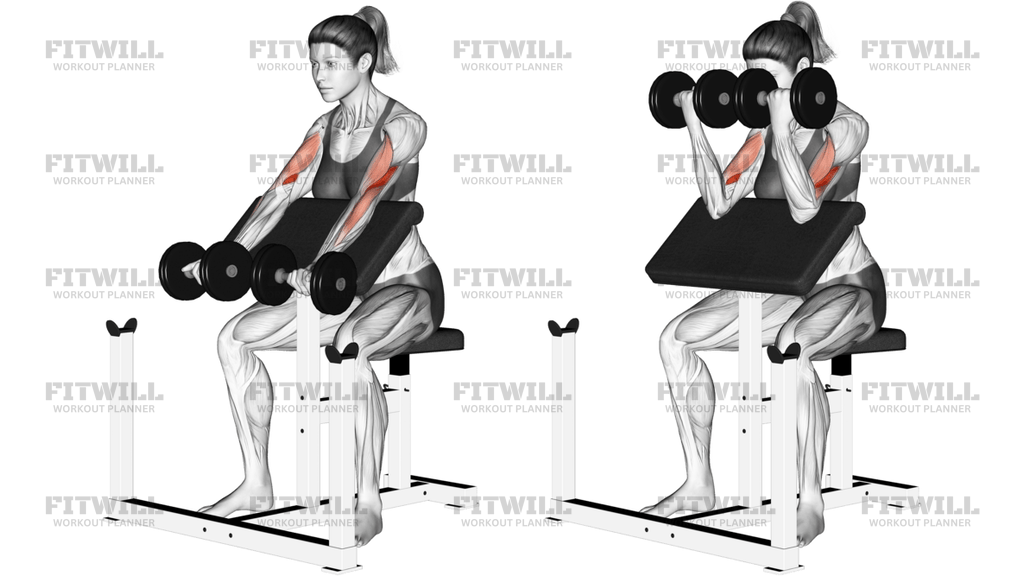
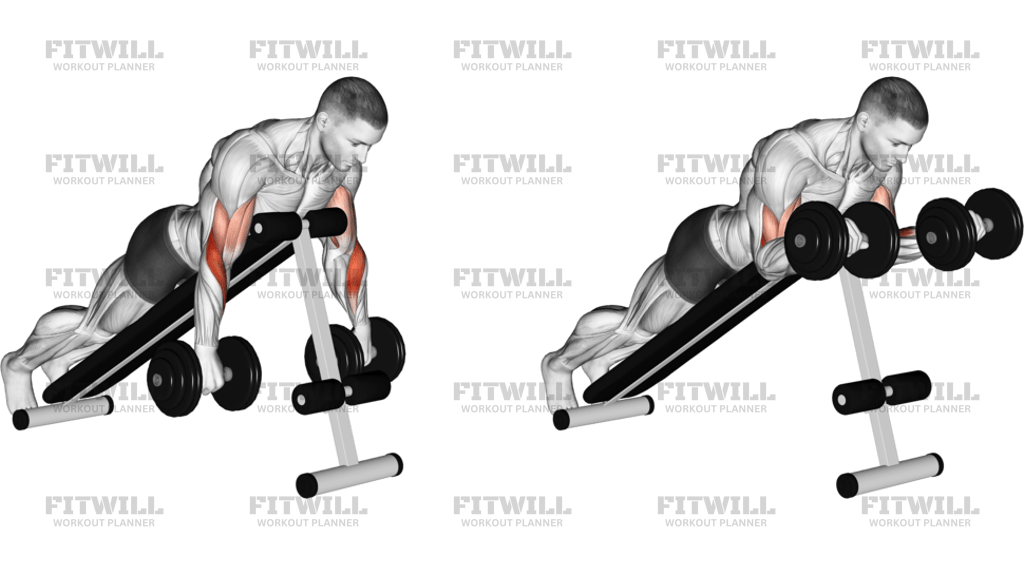
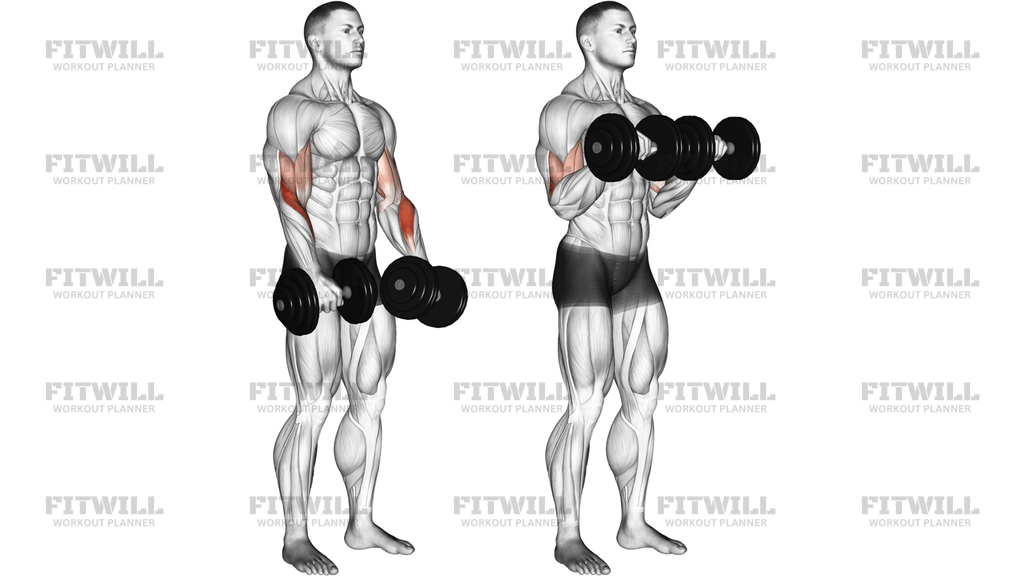
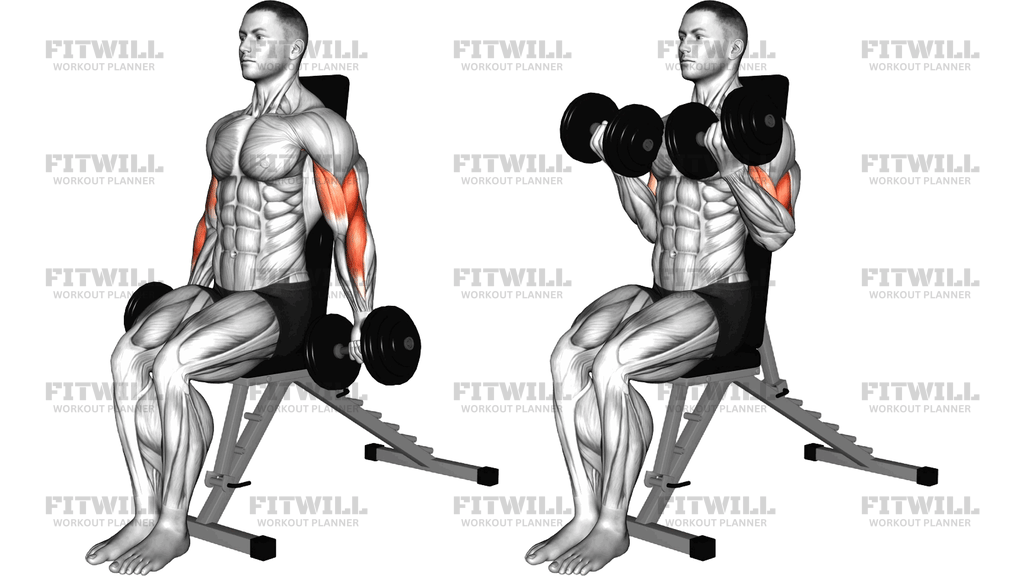
Dumbbell Seated Upper Half Biceps Curl
The Dumbbell Seated Upper Half Biceps Curl is a partial-range curl performed from a seated position on an upright bench. Instead of starting with the arms fully extended, you begin each rep with the elbows bent to roughly 90 degrees and curl the dumbbells from there up to full flexion near the shoulders. This keeps constant tension on the biceps through the strongest part of the strength curve, where the muscle is capable of producing the most force.
This variation is especially useful for lifters who want to overload the top portion of the curl — the phase responsible for the peak contraction and much of the visible biceps height. Because the bottom half of the range is removed, you can typically handle slightly heavier dumbbells than you would for a full-range seated curl, or you can use the same weight and accumulate more quality time under tension in the shortened position. It is a solid accessory movement for bodybuilders, and equally useful for anyone whose full curls tend to stall halfway up.
The seated setup matters more than it might seem. Sitting upright against the back pad removes the body English and hip drive that creep into standing curls, forcing the biceps to do the work on their own. Keeping the upper arms vertical and pinned to the sides of the torso creates a stable hinge at the elbow, so the load travels a consistent arc from the mid-range position up to the top.
Execution is simple but demanding on control. From the 90-degree starting position, curl both dumbbells up and slightly forward until the elbows are fully flexed and the weights are near shoulder height, squeeze the biceps briefly, then lower under control only until the forearms return to parallel with the floor — no lower. Each rep starts and ends at that mid-range point, which means the biceps never get a chance to rest between repetitions.
This exercise pairs well with a full-range curl performed earlier in the session: the full curl covers the stretch portion of the range, and the upper half curl finishes the muscle in the contracted position. Use moderate to moderately heavy dumbbells, keep the reps strict, and treat it as a finishing or hypertrophy movement rather than a max-effort lift.
[ Workout Log & Planner ]
Put your next workout in Fitwill
Keep your plan and training log ready when you are.


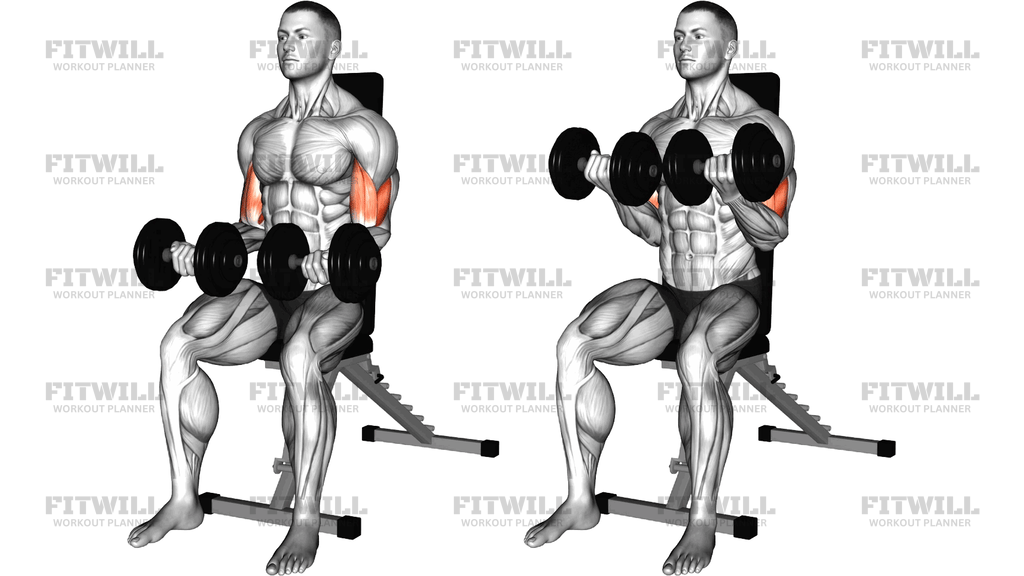
Instructions
- Sit upright on a bench with a back pad, feet flat on the floor about hip-width apart, and your back, shoulders, and head resting against the pad.
- Hold a dumbbell in each hand with a supinated grip, palms facing up, and let your arms hang at your sides with elbows fully extended.
- Curl both dumbbells halfway up and stop when your elbows reach about 90 degrees and your forearms are roughly parallel to the floor — this is your starting position for every rep.
- Brace your core lightly and press your upper arms firmly against the sides of your torso so they stay vertical and still.
- Exhale as you curl both dumbbells up in a smooth arc until your elbows are fully bent and the weights are near shoulder height.
- Squeeze the biceps hard at the top for a one-second pause without letting your elbows drift forward.
- Inhale as you lower the dumbbells slowly back down, stopping as soon as your forearms reach parallel to the floor — do not drop into the bottom half of the range.
- Begin the next rep immediately from that 90-degree position to keep tension on the biceps throughout the set.
- Once you finish the set, lower the dumbbells all the way down under control before setting them on the floor or racking them.
Tips & Tricks
- The most common mistake is letting the starting position sink below 90 degrees as fatigue sets in — once your forearms drop below parallel, the set becomes a full curl, so stop the set or lighten the weight.
- Keep your elbows glued to your ribs; if they travel forward toward the mirror at the top, the front shoulders take over and the biceps peak contraction is lost.
- Do not swing the torso off the back pad to help the weights up — if your upper back leaves the pad, the dumbbells are too heavy.
- Lower for two to three seconds on every rep; because there is no stretch phase to absorb momentum, fast lowering makes this movement far easier than it should be.
- Avoid relaxing your grip at the mid-range stopping point — a loose grip lets the dumbbell rotate and turns the supinated curl into an accidental hammer curl.
- Keep your wrists straight and stacked over the elbows rather than curling them inward, which strains the wrist flexors.
- Choose weights you can control for the full set with strict partials; because the range is short, it is tempting to go too heavy and bounce through the reps.
- If one arm fatigues faster than the other, perform the exercise one arm at a time so the stronger side does not compensate.
- Place this exercise after your heavy full-range curls rather than before, since starting with partials can leave the biceps too pre-fatigued for full-range loading.
Frequently Asked Questions
What muscles does the Dumbbell Seated Upper Half Biceps Curl work?
The biceps brachii is the primary muscle, with the brachialis and brachioradialis assisting. The forearm flexors also work isometrically to maintain your grip on the dumbbells.
Why does the Dumbbell Seated Upper Half Biceps Curl only use the top half of the range?
The upper half of the curl is where the biceps can produce the most force and achieve peak contraction. Removing the bottom half keeps tension constant and lets you emphasize the shortened position without resting between reps.
Is the Dumbbell Seated Upper Half Biceps Curl suitable for beginners?
Yes, as long as the weight is kept light and the 90-degree starting position is respected. Beginners often benefit from learning full-range curls first so they understand what the complete curl pattern feels like.
How heavy should I go on the Dumbbell Seated Upper Half Biceps Curl?
You can usually handle slightly more than your full-range seated curl since the range is shorter, but only if every rep starts at 90 degrees and reaches full flexion. If you have to drop below parallel or lean back, the weight is too heavy.
Why should my elbows stay at my sides during this curl?
Fixed upper arms create a stable elbow hinge and keep the dumbbells moving in a consistent arc. When the elbows drift forward, the front shoulders contribute and the biceps lose tension at the top.
What is the most common mistake in this exercise?
Letting the starting position creep downward so each rep gradually becomes a full curl, usually from fatigue or too much weight. Watch your forearms and stop the set the moment they drop below parallel at the bottom of the partial.
Can I do the Dumbbell Seated Upper Half Biceps Curl one arm at a time?
Yes. Unilateral reps let you focus on each arm, prevent the stronger side from taking over, and make it easier to keep the elbow pinned to your ribs.
What can I substitute if I don't have a bench with a back pad?
Any stable seated position works, such as the end of a flat bench or a sturdy box, as long as you stay upright without leaning back for leverage. The key points — 90-degree start, elbows at the sides, full flexion at the top — stay the same.
Where should the Dumbbell Seated Upper Half Biceps Curl fit in my workout?
Use it as an accessory or finisher after your main full-range biceps work. It is an effective way to add quality volume to the contracted position once heavier compound pulling is done.
Are partial curls safe for the elbows?
For most people, yes, because the load stays within a controlled mid-range arc with the elbow supported against the torso. Keep the movement smooth, avoid locking or snapping at the top, and reduce the weight if you feel any joint discomfort.