Squat Mobilization
Squat Mobilization is a supported deep-squat hold designed to restore the ankle, knee, and hip range you need for a full-depth squat. You stand behind a sturdy chair, grip the top of its backrest, and lower yourself into a deep squat while using your arms to unload some of your body weight. In that bottom position you settle, breathe, and let the joints and surrounding tissues gradually adapt to the depth instead of forcing it.
This drill is especially useful for anyone whose squat gets cut short: people whose heels lift, whose torso pitches forward, or whose knees drift in as they descend. Office workers who sit for long hours often lose hip and ankle mobility without noticing, and this hold gives them a safe, self-paced way to reclaim it. It is equally valuable as a warm-up before barbell squats, lunges, or leg days in general.
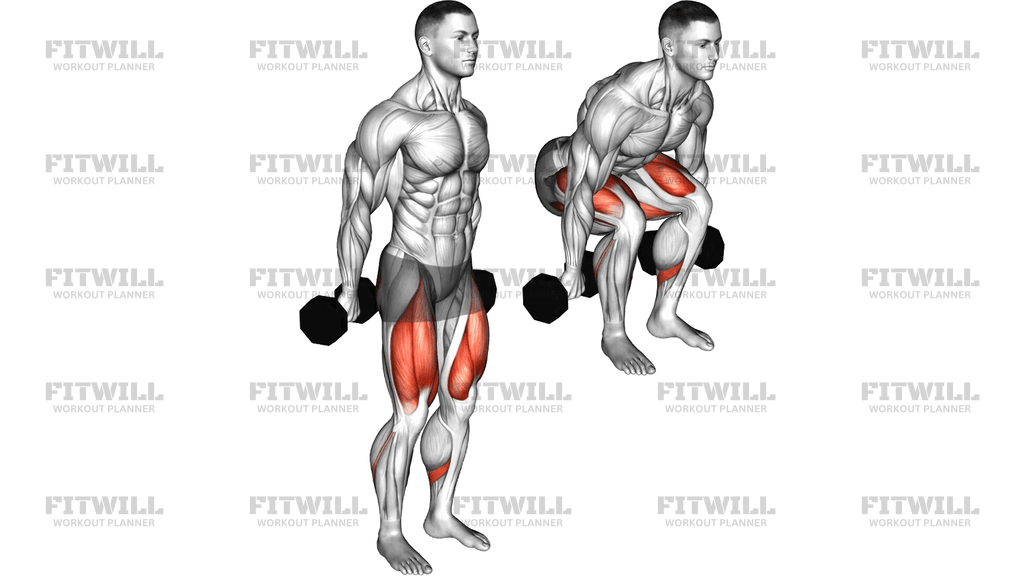
The chair support is what makes this accessible. Because your arms carry part of your load, you can reach a depth that would be uncomfortable unsupported, then progressively lean less on the chair as your mobility improves. The tension you feel concentrates around the quads, hips, glutes, calves, and ankles — the same areas highlighted in the movement — while your lower back stays long and your chest stays lifted.
Setup matters more than it looks. The chair must be heavy or braced so it cannot slide, your stance should be roughly shoulder-width with the toes turned out slightly, and your heels need to stay glued to the floor. If the chair shifts or your heels rise, you lose the exact joint positions this drill is meant to train.
To execute it well, descend slowly, let your elbows track just inside or outside your knees at the bottom, and use the hold to breathe deeply rather than to fight the position. Small shifts — sitting a little more to one side, gently easing the knees outward, pausing with more weight into the heels — let you explore the ranges that feel tightest.
Use it as a daily mobility practice, a pre-workout primer, or a recovery position between squat sessions. Most people benefit from two to four rounds of twenty to forty seconds. Stop short of sharp pain, and expect progress over weeks, not minutes.
[ Workout Log & Planner ]
Put your next workout in Fitwill
Keep your plan and training log ready when you are.


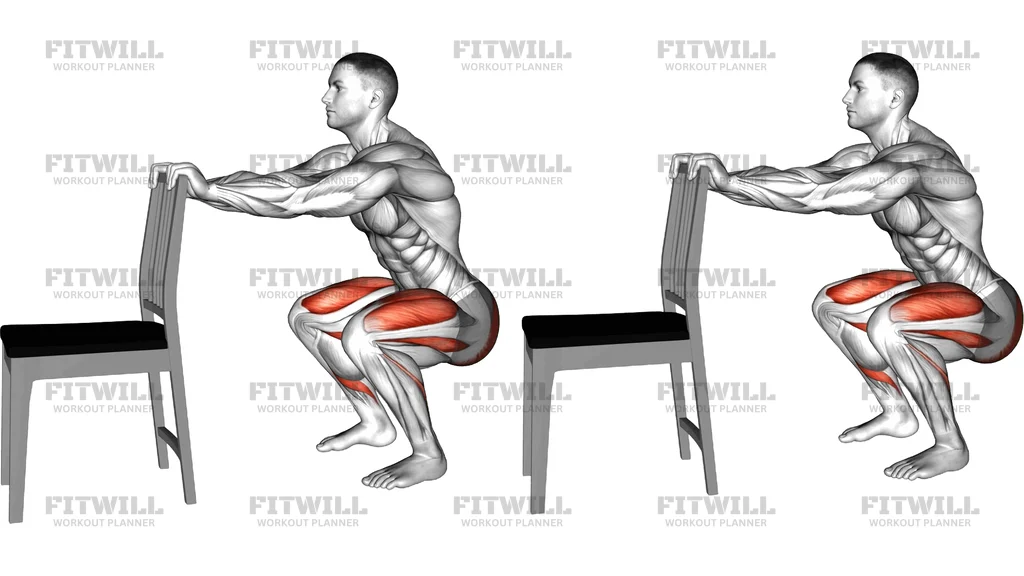
Instructions
- Place a sturdy chair on a non-slip surface and stand facing its backrest, about one step away.
- Set your feet shoulder-width apart or slightly wider, toes turned out about 15 to 30 degrees.
- Grip the top of the chair back with both hands, arms straight, shoulders relaxed.
- Brace your trunk lightly, keep your chest tall, and hinge at the hips as you begin to bend your knees.
- Lower slowly into a deep squat, keeping your heels flat and letting the chair take part of your weight through your arms.
- At the bottom, let your elbows press gently against the inner sides of your knees to help the knees track over your toes.
- Hold for 20 to 40 seconds, breathing deeply into your belly, and make small side-to-side or depth adjustments to explore tight ranges.
- Push through your heels and lightly through your arms to rise back to standing under control.
- Reset your stance, then repeat for 2 to 4 total holds.
- As your mobility improves, lean less on the chair and carry more weight through your legs.
Tips & Tricks
- If your heels lift at the bottom, widen your stance slightly and shift more weight into your arms; stubborn ankle stiffness can be eased by placing a thin book or small plate under the heels while you work on it.
- Knees collapsing inward is the most common fault in this position — cue your elbows to gently push the knees out so they track over or slightly outside your toes.
- Do not death-grip the chair back; a firm but relaxed hold keeps your shoulders down and prevents your upper body from stiffening up.
- Avoid letting the chair slide forward as you lean in — position it against a wall or use a heavy chair so the support stays put mid-hold.
- If your lower back rounds heavily at the bottom, you have gone past your current depth; reduce the range slightly and build up over sessions instead of sinking by collapsing.
- Breathe slowly through the hold rather than holding your breath — long exhales help you settle a little deeper each round.
- Treat this as a mobility hold, not a strength set: if your quads are burning from effort rather than stretching, you are carrying too much load through your legs too soon.
- Spend extra seconds in whichever direction feels tightest — sitting toward one hip or easing one knee outward — rather than rushing through symmetric reps.
- Warm ankles and hips respond far better than cold ones, so a minute of easy marching or leg swings before the holds makes the depth come easier.
Frequently Asked Questions
What does Squat Mobilization primarily improve?
It improves squat depth by targeting the mobility restrictions that usually limit it: the ankles, hips, and knees. The quads, glutes, and calves are placed under a stretch while the chair support lets you relax into positions you could not hold unsupported.
Why use a chair instead of doing a free deep squat hold?
The chair takes a portion of your body weight, so you can reach full depth comfortably and hold it long enough for the tissues to adapt. As your range improves, you simply lean on the chair less until you no longer need it.
Which muscles and joints does Squat Mobilization target?
The stretch lands mainly on the quads, hips, glutes, and calves, while the ankles, knees, and hips move through their full available range. It is a mobility drill, not a strength or hypertrophy exercise.
Is Squat Mobilization suitable for beginners?
Yes, and it is one of the best starting points for anyone working toward their first full squat. The chair lets you control exactly how much weight your legs handle, so you can start very assisted and progress at your own pace.
How long should I hold the bottom position?
Twenty to forty seconds per hold works well for most people, repeated two to four times. Longer, relaxed holds with deep breathing tend to produce better results than short, tense ones.
My heels keep lifting off the floor during the hold. What should I do?
Shift more weight into your arms, widen your stance slightly, and do not force the depth yet. If ankle stiffness is the clear limitation, temporarily elevating your heels on a thin book or small plate lets you train the hip position while you work on ankle range separately.
Can I use Squat Mobilization as a warm-up before barbell squats?
Yes, it is an excellent primer because it puts you directly in the positions you are about to load. Do two or three lighter holds before your warm-up sets rather than long fatigue-inducing holds right before heavy lifting.
What kind of chair works best for this exercise?
Use a heavy, stable chair with a solid backrest, ideally placed against a wall so it cannot slide when you lean into it. A lightweight chair that skids across the floor is a safety hazard in this position.
How long until I can squat deeply without the chair?
It varies with your starting point, but most people notice easier depth within two to four weeks of near-daily practice. Progress by leaning less on the chair each session rather than testing maximum depth every day.
Is it safe if I have knee discomfort at the bottom?
Mild stretching tension is normal, but sharp or pinching knee pain is a signal to reduce depth and keep more weight in your arms. If discomfort persists at shallower ranges, get it assessed before continuing.