Alternate Single Leg Sit Wall
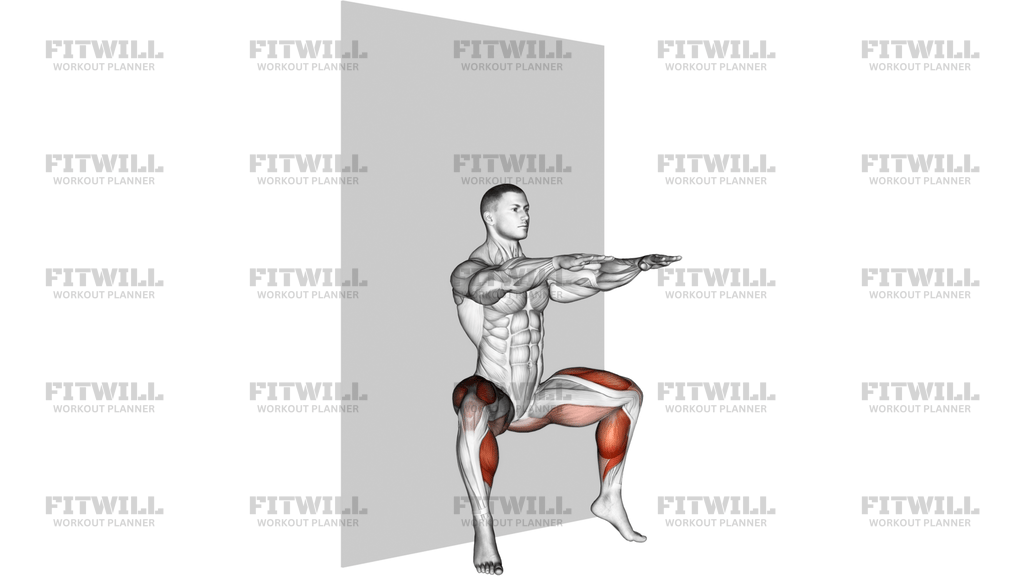
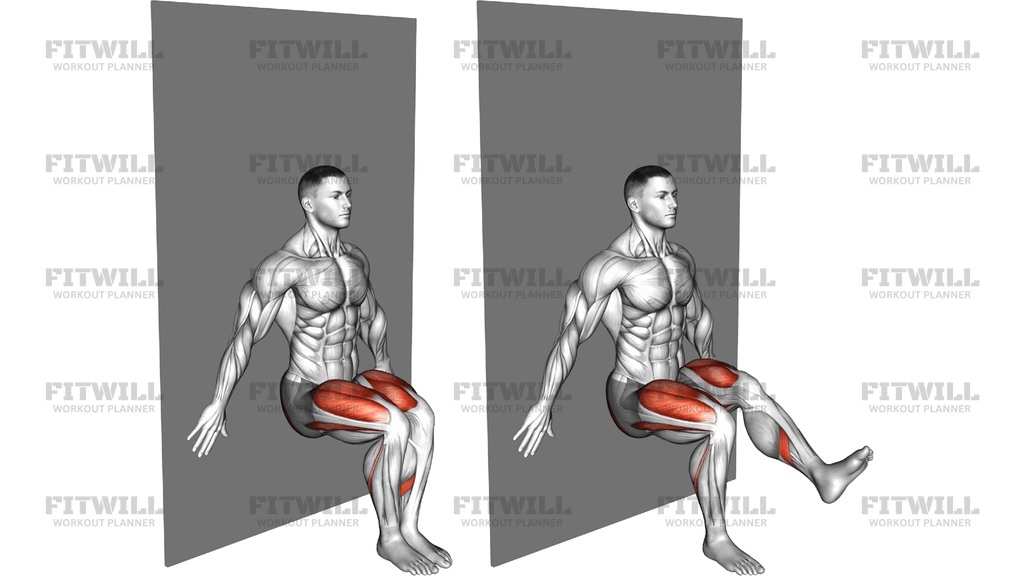
The Alternate Single Leg Sit Wall is an isometric hold with a twist: you settle into a standard wall sit against a flat vertical surface, then lift one foot off the floor at a time and extend that leg forward while the other leg keeps supporting your full body weight. Your back, hips, and shoulder blades stay pressed into the wall the entire time, so the working leg has to handle the load without any help from momentum or leaning. The result is a quad-dominant hold that also challenges hip stability, glute strength on the supporting side, and the core's ability to keep your torso square.
This movement earns its place in a routine because removing one leg roughly doubles the demand on the grounded limb while you are stuck in the hardest part of the squat pattern: the parallel position. It is a smart progression for anyone who has outgrown the basic wall sit but is not ready for heavy single-leg squatting, and it is equally useful as a finisher after squats or leg presses when you want to fatigue the quads safely. Runners, skiers, and field-sport athletes get a lot out of it too, since single-leg support under fatigue mirrors what their knees actually do in sport.
The setup matters more than people expect. Because you have no external load, the wall is the only reference point, and letting your hips drift away from it, your knees cave inward, or your hands press onto your thighs all quietly reduce the work. Aim for knees bent close to 90 degrees, weight spread across the whole foot of the standing leg, and arms hanging at your sides or lightly braced against the wall for balance only.
Execution is simple in theory: extend one leg until the knee is straight and the foot is off the floor, hold for a set count, place the foot back down, and immediately switch to the other leg. The temptation is to rush the switch and bounce between legs, but the controlled placement of the foot back on the floor is where a lot of the stability work happens. Keep the extended leg's toes pulled up and the kneecap tracking straight ahead rather than twisting outward.
Because it is body weight only, this exercise is very joint-friendly and scales easily. Beginners can perform it higher on the wall with a shorter hold on each side; advanced lifters can sink lower, lengthen the holds, or slow the transitions. If you feel sharp pain in the kneecap rather than working-muscle burn, come up slightly higher on the wall and reduce the hold time until your legs adapt.
[ Workout Log & Planner ]
Put your next workout in Fitwill
Keep your plan and training log ready when you are.


Instructions
- Stand with your back to a clear, flat wall and walk your feet out about two feet from the base, hip-width apart.
- Slide down the wall until your hips and knees are both bent close to 90 degrees, with your shoulders, upper back, and hips flat against the wall.
- Let your arms hang at your sides or rest your palms lightly against the wall for balance, without pushing on your thighs.
- Shift your weight evenly across the whole foot of one leg and brace your core as if preparing for a light push to the stomach.
- Lift the opposite foot off the floor and extend that leg straight out in front of you, keeping the knee in line with the supporting leg and the toes pulled up.
- Hold the extended position for your target time, keeping your lower back glued to the wall and your hips level, with no twisting toward the lifted side.
- Breathe steadily throughout the hold; avoid holding your breath as the working leg starts to burn.
- Lower the extended foot back to the floor with control, re-center your weight over both feet for a brief moment, then switch legs.
- Continue alternating for the desired number of reps or total time, then slide up the wall to stand and shake out your legs.
Tips & Tricks
- If your hips drift forward off the wall as soon as one leg lifts, slide slightly higher on the wall first; a shallower angle you can hold cleanly beats a parallel hold with poor position.
- Watch for the supporting knee collapsing inward when the load doubles on it. Cue yourself to press the knee out over the pinky toe of the standing foot.
- Do not slam the returning foot down and immediately pop the other leg up. Placing the foot softly and re-balancing for a second is what keeps the transition honest.
- Keep the extended leg at roughly hip height or slightly below. Kicking it higher shifts work to the hip flexors and pulls your back away from the wall.
- If you catch yourself pressing hands into your thighs to help, move your hands to the wall beside your hips or cross them over your chest instead.
- A burning quad and trembling supporting leg are normal; sharp pain at the front of the knee is not. Adjust the depth before pushing through knee discomfort.
- Breathe in through the nose and out through the mouth in a slow rhythm. Most people unknowingly hold their breath during the final seconds of a hard isometric hold.
- Time each side with a count or clock rather than guessing, so the weaker leg gets the same work as the stronger one.
- On smooth floors, be aware your supporting foot can slide forward. Position yourself against a wall with grippy flooring, or use a mat underfoot.
Frequently Asked Questions
What muscles does the Alternate Single Leg Sit Wall work?
The quadriceps of the supporting leg do most of the work, since they hold your full body weight at a near-90-degree knee angle. The glutes and hamstrings stabilize the hip, the calf complex steadies the ankle, and the core keeps your torso from twisting as one leg extends.
How is the Alternate Single Leg Sit Wall different from a regular wall sit?
In a regular wall sit both legs share the load, but here one leg supports your entire body weight while the other extends forward. That makes it far more demanding per leg and adds a balance and hip-stability element the two-legged version lacks.
Is this exercise suitable for beginners?
Yes, with modifications. Slide higher on the wall so your knees are only partly bent, hold each side for five to ten seconds, and build up gradually. Once you can manage 30 seconds per side at a shallower angle, progress toward a parallel-thigh position.
How long should I hold each side?
Start with 10 to 20 seconds per leg and alternate for two to four total rounds. Stronger trainees can work up to 30 to 45 seconds per side, or use the movement as a burnout finisher for 60 seconds or more of continuous alternating.
Why does my supporting knee drift inward during the hold?
The inner thigh and glute stabilizers fatigue quickly when one leg carries the full load, letting the knee collapse toward the midline. Consciously press the knee out over the little toe, and if it still caves in, reduce the hold time or raise your position on the wall.
Should my back stay flat against the wall the whole time?
Yes. Your shoulders, upper back, and hips should remain in contact with the wall throughout the set. When one leg lifts, the tendency is to lean the torso toward the supporting side, so check your contact points and square your hips back up before each switch.
What can I substitute if I do not have a clear wall space?
A sturdy pillar, closed door frame, or even a stability ball braced between your back and a wall works. Without any wall, a static single-leg squat hold at a comfortable depth trains a similar quality, though you lose the external reference for your back position.
Is it bad if my legs shake during the hold?
No, shaking is a normal response to a sustained isometric contraction and usually fades as your legs adapt. If the shaking comes with a loss of position, such as hips sliding off the wall or a knee caving in, end the set and rest rather than grinding through bad form.
Can I put my hands on my thighs for support?
Avoid it, because pressing on the working or supporting thigh takes meaningful load off the legs. Rest your hands lightly against the wall for balance, or cross your arms over your chest if you want to make the hold stricter.
How does breathing work during a long isometric hold?
Keep breathing in a slow, steady rhythm the entire time instead of holding your breath. Exhale as you extend the leg and switch sides, and continue controlled breathing through the burn; breath-holding raises tension unnecessarily and makes long holds harder than they need to be.