Resistance Band Overhead Hit
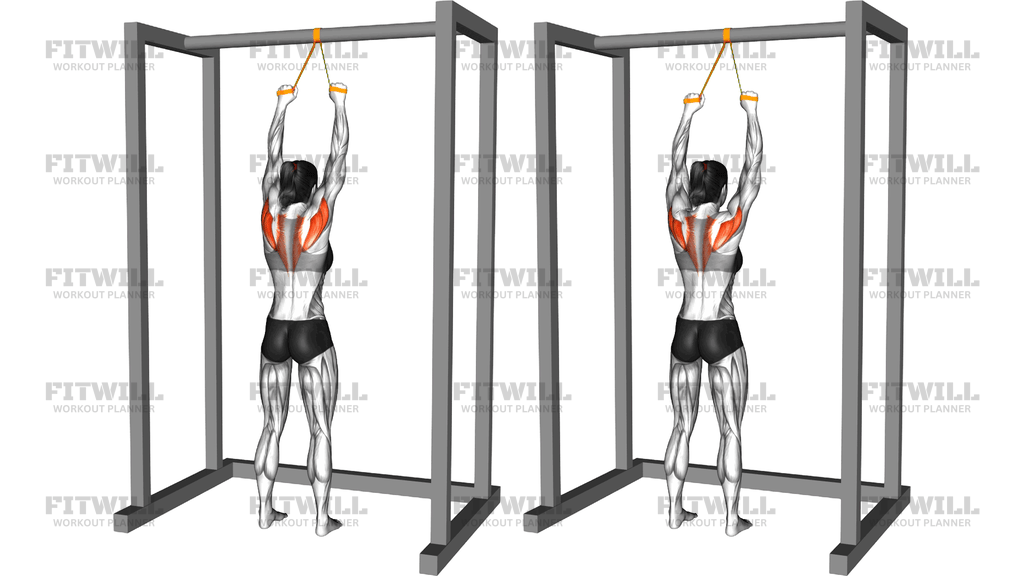
The Resistance Band Overhead Hit is a single-arm band exercise that trains the overhead reaching and striking pattern you use in throwing, serving, and hitting sports. A band is anchored to a high point on a rack or similar sturdy overhead support, and you drive one arm from a lowered position up to a full overhead reach against the band's tension. The result is a movement that loads the shoulder, lat, and triceps through exactly the arc they cover during an overhead swing or smash.
This is a useful exercise for volleyball, badminton, tennis, and handball players, as well as anyone who wants to build overhead arm speed and reach with light, joint-friendly resistance. Because the band's resistance increases as the arm extends upward, the hardest part lands at the very top of the reach, which is where the shoulder stabilizers and upper back have to finish the job. That resistance profile is difficult to replicate with free weights and makes the band version a natural fit for sport-specific overhead work.
Setup matters more here than with most band drills. The anchor needs to be genuinely high and directly above or slightly in front of your working arm's line, so the band pulls along the path of your reach rather than dragging you sideways or backward. Your stance should be about hip-width with a soft knee bend, and your trunk stays tall and braced so the arm does the hitting, not a lean or a torso twist. A slack or badly angled anchor turns the exercise into something else entirely, so take a moment to test the band angle before your first hard rep.
To execute it well, start with the working hand holding the band at roughly head height or slightly lower, elbow bent and shoulder cocked. From there, punch the hand up and slightly forward along a diagonal line until the elbow is fully locked out overhead and the band is taut at the top. Keep the movement in one clean plane, exhale as you drive up, and lower the hand back down under control instead of letting the band snap your arm down. The non-working arm stays relaxed at your side, and your hips stay square throughout.
In practice, this exercise slots in well as a warm-up activation before pressing or pulling days, as a higher-rep power-endurance finisher, or as part of a return-to-overhead-throwing progression when loads need to stay modest. Because it trains one side at a time, it also exposes and helps correct left-to-right differences in overhead strength and control, which matters for anyone who swings or serves with a dominant arm.
A few practical points keep it safe and effective. Use a band you can control through the whole reach without shrugging or arching backward, keep the neck relaxed rather than craning toward the working hand, and stop short of any pinching sensation at the top of the shoulder. The movement should feel like an athletic hit, sharp on the way up and smooth on the way back down, never like a strain against a band that is too heavy.
[ Workout Log & Planner ]
Put your next workout in Fitwill
Keep your plan and training log ready when you are.


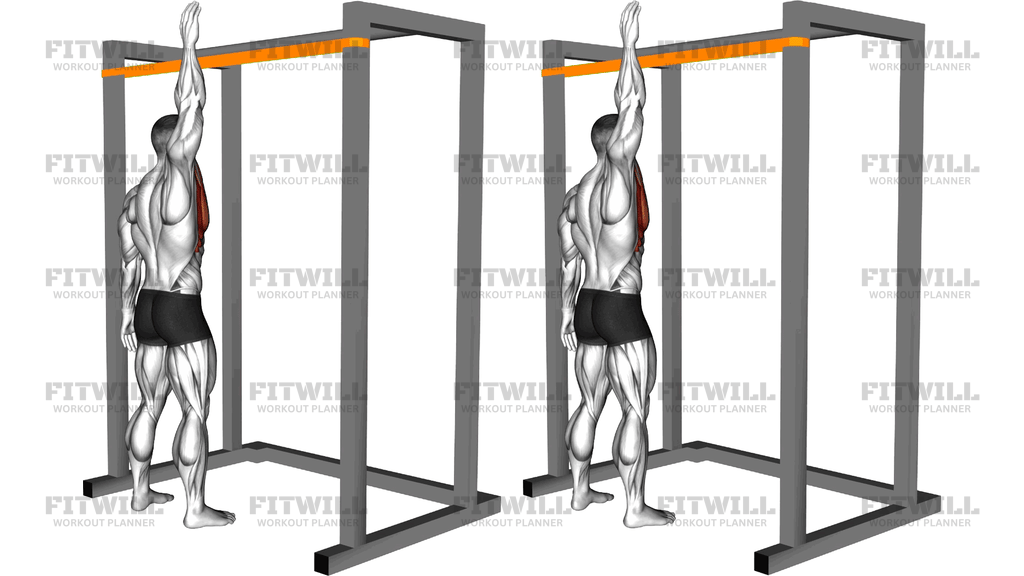
Instructions
- Anchor a resistance band to a secure high point on a power rack or overhead beam so the band hangs at or slightly above your full standing reach.
- Grip the free end of the band with one hand using a firm overhand grip, and step back until there is clear tension with your hand at head height and your elbow bent.
- Set your feet hip-width apart with a slight knee bend, square your hips toward the anchor line, and brace your trunk so your ribs stay stacked over your pelvis.
- Start with the working elbow bent and the hand just above shoulder height, shoulder blade settled down rather than shrugged toward your ear.
- Exhale and drive the hand up and slightly forward along a diagonal line, extending the elbow fully until the arm is locked out overhead and the band is taut at the top.
- At the top position, reach actively through the hand so the shoulder and upper back finish the movement instead of stopping at a loose elbow.
- Inhale and lower the hand back to the starting height under control, resisting the band's pull rather than letting it snap your arm down.
- Complete all reps on one arm, then reset your stance and switch hands so both sides get the same quality of work.
- Between sets, step out of the band tension from the low position first and check the anchor point before your next set.
Tips & Tricks
- If the band drags your arm backward at the top, shift your stance slightly toward the anchor's line so the pull travels through the shoulder instead of behind it.
- Watch for the working shoulder creeping up toward the ear as fatigue sets in; pull the shoulder blade down before each rep and keep the neck long.
- A common mistake is arching the lower back to gain extra reach at the top. Keep the trunk braced and let the shoulder do the reaching.
- If the elbow never fully extends, the band is too heavy or the anchor is too low. Drop to a lighter band or raise the anchor before adding reps.
- Aim for a crisp, accelerating drive upward and a slower two-count descent; this mirrors the timing of a real overhead hit and keeps the band from jerking the arm down.
- Do not let the torso rotate toward the working side as you press up. Keep both hips square so the work stays in the shoulder and lat.
- Start with the hand around head height on the first set. Starting lower with a heavy band loads the shoulder at its most vulnerable cocked angle.
- Alternate which arm goes first each session so the non-dominant side always works fresh instead of always chasing the dominant one.
- Check the band and anchor point for wear before every session; an overhead anchor failure during a hard drive is the main real risk of this drill.
Frequently Asked Questions
Which muscles does the Resistance Band Overhead Hit work?
The main drivers are the lats and shoulders working through the overhead reach, with the triceps locking out the elbow and the upper back and core stabilizing the trunk and shoulder blade.
How high should I anchor the band for the Resistance Band Overhead Hit?
Anchor it at or slightly above your full standing reach so the band pulls roughly along the line of your arm at the top. If the anchor is too low, the resistance angle changes and the shoulder gets pulled backward instead of loaded through the reach.
Is the Resistance Band Overhead Hit suitable for beginners?
Yes, provided you start with a light band and keep the hand at head height or above to start each rep. Beginners should prioritize a full, smooth lockout over speed until the movement pattern feels automatic.
Why does the band feel hardest at the top of the Resistance Band Overhead Hit?
Elastic resistance increases as the band stretches, so tension peaks when your arm is fully extended overhead. That is exactly where the shoulder stabilizers and upper back need to finish, which is one of the main reasons to train this pattern with a band.
How is the Resistance Band Overhead Hit different from a band overhead press?
An overhead press drives straight up from shoulder height with a neutral pressing path, while the Overhead Hit follows a diagonal hitting arc from a cocked elbow to a full reach, which matches the swing pattern of racket and ball sports more closely.
What is the most common mistake in the Resistance Band Overhead Hit?
Shrugging the working shoulder toward the ear and arching the lower back to chase extra height at the top. Both steal work from the shoulder and lat; fix them by settling the shoulder blade down before each rep and keeping the trunk braced.
How many reps and sets should I do for the Resistance Band Overhead Hit?
For warm-up activation, 2 sets of 10 to 15 controlled reps per arm with a light band works well. As a strength-endurance finisher, go 3 sets of 12 to 20 reps per arm, stopping before your lockout breaks down.
Can I do the Resistance Band Overhead Hit without a rack?
Yes, as long as you have a genuinely secure high anchor such as a sturdy overhead beam, pull-up bar, or door-mounted anchor rated for band tension. Never use a hook or fixture that could release while the band is loaded overhead.
What can I use instead of the Resistance Band Overhead Hit?
A single-arm cable pulldown from a high attachment covers a similar overhead pulling arc, and medicine ball overhead slams train the hitting pattern with more speed. Neither matches the band's rising tension at full reach, but both are solid substitutes.
Is it safe to do the Resistance Band Overhead Hit with a shoulder injury history?
If you have a current or past shoulder issue, start with a very light band, keep the starting hand height higher, and stay short of any pinching at the top of the reach. Clear the movement with a qualified professional before adding speed or load.