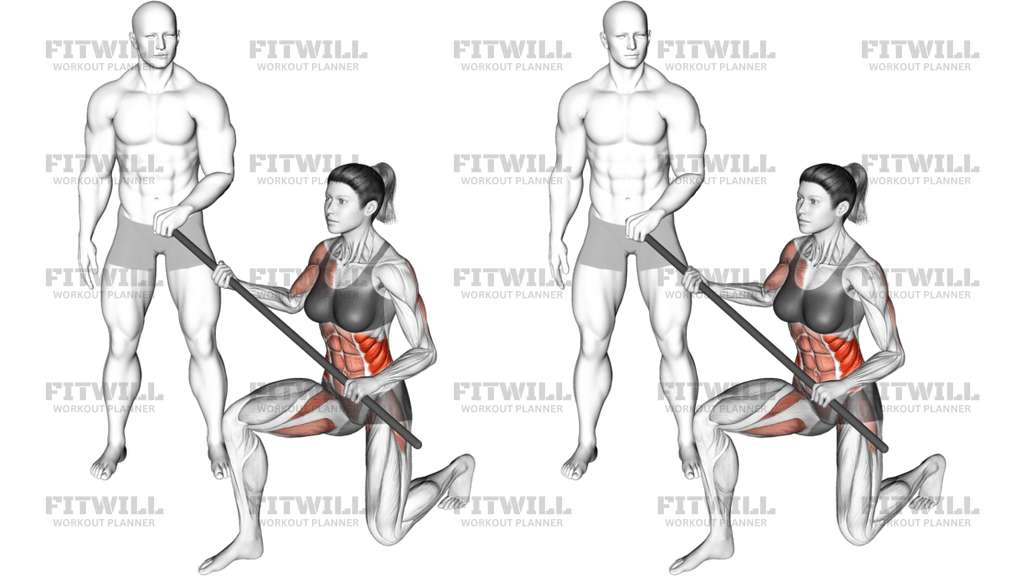
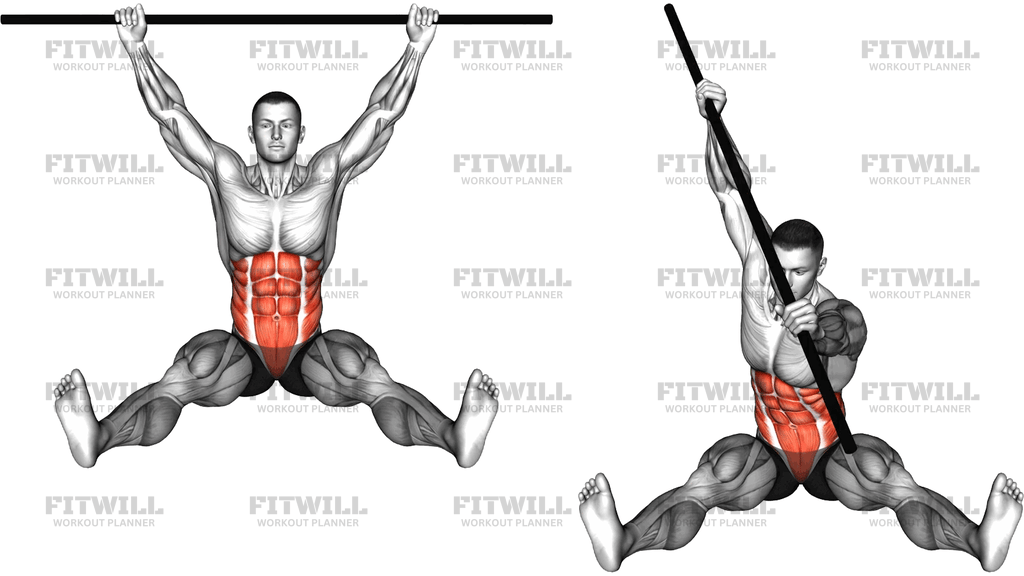
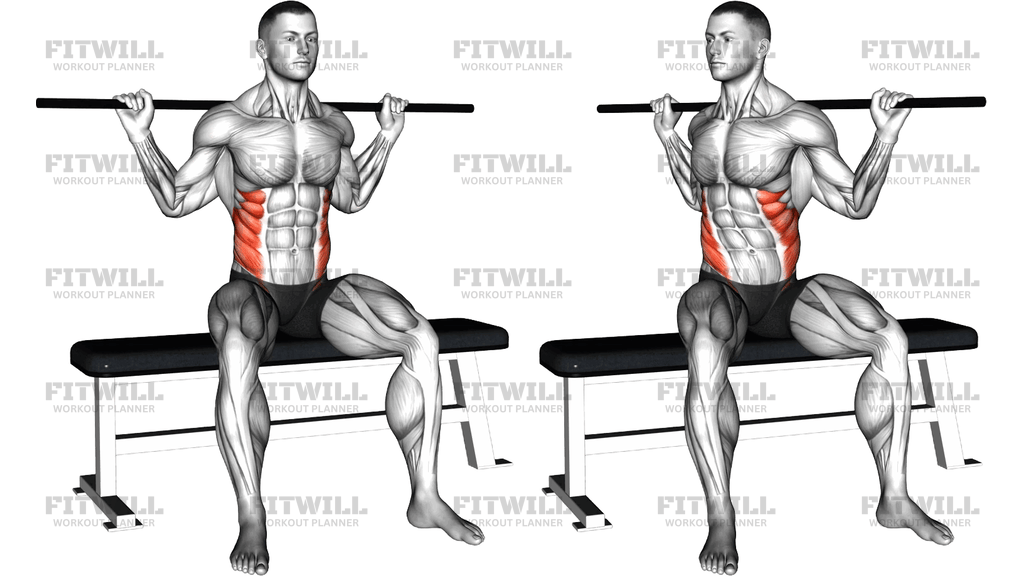
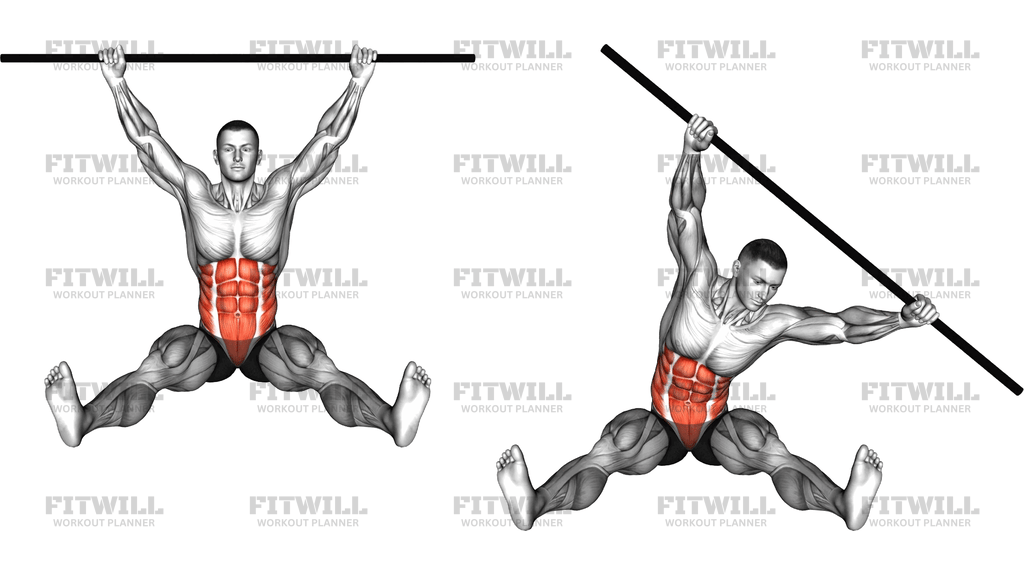
Stick Side To Front Bend Stretch
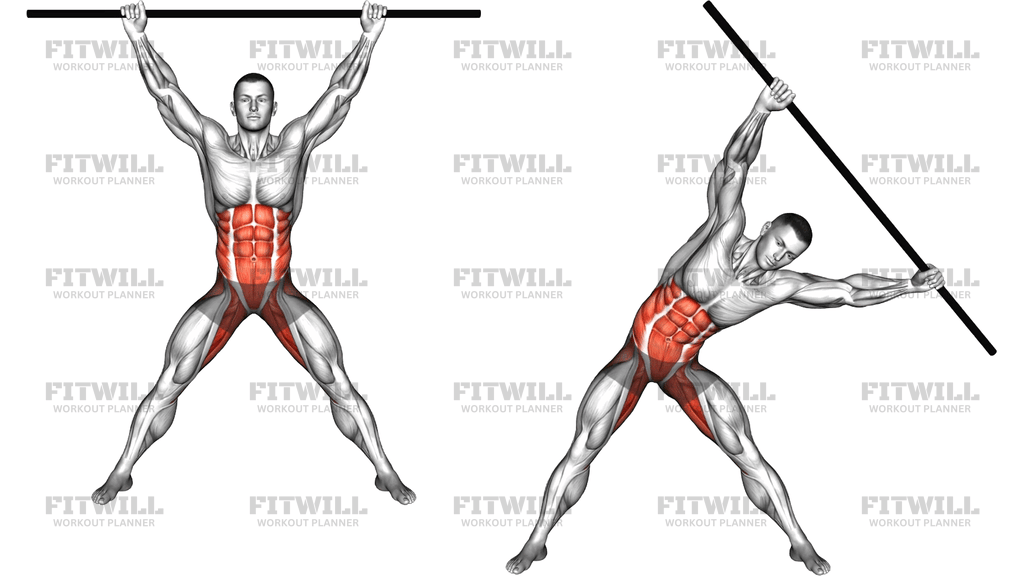
The Stick Side To Front Bend Stretch is a dynamic mobility drill performed with a light stick or dowel held overhead in a wide grip and a wide stance. From that tall starting position, you bend sideways to one side so the stick tilts into a diagonal line, then flow into a forward bend as you bring the stick back level in front of you. Because the stick keeps both arms connected, every angle your torso travels through stays visible and easy to correct.
This movement targets the entire anterior core, with strong lengthening of the rectus abdominis and obliques, while the wide-legged stance adds a stretch through the inner thighs and hip adductors. Holding the stick overhead also places the shoulders, lats, and upper back on gentle stretch, which makes it a genuine full-upper-body mobility drill rather than just an abs stretch.
The wide overhead grip is not cosmetic. It sets the width of your arc, keeps your ribs from collapsing, and gives you feedback: if one hand drifts or the stick tips early, you know your torso is rotating instead of bending in a clean plane. The wide stance similarly anchors the hips so the bend comes from your waist and spine rather than from your pelvis swinging sideways.
This drill suits anyone who needs the trunk and hips to move freely before training: lifters warming up for squats or overhead pressing, martial artists and racquet players who bend and rotate constantly, and desk workers whose midsection and shoulders feel locked in a forward slump. It is especially useful as a transition between a static warm-up and more loaded exercise.
To execute it well, move slowly and treat it as a stretch, not a ballistic swing. Bend only as far as you can keep both arms long and the stick in one continuous line, and let your breath lead each change of direction. Never force depth; the stick amplifies your range, and pushing into a sharp pull along the waist or inner thigh is counterproductive.
Keep the load trivial. A broomstick, PVC pipe, or even a resistance band held taut works. If your shoulders cannot reach overhead comfortably, widen your grip further or lower the stick slightly until your mobility improves.
[ Workout Log & Planner ]
Put your next workout in Fitwill
Keep your plan and training log ready when you are.


Instructions
- Stand with your feet roughly two shoulder-widths apart, toes turned out slightly, and hold a light stick with an overhand grip several inches wider than your shoulders.
- Press the stick straight overhead until your arms are fully extended and the stick sits level above your head; keep your ribs stacked over your pelvis and your weight spread across both feet.
- Brace your midsection lightly and take a breath in through your nose before you start moving.
- Exhale as you bend sideways to the left, letting the left end of the stick drop while the right end rises, so the stick forms one long diagonal line from your right hand down to your left.
- Reach actively with both hands through the top of the side bend and hold for a slow breath, feeling the stretch along the opposite waist and into the inner thigh of the straightened leg.
- Begin returning upright by pulling the lowered hand back up, and as the stick comes level overhead, continue the arc forward into a front bend, hinging at the hips and letting the stick travel down in front of your chest.
- In the front bend, keep both knees soft and your back long, holding the stick in a level position for a breath before reversing the arc back overhead.
- Inhale as you rise, exhale as you fold or bend, and let each exhale carry you slightly deeper without jerking.
- Complete the side-to-front arc to one side for the desired repetitions, then repeat on the other side.
- Finish by standing tall with the stick level overhead, then lower it to your chest or the floor with control.
Tips & Tricks
- If the stick tips forward or back during the side bend, your torso is rotating to steal range; face a mirror and check that the stick stays in one flat plane with your body.
- Do not let the knee of your straightened leg collapse inward during the side bend. Push that foot firmly into the floor so the stretch lands in the adductors instead of stressing the knee.
- Keep both elbows fully locked through the whole arc. Soft elbows shrink the leverage that makes the overhead position effective and let the shoulders shrug up.
- If your shoulders can't get the stick directly overhead, widen your grip an inch at a time rather than arching your lower back to fake the range.
- Treat the front bend as a hinge, not a slump. Reach the chest forward toward the stick instead of rounding down to touch your toes.
- The commonest mistake is rushing and bouncing between bends. The stick magnifies any momentum, so cap the tempo at roughly three seconds per direction.
- If you feel a pinch in the shoulder at the top, lower the stick slightly behind your head so it rests near the traps, or switch to a band held taut between the hands.
- Bend only until you feel a comfortable stretch along the opposite waist. Side bending with a long lever in your hands goes further than you expect, and pushing for depth usually just shifts the bend into the lower back.
- Keep the toes slightly turned out and both heels down throughout. Rocking onto the outside edge of the bending side's foot shortens the inner-thigh stretch you are trying to create.
Frequently Asked Questions
What muscles does the Stick Side To Front Bend Stretch work on?
It primarily lengthens the abs, especially the rectus abdominis and obliques along the side you are bending away from. The wide stance adds a stretch for the inner thighs and hip adductors, while the overhead hold places the shoulders, lats, and upper back on gentle stretch.
Is the Stick Side To Front Bend Stretch suitable for beginners?
Yes, provided you use a very light stick and keep the range modest. Beginners often get more from it than loaded drills because the stick gives instant feedback about whether the torso is bending cleanly or compensating with rotation.
How wide should my grip and stance be in the Stick Side To Front Bend Stretch?
Grip the stick several inches wider than your shoulders so the overhead position is comfortable, and stand roughly two shoulder-widths apart. Widen either one if your shoulders or inner thighs feel pinched rather than stretched.
Why does the stick have to stay in one plane during the side bend?
If the stick tips forward or back, your torso is rotating to manufacture extra range, which dilutes the lateral stretch. Keeping it in one flat plane ensures the bend comes from the waist and spine as intended.
Can I use a resistance band instead of a stick?
Yes. Hold a light band taut between both hands at the same width. The band is actually more forgiving for stiff shoulders because it allows a small amount of give at the top of the arc.
Should I feel the Stick Side To Front Bend Stretch in my legs?
A stretch through the inner thigh of the straightened leg is normal and desirable. If you feel sharp pulling at the knee joint instead, shorten your stance slightly and keep both knees soft.
Is this a stretch or a strength exercise?
It is a stretch and mobility drill. Your core works lightly to control the movement, but the goal is lengthening through the abs, obliques, inner thighs, and shoulders, not building force.
When is the best time to do the Stick Side To Front Bend Stretch?
It works well as part of a dynamic warm-up before squats, overhead presses, or any sport that involves bending and rotating. You can also use it mid-day to open up a stiff midsection and shoulders after long sitting.
How many repetitions should I perform per side?
Three to five slow arcs per side is enough for most people. Focus on smooth breathing and a clean stick path rather than adding reps.
What should I do if my lower back aches during the front bend portion?
Reduce how far you fold and hinge more from the hips with a longer, prouder chest. If discomfort persists, skip the front bend and use only the side-bend portion until you have checked the movement with a coach or professional.