Weighted Plate Standing Biceps Curl
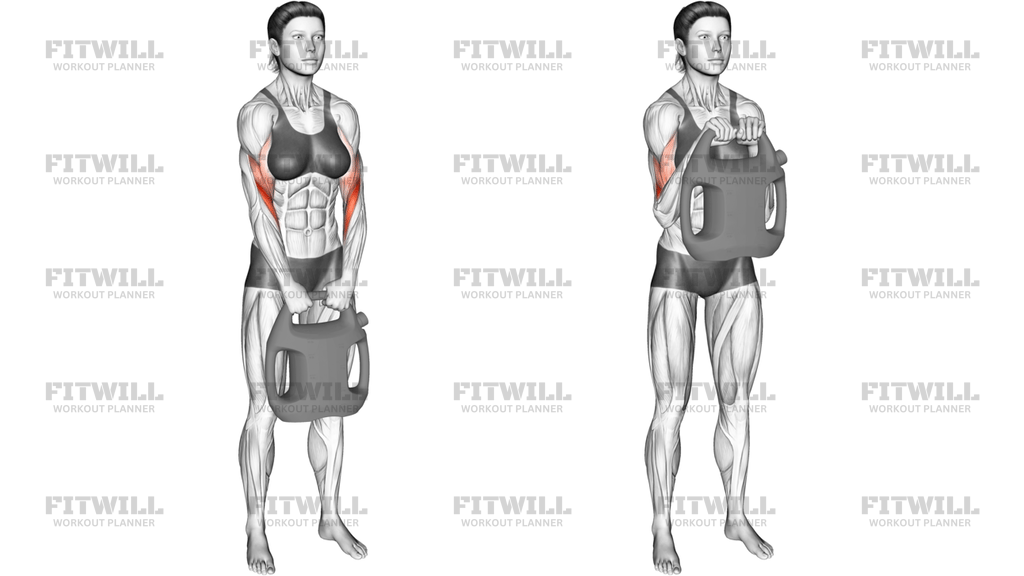
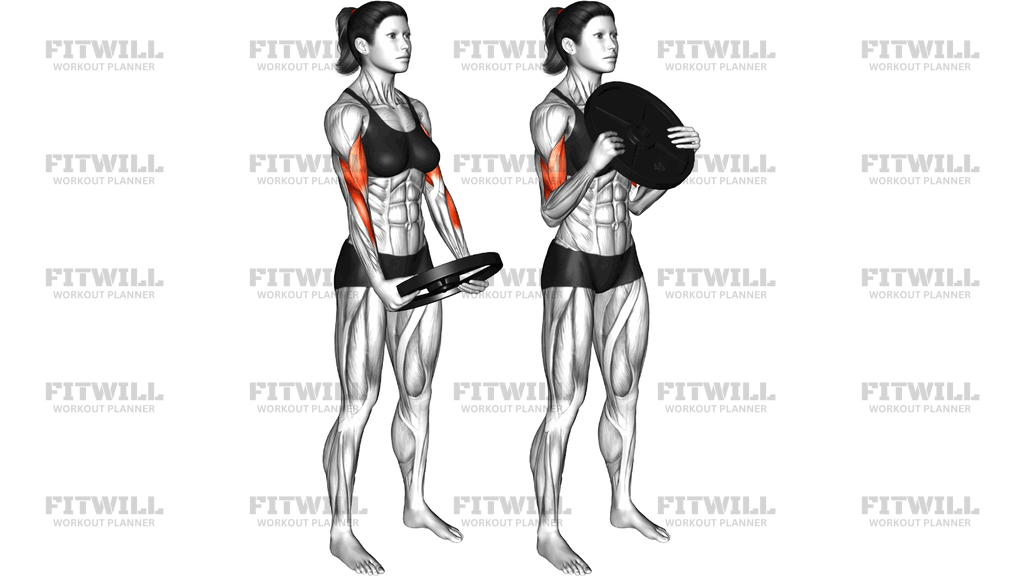
The Weighted Plate Standing Biceps Curl swaps the usual dumbbell or barbell for a single weight plate held with both hands, as if you were gripping a steering wheel. You stand tall, pinch the outer edges of the plate with your fingers, and curl it from thigh height up toward your chest before lowering it back down under control. It is a simple setup, but the wide, flat plate changes the feel of a curl in ways a dumbbell never quite does.
The main muscles at work are the biceps on the front of the upper arm, supported by the brachialis underneath and the brachioradialis in the forearm. Because both hands share one implement, your arms have to cooperate rather than work independently, and any strength difference between your left and right side shows up immediately as the plate tilts. Your forearms and grip also do real work here, since holding the plate pinched between your fingers keeps the flexors and hand muscles under constant tension from the first rep to the last.
The setup matters more than it looks. Holding a flat plate forces your hands slightly wider than shoulder width and turns your palms inward toward each other, which shifts some emphasis toward the brachioradialis and gives the movement a neutral-grip character. The plate also wants to tilt forward or backward if your wrists collapse, so keeping it upright through the whole arc is part of the training effect, not a nuisance.
To execute it well, keep your elbows pinned to your ribs and think about the plate traveling in a smooth vertical line close to your body. Curl until the plate reaches roughly chin or upper chest height, squeeze the biceps briefly at the top, then resist the weight on the way down instead of dropping it. Two or three seconds on the lowering phase does far more for arm development than bouncing through fast, sloppy reps.
This exercise suits lifters who want variety in their arm training, home gym owners with plates but few implements, and anyone whose grip gives out before their biceps on barbell curls and who wants a way to strengthen that weak link. It also works well as a finisher at the end of a pull or arm session, when your biceps are pre-fatigued and a modest plate weight is all you need. Because the movement is self-limiting and easy to set up, it is a friendly option for beginners learning what a strict curl is supposed to feel like.
A few practical points keep it safe and productive: use a plate you can hold securely without your fingers slipping, keep your torso upright rather than leaning back to heave the weight up, and stop the set when your grip starts to fail rather than risk dropping the plate on your foot. If balance is an issue, a staggered stance or a light support nearby helps without changing the movement itself.
[ Workout Log & Planner ]
Put your next workout in Fitwill
Keep your plan and training log ready when you are.


Instructions
- Stand with your feet about hip-width apart, knees soft, and your torso upright with your eyes forward.
- Hold one weight plate vertically in front of your thighs with both hands, pinching the outer edges of the plate between your thumbs and fingers, as if gripping a steering wheel at the three and nine o'clock positions.
- Let your arms hang fully extended with the plate resting lightly against the front of your thighs, and brace your core to keep your ribs stacked over your hips.
- Pin your elbows to the sides of your ribs and keep them there for the entire set.
- Curl the plate upward by bending your elbows, keeping your wrists straight so the plate stays vertical and travels close to your body.
- Continue curling until the plate reaches about chin or upper chest height, then squeeze your biceps hard for a beat at the top.
- Lower the plate slowly back to your thighs, taking two to three seconds and resisting the weight all the way down until your arms are fully extended again.
- Exhale as you curl the plate up and inhale as you lower it back down.
- Complete all reps with the same tempo, resetting your grip on the plate and your stance if either drifts during the set.
- Set the plate down safely on the floor or rack once finished rather than dropping it.
Tips & Tricks
- If the plate tilts forward at the top of each rep, your wrists are bending back to compensate for weak forearm strength — dial the weight down and consciously press your knuckles forward to keep the plate vertical.
- Leaning your torso back as the plate rises is the most common way to cheat this movement; brace your abs and imagine your shoulder blades pressed against a wall behind you.
- Because the plate sits between your fingers rather than in your palm, your grip will usually fail before your biceps do — chalk or a slightly smaller plate keeps the set honest.
- Keep the plate within a few centimeters of your body throughout the arc; letting it drift away from your torso turns the curl into a front raise and shifts tension off the biceps.
- If your elbows flare out to the sides, the weight is likely too heavy — lighter plates allow you to keep the elbows glued to the ribs where the biceps do the work.
- Pausing for one full second at the top, with the plate at chest height, builds the peak contraction that fast reps skip entirely.
- Superset this with a reverse-grip plate hold or wrist curls if your forearms fatigue first and cut your biceps sets short.
- Use a bumper plate or a plate with a coated edge rather than a raw steel edge if your fingers struggle to hold on during higher-rep sets.
- A staggered stance with one foot slightly ahead can help you stay balanced and resist the urge to swing on heavier reps.
Frequently Asked Questions
Which muscles does the Weighted Plate Standing Biceps Curl work?
The biceps brachii on the front of the upper arm is the primary mover, with strong support from the brachialis and the brachioradialis of the forearm. Your grip and forearm flexors also stay under constant tension from holding the plate pinched between your fingers.
Why hold the plate like a steering wheel instead of gripping it through the center hole?
Gripping the outer edges places your hands wide and your palms facing each other, which creates a neutral-grip curl that emphasizes the brachioradialis and forearm along with the biceps. Holding the plate only through the center hole would not let you control it safely through the arc.
Is the Weighted Plate Standing Biceps Curl good for beginners?
Yes. The setup is simple, a light plate is easy to handle, and the shared load between both hands makes it forgiving while you learn what a strict curl feels like. Beginners should start with a small plate and focus on keeping the elbows pinned and the torso still.
How is this different from a dumbbell curl?
A dumbbell curl lets each arm work independently and allows supination, while the plate forces both hands to share one implement in a fixed neutral position. That makes the plate version harder to cheat on one side and adds a standing grip demand the dumbbell does not have.
What size plate should I start with?
Start with a 5 or 10 kg plate, or whatever weight you can hold securely for 10 to 12 reps without your fingers slipping. If your grip gives out before your biceps feel worked, go lighter and build forearm strength first.
How high should I curl the plate?
Curl until the plate reaches roughly chin or upper chest height with your elbows still tucked at your sides. Curling higher than this usually means the elbows drift forward and the front shoulders take over the movement.
My plate keeps tilting forward during the curl. What am I doing wrong?
The tilt usually comes from your wrists collapsing backward as the biceps fatigue. Keep your wrists rigid and your knuckles pressing slightly forward, and if the tilt persists, reduce the weight until you can hold the plate vertical for the whole set.
Can I substitute another exercise if I do not have weight plates?
A similar neutral-grip feel can be approximated with a dumbbell hammer curl held with both hands on one dumbbell, or a cable rope hammer curl. Neither replicates the plate grip exactly, but both train the same muscles through a comparable arc.
Where should this exercise fit into my workout?
It works best as an arm-focused movement in a pull day, or as a finisher after barbell or dumbbell curls when your biceps are pre-fatigued. Doing it early in a session is fine too, as long as grip fatigue does not compromise the pulling work that follows.
Is it safe to do the Weighted Plate Standing Biceps Curl if my grip is weak?
Yes, as long as you use a plate you can hold confidently and set it down rather than dropping it between sets. Standing over a rubber gym floor and keeping the plate close to your body also limits any risk if your grip does fail mid-set.