Resistance Band Lateral Hit
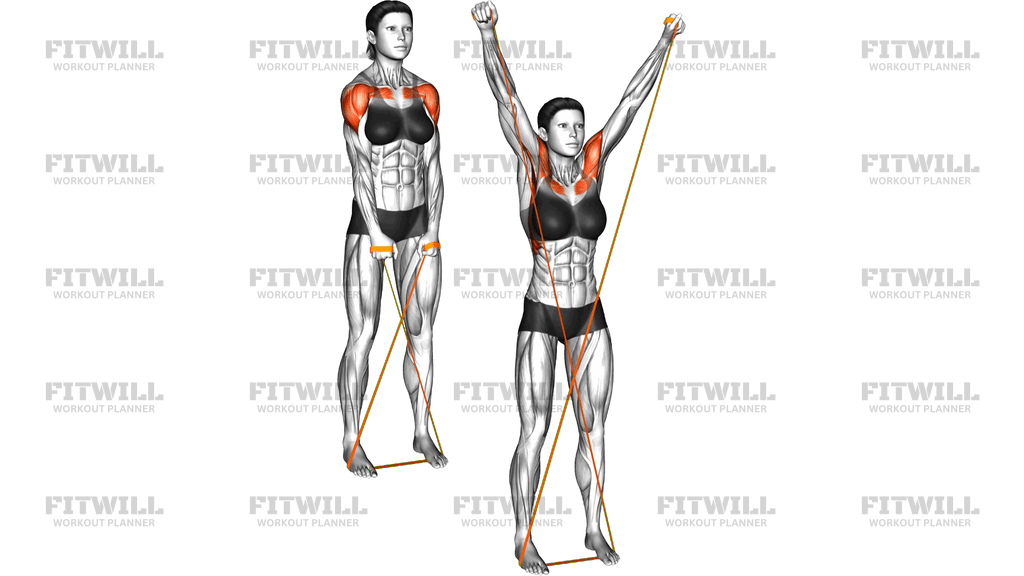
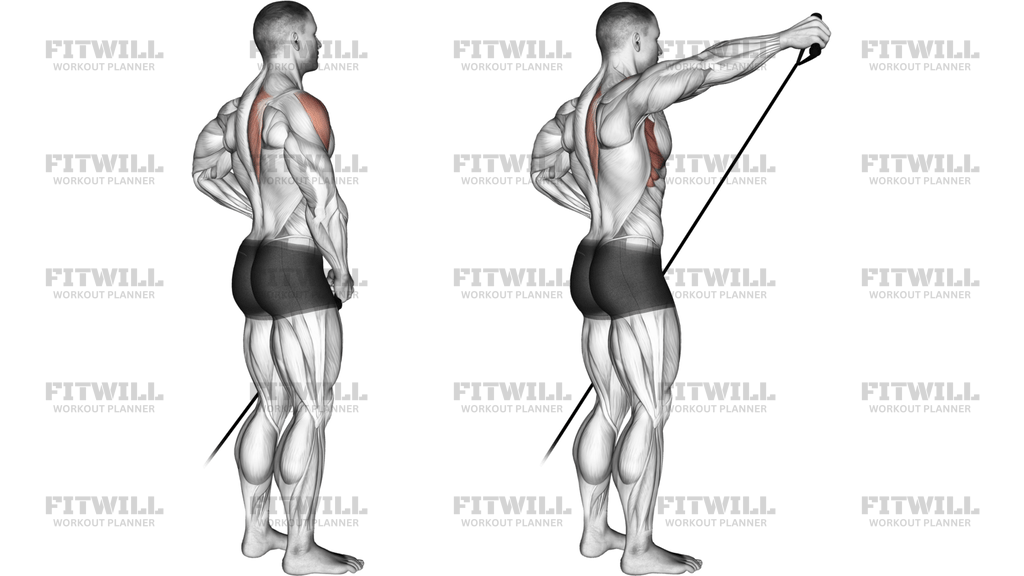
The Resistance Band Lateral Hit is a single-arm shoulder movement performed with a long resistance band anchored overhead, usually draped over the pull-up bar of a power rack so it hangs in a straight vertical line. You stand side-on to the band, grip it with one hand, and sweep your straight arm out to the side and up overhead in one wide, controlled arc. The band's line pulls your arm back toward vertical, so your side shoulder has to work through the entire lift to keep the arm traveling away from it.
This movement is a useful alternative to a standard dumbbell lateral raise because the resistance direction stays constant while your arm moves through a much longer range, finishing overhead instead of stopping at shoulder height. That long arc challenges the lateral deltoid at angles most side-raise variations never reach, and the overhead finish also asks the upper traps and front shoulder to assist near the top. Because you are standing and working one side at a time, your core works to stop your torso from leaning or rotating as the band pulls.
It suits lifters who want more shoulder work without heavy equipment, people rehabbing or prehabbing their shoulders with lighter, joint-friendly tension, and anyone training in a rack who wants to add a deltoid finisher without grabbing dumbbells. It is also a good teaching tool: the fixed vertical band line gives you instant feedback, because if your arm drifts forward or your torso tips sideways, the movement immediately feels wrong.
Setup matters more here than in most band exercises. The band needs to hang plumb and be secured so it cannot slide off the bar mid-set, and your distance from the anchor point determines how much tension you get at the bottom of the arc. Stand far enough away that the band already has light tension with your hand at hip height, but not so much that you cannot reach the overhead position.
To execute it well, keep the moving arm nearly straight with a soft elbow, lead with the pinky slightly, and think of drawing the longest possible arc from your hip to above your head. Stay tall, keep your ribs down, and let the shoulder do the work rather than shrugging or flinging the torso. A slow, deliberate return is where a lot of the benefit lives, since the band will happily yank your arm back down if you let it.
A few practical points: use a band you can control for 10 to 15 clean reps per side, keep your grip firm but not crushing, and stop the set as soon as your form leans on momentum. If your shoulder pinches at the very top, shorten the arc slightly rather than forcing the overhead position, and check that your palm stays facing forward or neutral instead of twisting inward.
The Resistance Band Lateral Hit fills a specific niche: it is a standing, overhead-reaching side deltoid exercise that needs nothing but a band and something sturdy to loop it over, and it pairs naturally with presses or pull-ups as a shoulder isolation slot in your session.
[ Workout Log & Planner ]
Put your next workout in Fitwill
Keep your plan and training log ready when you are.


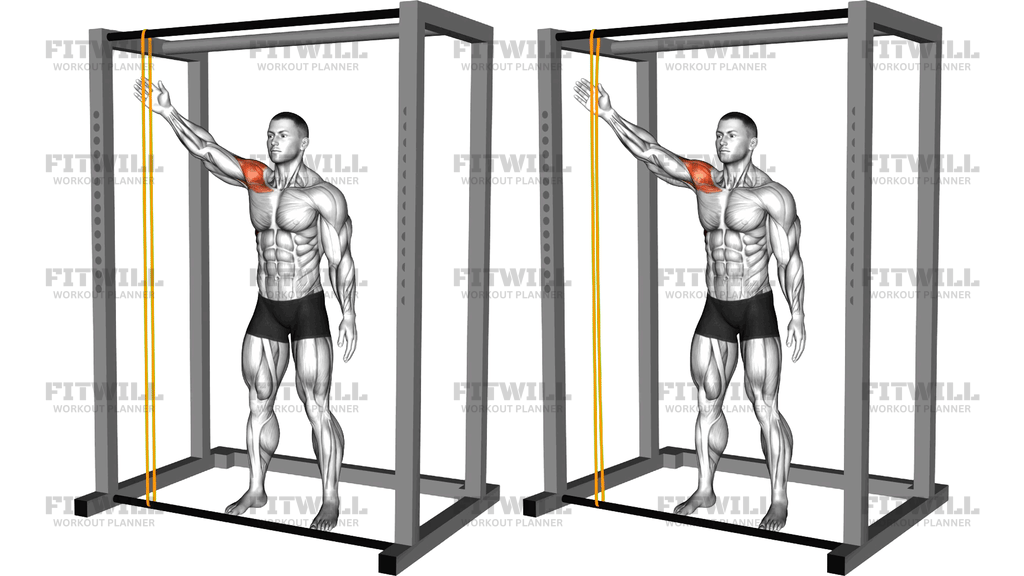
Instructions
- Loop a long resistance band over the pull-up bar of a power rack so it hangs straight down, and secure the bottom end to the base of the rack so the band forms a taut vertical line that cannot swing or slip.
- Stand side-on to the band with your working arm closest to it, feet about hip-width apart, positioned far enough away that the band already has light tension when your hand hangs at hip height.
- Grip the band firmly with your working hand, palm facing forward, and let the band run alongside the outside of your arm so its pull is directed slightly toward the anchor.
- Stand tall, brace your trunk, and pull your ribs down so your torso will not sway when the band loads.
- Keeping the elbow almost straight with a soft bend, raise your arm out to the side and up overhead in one wide arc, moving your hand away from the band's vertical line so the band resists the lift.
- Finish with the arm fully extended overhead and slightly out to the side, feeling the shoulder work hardest as you fight the band's pull near the top.
- Pause briefly at the top without shrugging, then lower your arm back down along the same arc, resisting the band's tension on the way down rather than letting it snap you back.
- Exhale as you raise the arm, inhale as you control it back to your hip.
- Complete all reps on one side, then reset your stance and switch hands so the opposite side faces the band.
- Re-check the band's anchor points before each set to make sure it has not shifted on the bar.
Tips & Tricks
- If your torso leans away from the band as you lift, you are standing too close to the anchor and the starting tension is too high; step in slightly until you can raise the arm without tipping.
- Do not let the elbow bend more than a few degrees. A bent elbow shortens the lever and turns the long arc into a partial arm curl-and-press hybrid instead of a shoulder movement.
- Watch for the hand drifting forward of your body. The band should be resisting a lift directly out to your side, so keep your arm in the plane of your torso for most of the arc.
- A shrug at the top means the upper trap is taking over a lift the shoulder should own. Lower the band tension and focus on keeping the space between your ear and shoulder long.
- The most common failure point is the descent: the band snaps the arm back down in the final third. If you cannot lower over two to three seconds, switch to a lighter band.
- If the band slides along the pull-up bar as you pull, loop it around the bar twice or anchor the top end more securely before continuing.
- Use a band with a smooth, continuous loop rather than one with handles if the grip end chafes your palm during the long arc.
- Avoid twisting your palm inward as you go overhead; a neutral or forward-facing palm keeps the shoulder in a friendlier position at the top range.
- Keep your working-side foot planted. Stepping toward the band mid-set changes the tension and makes your reps inconsistent.
Frequently Asked Questions
Which muscles does the Resistance Band Lateral Hit work?
The side shoulder, particularly the lateral deltoid, does most of the work through the long arc. The front shoulder and upper traps assist near the overhead position, and your core stabilizes your torso against the band's pull.
How is the Resistance Band Lateral Hit different from a dumbbell lateral raise?
A dumbbell raise fights gravity and usually stops at shoulder height, while the band's resistance stays constant and the arc continues all the way overhead. That means the deltoid works through a longer range and at angles the dumbbell version never loads.
How do I anchor the band for the Resistance Band Lateral Hit?
Drape a long band over the pull-up bar of a rack so it hangs vertically, and secure the lower end to the base of the rack so it cannot swing. Stand side-on to the hanging band with the working arm nearest to it.
Why does my arm get pulled back toward the band during the lift?
That is the point of the setup. The band's vertical line pulls your arm back toward it, and your lateral deltoid must generate force away from that line to complete the arc, which is what makes the movement effective.
Is the Resistance Band Lateral Hit suitable for beginners?
Yes, as long as you start with a light band and a shorter arc. Beginners should master keeping the torso still and the elbow nearly straight before pushing all the way overhead.
My shoulder pinches when my arm goes overhead. What should I change?
Shorten the range so the lift stops just above shoulder height, keep your palm facing forward or neutral, and reduce the band tension. If discomfort persists, stop the movement and have it assessed by a qualified professional.
How far should I stand from the band anchor?
Stand at a distance where the band already has light tension with your hand at hip height, but you can still raise your arm fully overhead. Too close gives you no resistance at the start; too far makes the bottom of the arc a struggle.
What can I use instead of a power rack for the Resistance Band Lateral Hit?
Any sturdy overhead anchor works, such as a pull-up bar or a firmly mounted beam, provided the band can hang vertically and cannot slide off. Avoid door frames or hooks that are not rated to hold tension overhead.
Should I do the Resistance Band Lateral Hit for high reps or low reps?
It works best in the moderate-to-high rep range, roughly 10 to 20 controlled reps per side, because band tension and a long arc favor quality repetitions over maximal load. Slow lowering matters more than adding resistance.