Resistance Band Assisted Single Arm Pull Up
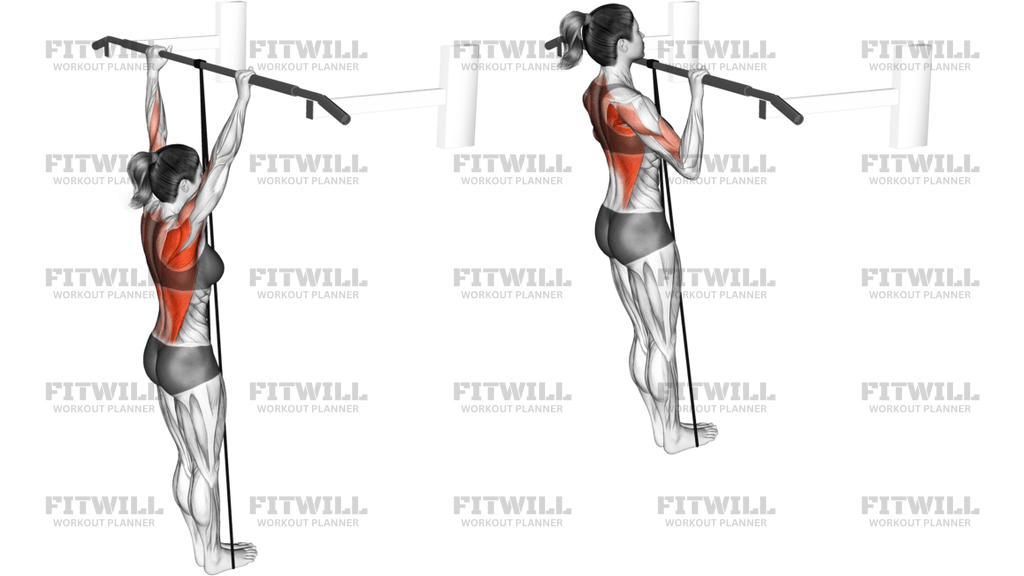
The Resistance Band Assisted Single Arm Pull Up is a one-arm pulling exercise performed on a pull-up bar, with a resistance band looped over the bar and hooked around the working hand to offset part of your body weight. From a dead hang, you pull yourself up until your chin clears the bar, then lower back down with control. It bridges the gap between two-arm pull ups and the full one-arm pull up, one of the most demanding bodyweight skills there is.
This movement is ideal for lifters who can already perform several strict two-arm pull ups and want to start building genuine single-arm strength. Because the band provides assistance only where you loop it and only as much as its tension allows, you can progress by gradually moving to lighter bands over weeks and months. It is far more specific to the one-arm pull up than machine-assisted variations, since the band still lets your body rotate and swing slightly, forcing you to control anti-rotation just like in the unassisted version.
The primary muscles worked are the lats of the working arm, supported heavily by the biceps, forearm flexors, and grip. Your upper back, including the rhomboids and mid traps, drives the scapula down and in as you pull, while the core and obliques on the non-working side work hard to stop your torso from twisting away from the bar. Because one arm is doing all the work, grip fatigue usually arrives before back fatigue, which makes this exercise a useful grip builder in its own right.
Setup matters more here than in almost any other pull-up variation. The band must be securely looped over the bar with the working hand threaded through it from below, so that tension increases as you descend and supports you at the bottom where single-arm pulling is hardest. Your free hand should stay clear of the bar, usually held against your chest or thigh, and your legs can be crossed or held together behind you to keep the body compact and reduce swinging.
To execute it well, start each rep from a full hang with the shoulder of the working arm engaged, not slack. Pull your elbow down toward your ribs while keeping your torso square to the bar, drive until your chin clears, then resist the way down for two to three seconds rather than dropping. Expect the band to pull you slightly toward the side it is anchored on; fighting that lateral drift is part of the training effect.
Common use cases include one-arm pull up progressions, fixing left-right strength imbalances, and adding high-quality single-arm volume without needing a spotter or assisted pull-up machine. Keep the reps in the three to six range per side at first, rest fully between arms, and stop the set as soon as your form starts tilting or swinging.
[ Workout Log & Planner ]
Put your next workout in Fitwill
Keep your plan and training log ready when you are.


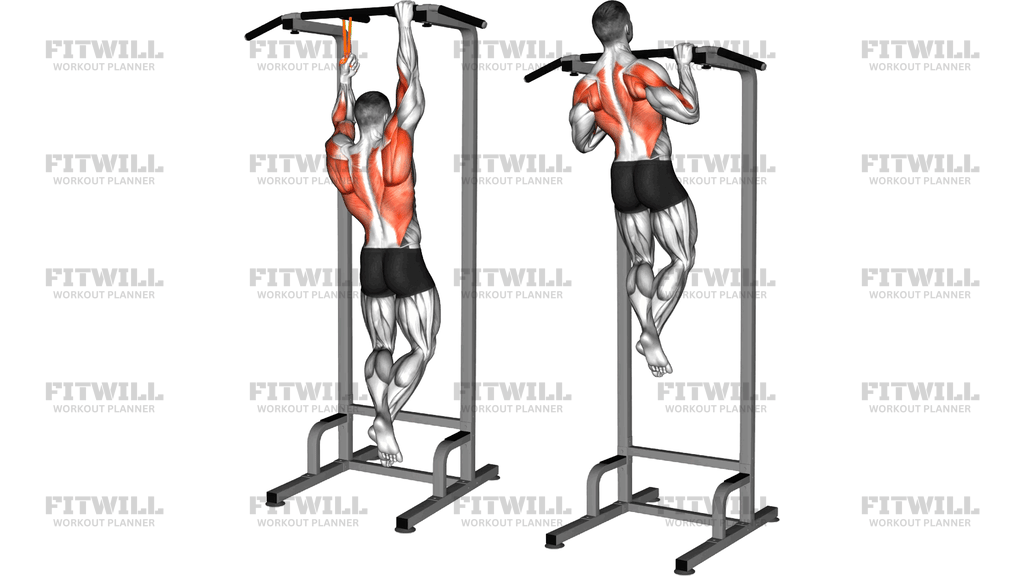
Instructions
- Loop a resistance band over the pull-up bar and pull one end through the other so it cinches tightly around the bar, leaving a loop hanging down.
- Grip the bar with one hand using a neutral or slightly wider-than-shoulder overhand grip, then thread that hand up through the band loop so it sits around your wrist or forearm.
- Let your body settle into a full hang with the working arm straight, hold your free hand against your chest or thigh, and cross your ankles or squeeze your legs together behind you.
- Brace your core and pull your shoulder blade down before you bend the elbow, so the hang starts active rather than loose.
- Pull your elbow down toward your ribs and drive your body up, keeping your torso square to the bar instead of twisting away from the working side.
- Continue pulling until your chin clears the bar and your working hand is roughly level with your lower chest or ribs at the top.
- Lower yourself under control over two to three seconds until the arm is fully straight and the band is holding your weight again at the bottom.
- Exhale as you pull up and inhale on the way down, keeping the breath steady rather than holding it through the rep.
- Complete all reps on one side, then re-thread the band and switch arms, matching the rep count between sides.
Tips & Tricks
- If the band slips off your hand mid-set, it is threaded too loosely; work it up past the wrist onto the forearm so it cannot slide down during the pull.
- Most people rotate their torso away from the working arm as they fatigue, letting the chest turn toward the free-hand side; film a set from the front and cue your chest to stay facing the bar.
- Dropping the last few inches of the descent is the most common fault, because the stretched band is pulling hardest at the bottom; that is exactly where single-arm strength is built, so slow that portion down deliberately.
- Do not grip the bar with your free hand or hook it behind the bar; keep it at your chest or thigh so the working arm truly handles the load.
- Start each rep from a completely straight arm. Bouncing out of the stretch with a kip turns this into a momentum exercise and robs the lats of the hardest part of the range.
- If your grip fails before your back does, use a slightly thicker bar or chalk up rather than shortening the range; grip strength on one arm is a real bottleneck in this movement.
- Match sides by reps first, then by band tension, and always start with your weaker arm so it sets the standard for the stronger side.
- Progress by thinning the band, not by adding reps; once you can control six clean reps per side, move to the next lighter band and rebuild from three to four reps.
Frequently Asked Questions
Which muscles does the Resistance Band Assisted Single Arm Pull Up work the most?
The lats of the working arm do the bulk of the work, with strong support from the biceps and forearm flexors. The rhomboids and mid traps pull the shoulder blade down and in, while the obliques resist the torso twist that single-arm pulling creates.
How do I attach the resistance band for the Resistance Band Assisted Single Arm Pull Up?
Loop the band over the bar and cinch it through itself so it cannot slide, then thread your working hand up through the hanging loop so it sits around the wrist or forearm. Tension should support you most at the bottom of the hang, where the band is stretched longest.
Is the Resistance Band Assisted Single Arm Pull Up suitable for beginners?
Not as a starting point. It works best for people who can already do several strict two-arm pull ups; true beginners will get more out of band-assisted two-arm pull ups, negatives, and scapular hangs first.
Why does my body twist during the Resistance Band Assisted Single Arm Pull Up?
Single-arm pulling creates a rotation force that your obliques and core have to cancel out, and the band adds its own sideways pull. Keep your chest square to the bar, squeeze your legs together, and cut the set short if the twist becomes unavoidable.
How much assistance does the band provide in this exercise?
It depends on the band thickness and how far it is stretched, but expect roughly 20 to 60 kilograms of offset at the bottom, decreasing as you rise toward the bar. This means the top of the rep is always the truest test of your single-arm strength.
Can I use an assisted pull-up machine instead of a resistance band?
You can, but the machine fixes your body on a pad and removes the anti-rotation and balance demands that make the one-arm pull up hard. The band version transfers far better to an unassisted single-arm pull up.
How should I progress with the Resistance Band Assisted Single Arm Pull Up?
Build to six controlled reps per side with a given band, then drop to a lighter band and work back up from three to four reps. Keep the descent slow; losing control on the way down means the band is too light for now.
What is the most common mistake in the Resistance Band Assisted Single Arm Pull Up?
Kicking and kipping out of the bottom instead of pulling from a straight arm. The stretch reflex hides the weakness at the end range, which is exactly the portion you need to strengthen for a full one-arm pull up.
Is it safe to hang the resistance band from the pull-up bar like this?
Yes, as long as the band is rated for bodyweight assistance, cinched securely around the bar, and inspected for tears before every session. Check that the loop cannot slip down the bar, and step out of the hang rather than jumping off with the band under tension.