Headbanger
The Headbanger is an advanced bodyweight pulling exercise performed on a pull-up bar. You hold the top portion of a pull-up with your arms bent around 90 degrees, raise your legs into an L-sit position in front of you, and then rock your head and torso forward and back by slightly straightening and re-bending your arms. The name comes from the way your head travels toward and away from the bar with each repetition while your elbow angle barely changes.
This movement is aimed at calisthenics trainees who already have a solid foundation of pull-ups and isometric holds. If you can hang comfortably and hold the top of a pull-up for at least 15 to 20 seconds, the Headbanger is a logical next step. It is especially popular among people working toward one-arm pull-up progressions, front lever training, and general bodyweight strength, because it forces you to control your entire bodyweight from a bent-arm hang.
The main work is done by the biceps and the elbow flexors, which hold and adjust the arm angle under full body load. Your lats, upper back, and middle traps keep the shoulders pulled down and stable in the hang, while the abs and hip flexors work hard to keep the legs lifted and prevent your lower body from dropping or swinging. Grip strength is also under constant demand for the entire set.
The setup matters more than it might look. Because you are hanging with bent arms and elevated legs, every bit of slack or swing multiplies the difficulty and shifts stress away from the arms and into the shoulders. Grip the bar firmly, pull the shoulder blades down before you begin, and keep the legs high and quiet. Most people who struggle with this exercise are not limited by arm strength but by a sagging body position or an uncontrolled swing.
To execute it well, think of the arm angle as fixed and the head as the moving part. Extend the elbows a few degrees to send your head and torso forward under the bar, then pull back to the starting bent-arm position without letting the legs drop. Each repetition should be smooth and short in range. If your range grows large or your legs sink toward the floor, the set is over from a quality standpoint.
Use the Headbanger sparingly, at the end of a pulling session or in small doses within a calisthenics cycle. Two to four sets of a handful of quality reps is plenty, and it pairs well with pull-ups, hanging leg raises, and front lever holds. Because the elbows are loaded through a partial range under heavy load, warm up thoroughly and stop before form breaks down.
Fitwill
Log Workouts, Track Progress & Build Strength.
Achieve more with Fitwill: explore over 9600 exercises with images and videos, access built-in and custom workouts, perfect for both gym and home sessions, and see real results.
Start your journey. Download today!




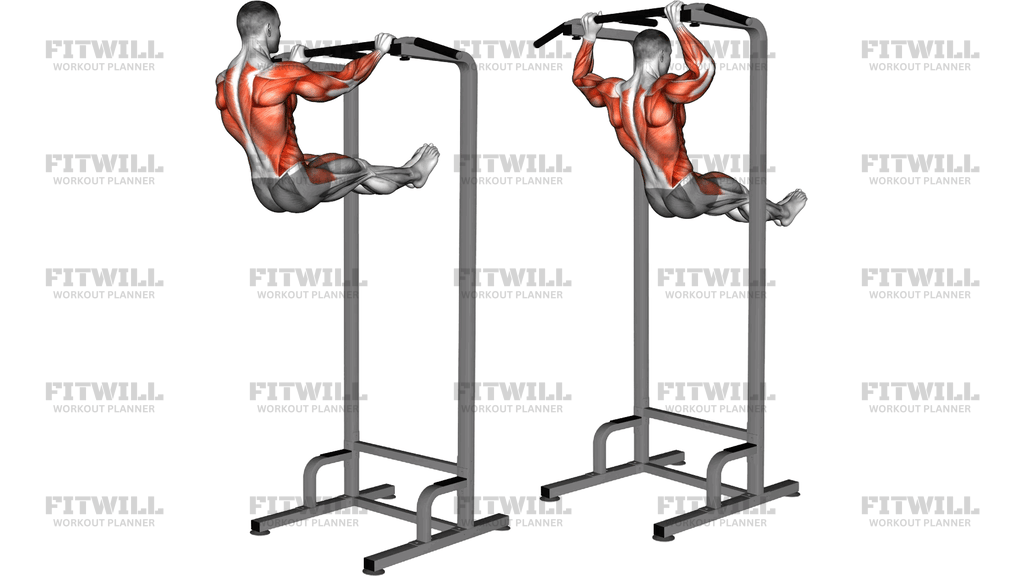
Instructions
- Stand under a sturdy pull-up bar and grip it with an overhand grip, hands roughly shoulder-width apart.
- Pull yourself up until your elbows are bent about 90 degrees and your chin is above the bar, then pull your shoulder blades down and together so your shoulders sit away from your ears.
- Raise your straightened legs forward until they are roughly parallel to the floor in an L-sit position, and squeeze your thighs together.
- Brace your abs hard and set your gaze slightly upward so you can track the bar as it passes near your head.
- Slowly extend your elbows a few degrees to let your head and upper torso travel forward and under the bar, keeping the shoulder blades pinned down.
- Stop the forward movement just before your forehead would contact the bar, then pull back with your arms to return your head behind the bar to the starting bent-arm hang.
- Exhale as you move forward, inhale as you pull back, and keep the breathing rhythm steady throughout the set.
- Keep the legs at the same height for every repetition; if they start dropping, end the set rather than letting the position collapse.
- After the final rep, bend your arms fully, lower yourself under control to a dead hang, and drop or step down carefully with soft knees.
Tips & Tricks
- Keep the elbow angle change small. Most people turn the Headbanger into a sloppy partial pull-up by straightening the arms too far, which dumps load onto the shoulder capsule instead of the biceps.
- Squeeze your glutes and thighs together to keep the L-sit stable. If the legs are loose, they swing and every rep becomes a momentum exercise.
- Chalk your hands or use a bar with a secure grip surface. Sweaty hands are a common failure point because you spend the whole set hanging from bent arms.
- Do not let your shoulders shrug up toward your ears. Re-set the shoulder blades down before each rep if you feel the hang riding into your neck.
- Aim your head slightly to one side of the bar if the bar sits close to your face, and leave enough clearance so you never actually strike it.
- Shorten the set the moment your hips start sinking toward a vertical hang. Quality reps with legs horizontal beat double the reps with a collapsing position.
- Build up with easier progressions first, such as holding a bent-arm hang with legs tucked, before attempting full L-sit Headbangers.
- Warm up your elbows with light pulling work or a few slow pull-ups first, since the exercise loads the elbow flexors through a partial range under full bodyweight.
- Rest at least 48 hours between sessions that include this exercise; heavy bent-arm hanging work recovers slower than sets of ordinary pull-ups.
Frequently Asked Questions
What muscles does the Headbanger work?
The Headbanger primarily trains the biceps and other elbow flexors, which control the changing arm angle under full bodyweight. The lats and upper back stabilize the hang, while the abs and hip flexors hold the legs up in the L-sit position.
Why is the exercise called the Headbanger?
Because your head rocks toward and away from the bar with each repetition as your elbows open and close slightly, mimicking a headbanging motion. Your head passes just in front of the bar at the forward point of each rep.
Do I have to hold my legs horizontal during the Headbanger?
No. Beginners can keep the legs bent and tucked toward the chest, which shortens the lever and makes the core portion far easier. The straight-leg L-sit version is the full expression of the movement.
Is the Headbanger safe for the elbows?
It is generally safe when your elbows are warmed up, your range is small, and your sets end before form breaks down. The elbows hold your full bodyweight through a bent-arm position, so build volume gradually and skip the exercise if you feel sharp joint pain rather than muscle effort.
What is the most common mistake with the Headbanger?
Turning it into a series of partial pull-ups by straightening the arms too much and dropping the legs. Keep the elbow range to a few degrees and hold the legs at a constant height so the arms and core stay in control.
How strong do I need to be before trying the Headbanger?
A reasonable baseline is several clean pull-ups plus the ability to hold a 90-degree bent-arm hang for 15 to 20 seconds. If you cannot hold that position yet, spend time on bent-arm hangs and chin-over-bar holds first.
Can I do the Headbanger on rings instead of a fixed bar?
You can, but rings make it considerably harder because they are unstable and move as your arms open and close. Start on a fixed pull-up bar and only try the ring version once the bar version feels solid.
How many sets and reps should I do?
Two to four sets of 4 to 8 controlled repetitions works well, resting 2 to 3 minutes between sets. Treat the exercise as a strength skill and stop each set when your leg position or elbow path starts to deteriorate.
What can I use instead of the Headbanger if I cannot do it yet?
Bent-arm bar hangs, slow negative pull-ups, chin-up holds at 90 degrees, and front lever or tuck holds with legs raised all train the same combination of arm, back, and core strength in a more forgiving way.