Resistance Band Standing Lat Pulldown
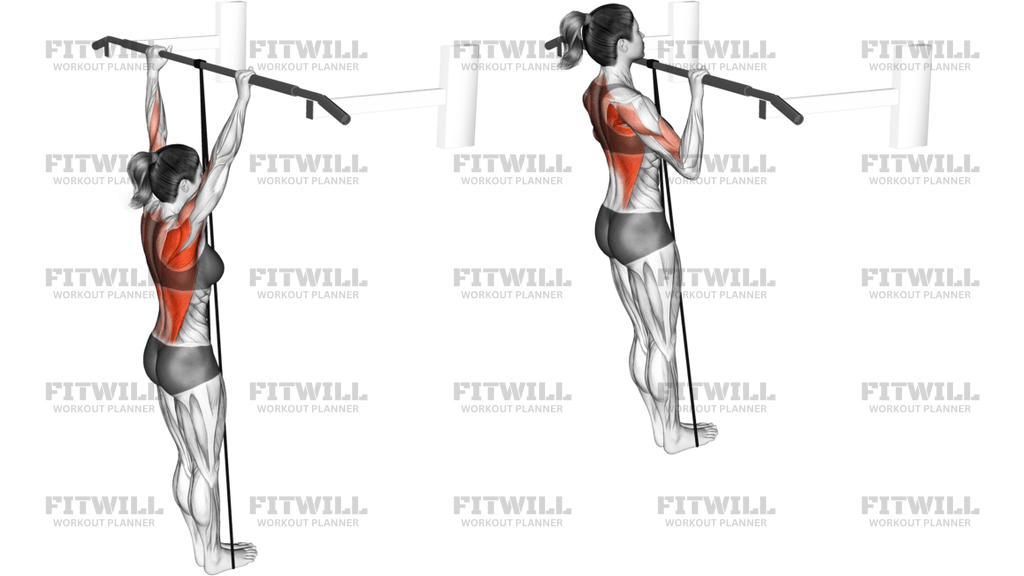
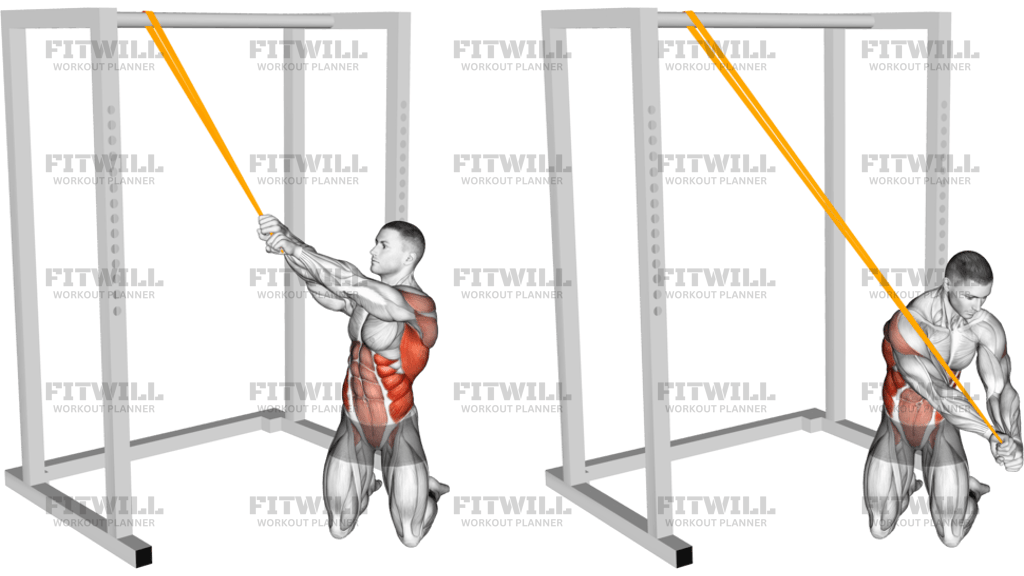
The Resistance Band Standing Lat Pulldown is a vertical pulling exercise that recreates the classic lat pulldown without a cable machine. A resistance band is anchored overhead to a pull-up bar or sturdy rack crossbar, and you stand facing the anchor point, holding one end of the band in each hand. From a straight-arm overhead position, you pull your elbows down and back until your hands reach shoulder height, then resist the band on the way back up.
This exercise is especially useful when you train at home or travel and have no access to a lat pulldown station. It also works well as a warm-up or volume accessory for lifters who already do pull-ups, because the band provides a smooth, joint-friendly resistance curve that is heaviest at the bottom of the pull and easier near the top. Beginners who cannot yet perform a single strict pull-up can use it to build the pulling strength and lat awareness needed to get there.
The primary work is done by the lats, the broad muscles of the mid-back that drive the arms down and back. The biceps assist as the elbows bend, while the rhomboids, mid traps, and rear shoulders retract the shoulder blades at the end of each pull. Because you are standing, your core and lower back also work to keep your torso upright and still, which adds a postural element you don't get from a seated pulldown machine.
Setup matters more than people expect. Anchor the band at a point directly overhead and high enough that the band stays taut even with your arms fully extended. Grip the band with palms facing forward, roughly shoulder-width or slightly wider. If you stand too close, the band angle turns the movement into something closer to a face pull; too far back, and you fight excessive tension at the top and lose range.
Execution should feel like driving your elbows toward your back pockets. Lead with the elbows rather than the hands, keep the wrists neutral, and squeeze the shoulder blades together at the bottom without shrugging. Pause briefly, then return under control until the arms are fully extended overhead. Avoid leaning back to move the weight; the band already supplies plenty of challenge.
Common use cases include home back training, pull-up preparation, rehab-friendly upper-body work after guidance from a professional, and high-rep finishers at the end of a back session. Check the band and anchor before every set, keep the hands on the inside of the band so it cannot snap toward your face, and choose a tension level that lets you complete each rep with a full range of motion.
[ Workout Log & Planner ]
Put your next workout in Fitwill
Keep your plan and training log ready when you are.


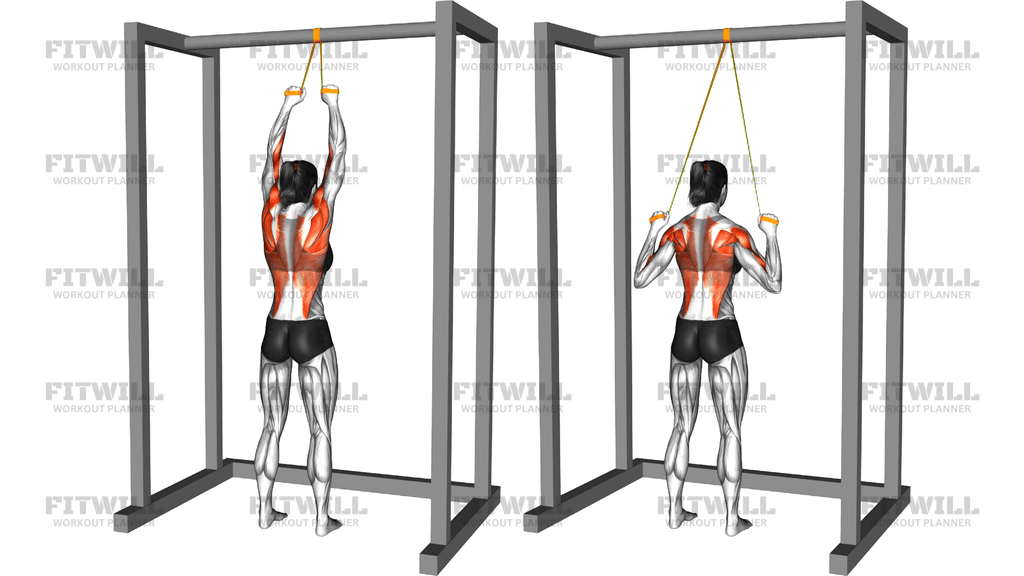
Instructions
- Anchor a resistance band securely over a pull-up bar or the top crossbar of a rack, centered so both sides hang evenly, and check that the anchor will not slip.
- Stand facing the anchor with your feet about hip-width apart, and grip one side of the band in each hand with your palms facing forward, hands slightly wider than shoulder-width.
- Step back just enough that the band is already under light tension with your arms fully extended overhead.
- Stand tall with a soft bend in the knees, brace your abdominal muscles, and pull your shoulder blades down and slightly together before you start the pull.
- Pull your elbows down and back toward your sides, letting your hands travel with the band until they reach shoulder height.
- Pause at the bottom with your elbows just below your shoulders and your chest lifted, squeezing your lats and shoulder blades.
- Slowly let your arms rise back up overhead, resisting the band the whole way instead of letting it snap your arms up.
- Exhale as you pull down, and inhale as you return to the top position.
- Complete your reps, then step forward toward the anchor to release the band tension before letting go, one hand at a time.
Tips & Tricks
- If your shoulders creep up toward your ears as you pull, drop to a lighter band and practice pulling the shoulder blades down first, then bending the elbows.
- Do not turn this into a row by stepping too far back; if your hands end up near your waist instead of your shoulders, reposition directly under the anchor.
- Keep the wrists straight and the grip relaxed enough that your forearms don't take over; squeezing the band too hard shifts work away from the lats.
- A slight backward lean of a few degrees is fine, but if your torso swings back with each rep, the band is too heavy or you're rushing the pull.
- Use a slower return for 2-3 seconds; the eccentric phase is where the lats get most of the stretch and much of the benefit with band training.
- Choke up on the band or use a shorter band if you can't reach full overhead extension with tension, since starting slack steals the first third of the movement.
- Check that your hands stay on the side of the band facing you so it cannot slip out toward your fingertips mid-set.
- If one side pulls faster than the other, slow down and watch your hands in a mirror to keep the elbows tracking evenly.
- Bands lose tension as they age; replace one that shows cracking or thin spots, especially when it's anchored overhead near your face.
Frequently Asked Questions
What muscles does the Resistance Band Standing Lat Pulldown work?
The lats do most of the work, pulling the arms down and back. The biceps, rhomboids, mid traps, and rear shoulders assist, and your core stabilizes you because you're standing rather than seated.
Is the Resistance Band Standing Lat Pulldown good for beginners?
Yes, it's one of the most accessible vertical pulls. You can pick a light band for manageable tension, and there's no body weight to lift, unlike a pull-up.
How high should I anchor the band for the Resistance Band Standing Lat Pulldown?
Anchor it directly overhead, on a pull-up bar or rack crossbar, so your arms reach full extension while the band is still lightly taut. A lower anchor changes the pull angle and shifts work toward the rear shoulders.
Why do my hands end up at my chest instead of my shoulders?
You're likely pulling with the arms and letting the elbows flare wide, or standing too far back so the band angle points downward. Lead with the elbows driving down and reposition yourself closer to a spot directly under the anchor.
Can the Resistance Band Standing Lat Pulldown help me get my first pull-up?
It builds the lat strength and elbow-down pulling pattern a pull-up requires, so it's a solid preparatory exercise. Pair it with scapular pulls and eventually assisted or negative pull-ups for the best carryover.
How do I choose the right band tension?
Pick a band that lets you complete 8-15 reps with a full overhead stretch and a controlled pause at the bottom. If your torso leans back or your arms snap up on the return, the band is too heavy.
Is it safe to anchor a resistance band overhead?
It is, as long as the anchor is a fixed bar designed to hold load and the band is undamaged. Always keep your hands on the inside of the band loop and release tension by stepping toward the anchor before letting go.
Can I substitute the Resistance Band Standing Lat Pulldown with a seated cable pulldown?
Yes, a cable lat pulldown or a straight-arm pulldown trains the same lats with a more constant resistance. The band version simply needs no machine and adds a light core stability demand from standing.
Should my elbows stay wide or tuck in during the Resistance Band Standing Lat Pulldown?
Keep them angled down and slightly out, roughly in line with your hands at shoulder width. Flaring the elbows out to the sides turns the pull into more of a rear-delt movement and reduces lat involvement.
How many sets and reps should I do?
Two to four sets of 10-15 reps works well for most people, resting about 60-90 seconds between sets. For a warm-up, use a light band for one or two sets of 12-15 with an emphasis on the controlled return.