Kettlebell Gorilla Row
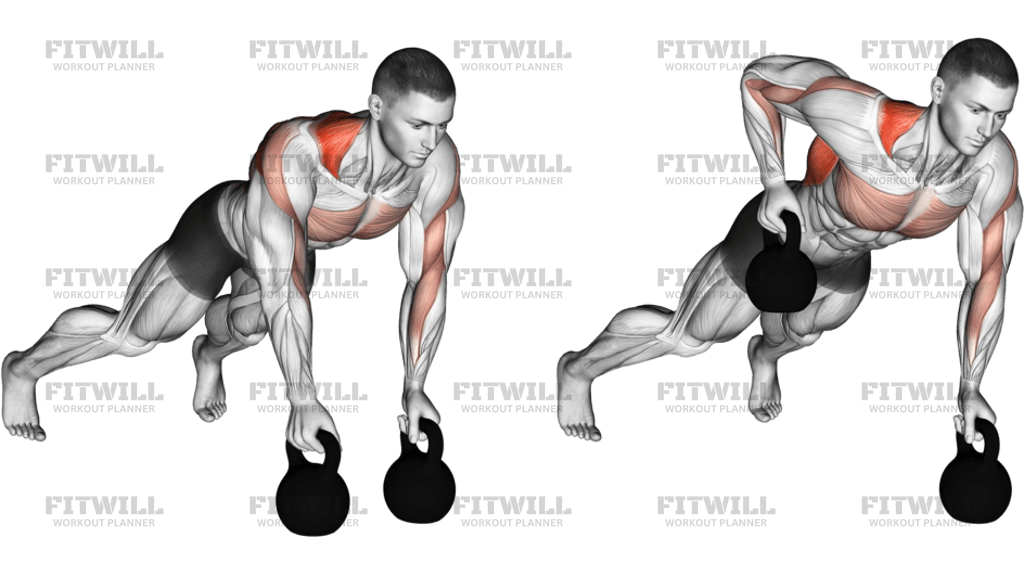
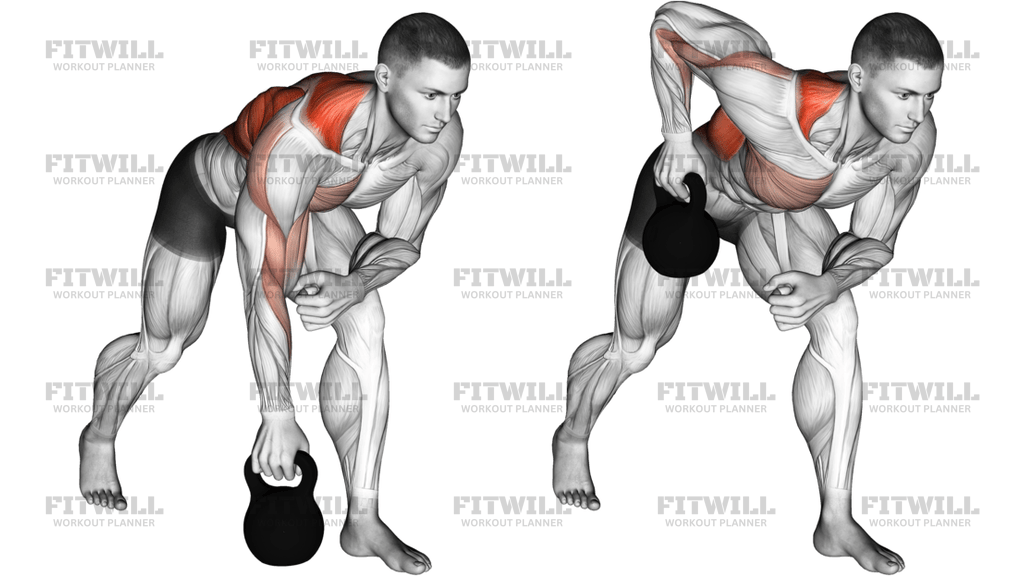
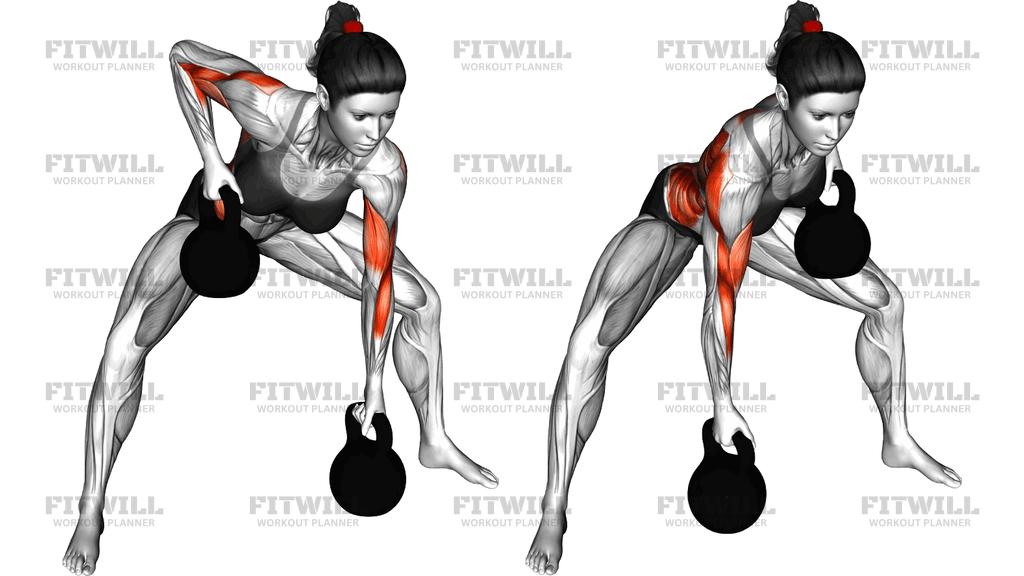
The Kettlebell Gorilla Row is a bent-over row variation performed from a wide, athletic stance with two kettlebells placed on the floor between your feet. Instead of holding the weights in your hands throughout the set, you row one kettlebell up at a time while the other stays parked on the ground, which gives you a brief rest on each side and lets you handle slightly heavier loads than a standard double row. The name comes from the ape-like posture: hips pushed back, knees bent, back flat, and knuckles hovering just above the weights.
This movement is a solid pick for building the lats, rhomboids, and mid-traps, along with the biceps and rear shoulders that assist on every pull. Because you are hinged forward without a bench or rack for support, your spinal erectors, glutes, and hamstrings work isometrically the entire time to hold your torso position. The alternating tempo also challenges your grip and anti-rotation control, since your torso wants to twist each time one side pulls.
The setup matters more than people expect. A wide enough stance is what creates room for the kettlebells to sit directly under your shoulders, and a proper hip hinge — not a squat and not a rounded-over stretch — is what protects your lower back. If your hips are too high your torso stays too upright and the row angle changes; if they are too low your knees drift forward and crowd the weights. Taking a moment to set the feet and hinge correctly is what makes every rep productive.
To execute the row itself, think of pulling the kettlebell straight up toward your hip rather than dragging it backward. Drive the elbow up and slightly back, keep the wrist neutral, and squeeze the shoulder blade at the top without shrugging it toward your ear. Lower the bell under control back to the floor, let it settle for a beat, then pull with the other hand. That brief contact with the ground on every rep is a built-in quality check: if you cannot set the bell down cleanly, you are losing your hinge position.
The Kettlebell Gorilla Row fits well into strength days as a heavy pulling lift, into conditioning circuits where it pairs naturally with swings or carries, and into general training plans as a back exercise that needs nothing but two kettlebells and a few square feet of floor. Beginners should start light to learn the hinge-and-pull rhythm, while more experienced lifters can use it as a way to load the upper back harder than a single-arm row allows, since the parked kettlebell acts as a mini rest between sides.
Two safety points are worth repeating. First, keep your back flat and your hips hinged for the entire set — if you feel your lower back rounding or your torso climbing up, end the set and reset. Second, place the kettlebells on a flat, non-slip surface and make sure the handles stay oriented so you can grab them cleanly without twisting your wrists.
Fitwill
Log Workouts, Track Progress & Build Strength.
Achieve more with Fitwill: explore over 9600 exercises with images and videos, access built-in and custom workouts, perfect for both gym and home sessions, and see real results.
Start your journey. Download today!




Instructions
- Place two kettlebells of equal weight on the floor about shoulder-width apart, handles running side to side so you can grip both without turning your wrists.
- Stand over the bells with your feet wider than shoulder width, toes turned slightly out, so each kettlebell sits inside the line of your feet.
- Push your hips back and bend your knees until your torso leans forward to roughly 45 degrees or a bit lower, back flat and chest facing the floor, then grip one handle in each hand and lift them just off the ground.
- Brace your core as if bracing for a light punch, squeeze your glutes, and hold this hinged position — this is your starting posture for the whole set.
- Keeping your torso still, pull the right kettlebell straight up toward your lower ribs by driving your elbow up and back until the handle is near your hip.
- Pause briefly at the top with your shoulder blade pulled back and down, then lower the kettlebell under control until it touches the floor.
- Let that bell rest on the ground for a second, then pull the left kettlebell up to the same position with the same elbow path.
- Continue alternating sides, one pull at a time, making sure each bell touches the floor before the opposite arm rows.
- Breathe out as you pull each kettlebell up and breathe in as you lower it, keeping the brace steady throughout.
- When the set is finished, lower both kettlebells to the floor, release your grip, and stand up by driving your hips forward, keeping your back flat as you rise.
Tips & Tricks
- If your knees keep bumping the kettlebells, widen your stance rather than moving the bells outward — they should stay directly under your shoulders for a vertical pull.
- A common mistake is turning the row into an upright row by pulling the elbow flared out to the side; keep the elbow tracking back toward your hip so the lats do the work.
- Watch for torso rotation: as one side pulls, the chest tends to twist toward that arm. Imagine a glass of water balanced on your upper back and keep it level.
- Do not let the top shoulder shrug toward your ear at the end of the pull; finish with the shoulder blade pulled down and back instead.
- The floor contact between reps is a feature, not a pause for distraction — use it to re-brace and re-hinge rather than letting your chest rise between sides.
- If your lower back fatigues before your upper back, reduce the weight or shorten the set; a rounded hinge position under load is the main risk in this exercise.
- Use kettlebells with matching handle thickness and width. Mismatched handles change your grip timing and make the alternating rhythm feel lopsided.
- Chalk or a dry towel on your hands helps more than you'd expect here, since your grip holds and releases repeatedly within one set.
- If your hamstrings limit how far you can hinge, bend the knees a little more and accept a slightly higher torso rather than rounding your back to get deeper.
Frequently Asked Questions
What muscles does the Kettlebell Gorilla Row work?
The primary movers are the lats and the muscles of the upper back, including the rhomboids and mid-traps, with the biceps and rear shoulders assisting each pull. Your lower back, glutes, and hamstrings also work the entire set to hold the hinged position.
Why use two kettlebells instead of just rowing one?
The second kettlebell balances your body and acts as a counterweight, while the parked bell between reps gives each side a short recovery. That lets you row heavier than a single-arm version and keeps the movement symmetrical.
Is the Kettlebell Gorilla Row suitable for beginners?
Yes, as long as you start with light kettlebells and learn the hip hinge first. If you cannot hold a flat-back bent-over position comfortably, practice kettlebell deadlifts for a week or two before adding the row.
How high should I pull the kettlebell during the Gorilla Row?
Pull until the handle reaches roughly your hip or lower rib level with your elbow driven up and back. Pulling toward your chest usually means the elbow is flaring and the shoulders are taking over from the back.
Why does my lower back get tired before my back muscles?
Your spinal erectors are holding an isometric hinge the whole set, so some fatigue is normal, but if they give out early the weight is probably too heavy or your torso angle is too low. Raise your torso slightly, drop the load, or cut the set short and reset.
What can I substitute if I only have one kettlebell?
A single-arm bent-over kettlebell row from the same wide hinged stance is the closest option, with your free hand braced on your thigh or a bench. You lose the balance challenge, but the rowing motion is nearly identical.
Should the kettlebells touch the floor between reps?
Yes, that is part of what defines the Gorilla Row. Each bell should settle on the floor briefly before the opposite arm pulls, which keeps both sides even and gives you a chance to reset your brace.
How do I stop my torso from twisting during the alternating rows?
Keep your chest facing the floor and your hips square, and slightly reduce the weight until you can pull without rotating. Squeezing both glutes throughout the set also locks the pelvis in place and cuts down the twist.
How heavy should the kettlebells be for this exercise?
Choose a weight you can row to hip height for 8 to 12 controlled reps per side without your back rounding or your torso climbing up. Most people can use slightly heavier bells here than in a standard bent-over row because of the floor contact between reps.
Can I do the Kettlebell Gorilla Row if I have lower back issues?
If you have a history of back problems, get clearance from a qualified professional first and start with a supported row variation while you build hinge tolerance. Never continue a set once your back starts rounding under the load.