Kettlebell Pullover Dead Bug
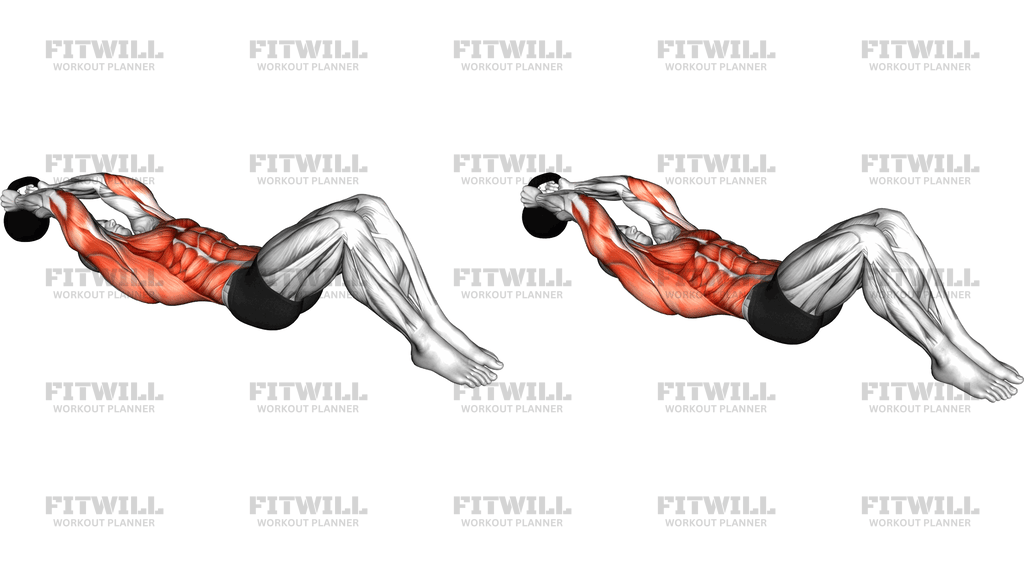
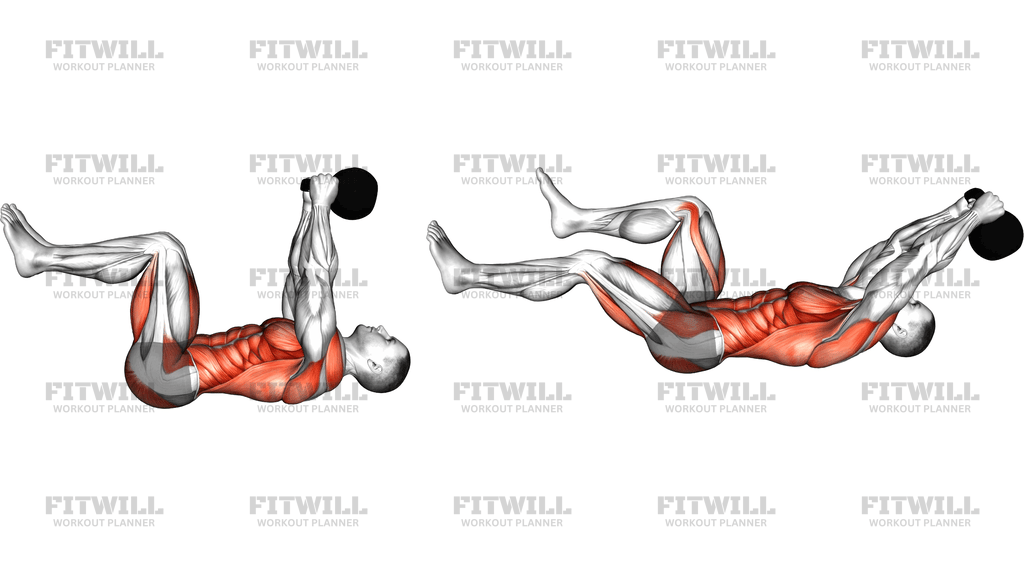
The Kettlebell Pullover Dead Bug combines two proven floor exercises into one coordinated movement. You lie on your back holding a kettlebell with both hands, then lower the weight overhead behind your head while extending the opposite leg out long — the same leg pattern as a classic dead bug, paired with the arm path of a pullover. When you reverse the motion, the kettlebell travels back over your chest as the knee returns to the tabletop position, then you switch legs and repeat.
This pairing works because both moving parts threaten the same thing: the position of your ribcage and lower back. The kettlebell pulling overhead stretches the lats and chest while tempting your spine to arch, and the extended leg pulls on the hip flexor while doing the same. Holding your ribcage down and your lower back flat against the floor through both motions forces the deep core to work continuously, which is exactly why coaches use it for people who have outgrown the standard dead bug but are not ready for loaded carry work or hanging variations.
You will feel this across the front of the core, along the lats and chest as they lengthen under load, and through the hip flexors of the working leg. The triceps and shoulders also stay busy keeping the kettlebell stable overhead, and your grip gets steady low-level work holding the handle for the duration of the set.
Setup details matter more here than in most core exercises. The kettlebell starts directly over your chest with your arms straight, not behind your head, so you control the descent rather than starting from an overloaded stretched position. Choosing a weight you could hold overhead comfortably for a full minute is the right starting point — this is a coordination and control exercise first, and the load should never be the limiting factor.
To execute it well, keep the movement slow and paired: the arms and the leg move together, and everything returns together. Move the kettlebell only as far overhead as you can while keeping contact between your lower back and the floor. Most people find that hovering the kettlebell an inch or two above the floor behind them is plenty, and there is no need to tap the ground.
This drill fits well early in a training session as core activation, at the end of upper body or full body days as controlled anti-extension work, or in rehabilitation and postpartum return-to-training contexts where the floor provides feedback and safety. If your lower back lifts, ribs flare, or you feel strain rather than effort in your midsection, regress to the standard dead bug with no weight before returning to this version.
[ Workout Log & Planner ]
Put your next workout in Fitwill
Keep your plan and training log ready when you are.


Instructions
- Lie flat on your back on the floor or an exercise mat with your knees bent and feet flat on the ground.
- Place a light kettlebell on the floor beside your shoulder, grip the handle firmly with both hands, and press it up so it sits directly over your chest with your arms straight and elbows locked.
- Lift your feet off the floor until your hips and knees are both bent to roughly 90 degrees in a tabletop position.
- Press your lower back gently into the floor and brace your midsection as if bracing for a light punch; keep this brace for the entire set.
- Inhale, then slowly lower the kettlebell back over and behind your head while simultaneously extending your left leg out long, keeping the heel a few inches off the floor.
- Stop when the kettlebell hovers just above the floor behind you and the leg is fully extended, with your lower back still flat against the ground.
- Exhale and reverse both motions together: pull the kettlebell back over your chest and draw your left knee back to the tabletop position.
- Repeat the same sequence extending your right leg, and continue alternating legs for the desired number of reps.
- When finished, bend both knees back to tabletop, lower your feet to the floor, and set the kettlebell down beside you rather than dropping it overhead.
Tips & Tricks
- The most common failure point is the lower back arching as the kettlebell passes ear level — if your back lifts off the floor, do not extend the leg as far; a slightly bent extended knee shortens the lever and keeps the spine neutral.
- Start with a kettlebell light enough that the weight itself is never the challenge; if you cannot hold it steady over your chest for the whole set, go lighter before progressing.
- Keep the arms fully straight throughout — bending the elbows turns this into a triceps exercise and shortens the lat stretch the pullover is meant to create.
- Do not rush the transition point where the kettlebell passes your face; this is where control slips and where the weight ends up dropped behind your head.
- If your ribs flare upward toward the ceiling as you reach overhead, exhale as the kettlebell travels back and imagine pulling your bottom ribs toward your hips.
- Keep the extended leg hovering rather than resting it on the floor; if you need an easier version, tap the heel down lightly instead of holding it suspended.
- Only lower the kettlebell as far behind your head as your shoulder mobility allows — stopping a few inches above the floor is a complete rep, and forcing depth only strains the shoulders and lower back.
- Hold the kettlebell by the handle with both hands cupping around it, and keep your grip firm for the whole set; a loose grip makes the weight wobble and steals focus from your core.
- Pair the arm and leg timing deliberately — the limb that moves on the way out should move on the way back, so reps stay clean and symmetrical on both sides.
Frequently Asked Questions
What muscles does the Kettlebell Pullover Dead Bug work?
The deep core and abs work hardest to keep your ribcage and lower back stable, while the lats and chest control the kettlebell as it lowers overhead. The hip flexors of the extended leg, along with the triceps, shoulders, and grip, all contribute as well.
How is the Kettlebell Pullover Dead Bug different from a regular dead bug?
The regular dead bug only moves your limbs against gravity with no external load. Adding the kettlebell pullover puts weight in your hands and stretches the lats and chest overhead, which makes the anti-extension demand on your core significantly higher.
How heavy should the kettlebell be for this exercise?
Start with a weight you could comfortably hold overhead with straight arms for a minute or more — often much lighter than you would use for a standard kettlebell pullover on a bench. The core and coordination demands should be the challenge, not the load.
Should the kettlebell touch the floor behind my head?
No, hover it just above the floor and reverse the movement there. Touching the floor lets you lose tension momentarily, and going deeper than your shoulders and lower back can control is where form breaks down.
Why does my lower back arch when I extend my leg?
That happens when the weight of the extended leg pulls your spine into extension faster than your core can resist. Keep the leg higher or leave the knee slightly bent, and focus on pressing your lower back into the floor before every rep.
Can beginners do the Kettlebell Pullover Dead Bug?
It is better as a step after you have mastered the bodyweight dead bug with clean leg extensions. Beginners can start by holding the kettlebell locked out over the chest without lowering it, then add the pullover arm movement, and finally combine both motions.
Can I perform this exercise on a bench instead of the floor?
The floor is strongly preferred because it gives your lower back constant feedback — you can feel immediately when it lifts. A bench removes that reference and makes it much easier to arch without noticing.
What can I use if I do not have a kettlebell?
A single dumbbell held vertically with both hands works well, or a light weight plate gripped at its edges. Even a household object of modest weight can serve, since the movement is about control rather than load.
Is this exercise safe for my shoulders?
It is generally shoulder-friendly when you keep the weight light and only lower the kettlebell as far as your mobility comfortably allows. If you feel pinching at the front of the shoulder as the arms pass overhead, reduce the range or work on overhead mobility first.