Kettlebell Strict Press
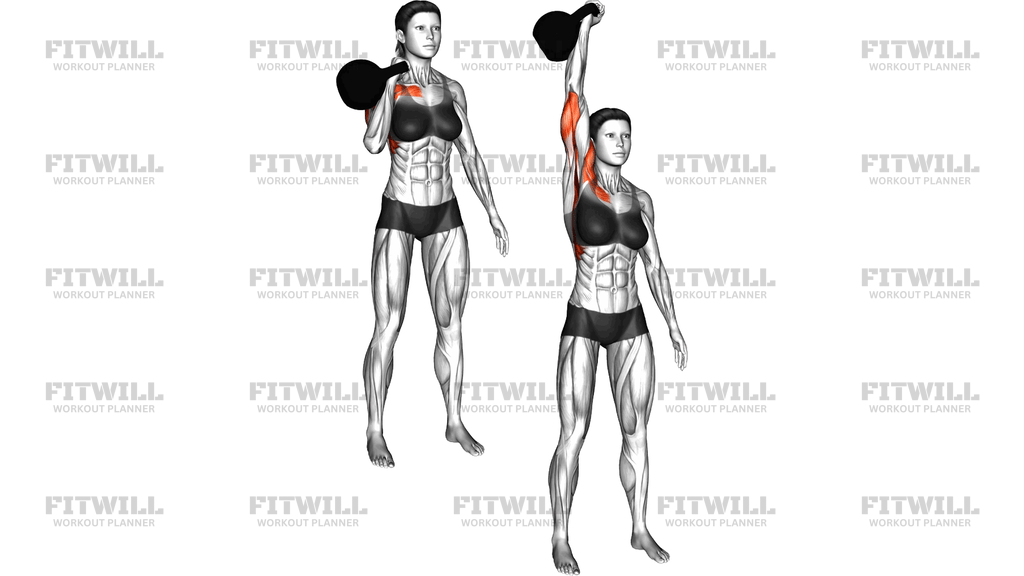
The Kettlebell Strict Press is a one-arm overhead press performed from a standing position with no leg drive, no dip, and no momentum. The kettlebell starts in the rack position at your shoulder, and you press it straight up until your arm is locked out overhead, then lower it back to the rack under control. Because every bit of the work comes from the shoulder girdle and arm, the movement is honest in a way that push presses and jerks are not: if your press is weak, you will know it immediately.
The primary muscles at work are the front and side shoulders, with the triceps finishing the lockout. What makes the kettlebell version distinct from a barbell or dumbbell press is the offset load. The bell sits behind your hand and slightly outside your forearm, so your stabilizing muscles around the shoulder blade and rotator cuff have to work overtime to keep the weight stacked over your elbow and wrist. Your upper traps, serratus anterior, and the muscles of your working-side trunk all contribute to keeping your ribs down and your spine neutral as the load travels overhead.
This lift suits a wide range of trainees. Beginners can use it to build a solid overhead pressing pattern with a modest load before touching a barbell. Intermediate and advanced lifters use it to expose and fix left-to-right strength differences, since each arm works independently and a stronger side can no longer cover for a weaker one. It is also a staple in kettlebell sport preparation, where an efficient rack position and a smooth pressing path determine how long you can keep going.
Setup matters more here than in most presses because the kettlebell rests against your forearm and chest rather than sitting in your palm. A good rack position puts the bell on the back of your forearm, your elbow tucked close to your ribs, and your wrist straight. If the bell sits too far forward or your elbow flares out, the press starts from a compromised angle and your shoulder takes unnecessary stress.
To execute well, brace your midsection, keep your ribs stacked over your pelvis, and press the bell up and slightly back so it finishes over the middle of your head, not out in front. Avoid leaning your torso away from the working side, which is the most common way lifters cheat the movement. Lower the bell along the same path, letting it settle back onto your forearm rather than catching it with a tense, rigid arm.
In practice, the Kettlebell Strict Press shows up in strength circuits, unilateral upper-body days, and warm-up progressions for heavier overhead work. Start lighter than you think you need, because the anti-rotation demand and the stabilizing work are bigger than the weight on the bell suggests. A controlled two-second descent and a deliberate pause in the rack between reps will teach you more than grinding out extra sloppy reps.
[ Workout Log & Planner ]
Put your next workout in Fitwill
Keep your plan and training log ready when you are.


Instructions
- Stand with your feet about hip-width apart and clean one kettlebell into the rack position, with the bell resting on the back of your forearm and the handle settled across your heel of palm.
- Tuck your working elbow close to your ribs so the upper arm sits against your torso, and keep your wrist straight rather than bent back.
- Grip the handle firmly, set your free arm relaxed at your side, and squeeze your glutes to lock your pelvis in place.
- Brace your midsection as if preparing for a light punch, and pull your ribs down so your lower back does not arch.
- Press the kettlebell straight up, letting your forearm rotate naturally so the bell travels up and slightly back over your head.
- Continue until your elbow is fully extended and the kettlebell sits stacked directly over your shoulder and hip, with your bicep near your ear.
- Pause briefly at the top and keep your shoulder packed, not shrugged up toward your ear.
- Lower the kettlebell along the same path, bending your elbow and guiding the bell back onto your forearm into the rack.
- Exhale as you press up and inhale as you lower the bell, or use a short breath hold through the sticking point on heavier sets.
- Complete all reps on one side, re-rack or set the bell down safely, then switch hands and match the rep count.
Tips & Tricks
- If the bell drifts forward and finishes over your face instead of over your head, think about pressing up and slightly back, as if pushing the bell toward a point just behind your crown.
- A common mistake is leaning the torso sideways as the press stalls. Keep your working-side glute tight and your ribs down so the trunk stays tall; if you cannot, the weight is too heavy.
- Do not let your wrist collapse backward under the bell. Keep a straight line from forearm to hand, since a bent wrist turns the press into a grip and wrist strain.
- Keep your elbow pointing slightly forward in the rack rather than flared wide out to the side. This lets the bell rest on your forearm instead of hanging off your shoulder.
- Avoid shrugging the working shoulder up during the press. Think of pressing the bell away from your body while your shoulder blade stays controlled, letting the upper traps assist rather than take over.
- If your lower back arches as the bell goes up, exhale through the top of the press and squeeze your abs harder before the next rep.
- Rest the bell on your forearm in the rack between reps and take a real breath there instead of rushing. Rushed rack recovery is where most form breakdowns start.
- Choose a weight you can press for strict reps without a leg dip. If your knees bend or your heels lift, drop the load and rebuild the pattern.
- Alternate which arm you start with across sets so your weaker side is not always training second while fatigued.
Frequently Asked Questions
Which muscles does the Kettlebell Strict Press work the most?
The front and side shoulders do most of the pressing, with the triceps straightening the elbow at lockout. The upper traps, rotator cuff, and working-side core stabilize the shoulder blade and trunk throughout.
Is the Kettlebell Strict Press suitable for beginners?
Yes, as long as the weight is modest and the rack position is learned first. Beginners often benefit from starting with a light bell and practicing the clean-to-rack before pressing at all.
Why does the kettlebell rest on my forearm instead of in my hand?
In a proper rack the bell's mass sits on the back of your forearm, which lets the weight stack over your wrist and elbow. Holding it out in your palm forces your wrist and grip to fight the load and makes the press path less stable.
How is the Kettlebell Strict Press different from a push press?
A strict press uses only your shoulder and arm, while a push press adds a small knee dip and hip drive to help the bell up. In the strict version your legs stay still and simply act as the base.
Should I press with one kettlebell or two at the same time?
The single-arm press shown here is the best starting point because it reveals side-to-side differences and demands anti-rotation from your trunk. Two-bell pressing is a valid progression once each side presses cleanly on its own.
My shoulder shrugs up near my ear at the top of the press. Is that a problem?
Some upper trap involvement is normal, but an aggressive shrug means the shoulder blade is riding up instead of staying controlled. Lower the weight slightly and focus on reaching the bell up while keeping space between your ear and shoulder.
What can I use if I do not have a kettlebell?
A single dumbbell works with a similar one-arm press, though the load sits more evenly in the hand and the stabilizing demand is lower. The kettlebell's offset mass is part of what makes this version valuable.
How many reps and sets should I do?
For strength, work in sets of 3 to 6 strict reps per arm with heavier bells; for muscle and control, 6 to 10 reps per arm works well. Rest enough between sides that your second arm gets an honest attempt.
Is it safe to do this press with a shoulder injury history?
If you have a current or recent shoulder issue, get clearance from a qualified professional first and start with a very light bell. Keeping the wrist straight, the elbow tucked in the rack, and the bell stacked overhead reduces unnecessary joint stress.