Burpee Over The Bar
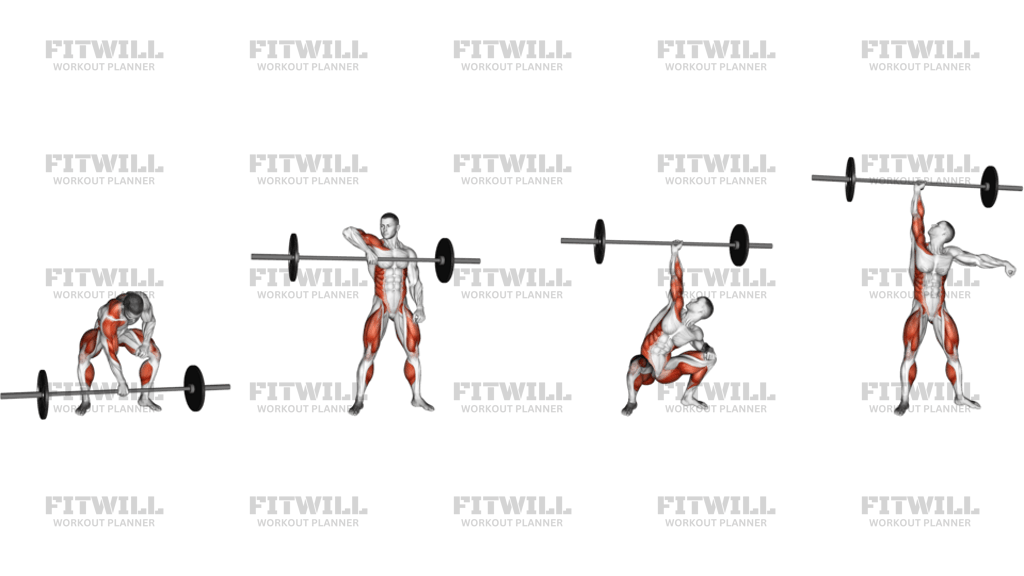
Burpee Over The Bar is a full-body conditioning movement that combines a standard burpee with a lateral jump over a barbell lying on the floor. Instead of finishing the rep with a vertical jump, you push off sideways to clear the bar, land on the other side, and immediately drop into the next burpee facing a new direction. The barbell acts purely as a hurdle, so the load on it matters far less than its height and stability.
This exercise earns its reputation in conditioning circuits, CrossFit-style workouts, and athletic training blocks because it stacks three demands on top of each other: a push, a hip hinge, and a repeated lateral jump. Your chest, shoulders, and triceps handle the push-up portion, your quads, glutes, and hamstrings drive the squat and jump, and your calves and ankles absorb and redirect force every time you land. Your core ties it all together by keeping your spine stable as you move from horizontal to vertical and back down again.
Setup matters more than most people expect. The bar should rest on the floor where it cannot roll, and you need enough clearance on both sides to land with your whole foot and stay balanced. A loaded bar with plates, as commonly used, sits higher off the ground than a bare bar, so choose the height honestly. If you cannot clear it with a confident two-foot jump when fresh, you will not clear it reliably when fatigued.
To execute well, think of the burpee and the side jump as one rhythm rather than two separate skills. Drop your hands to the floor, shoot your feet back into a plank, perform the push-up, jump your feet in under your hips, and instead of jumping straight up, push laterally so both feet clear the bar together. Land softly with bent knees, reset your posture for a split second, and flow straight into the next rep.
Burpee Over The Bar works well as a timed interval, a rep target in a circuit, or a finisher when you want a large amount of work in a small space. Because the lateral jump adds a change-of-direction element, it also carries more coordination and ankle demands than a standard burpee. Build up gradually, keep the jumps crisp rather than sloppy, and step over the bar instead of jumping whenever your control starts to slip.
[ Workout Log & Planner ]
Put your next workout in Fitwill
Keep your plan and training log ready when you are.


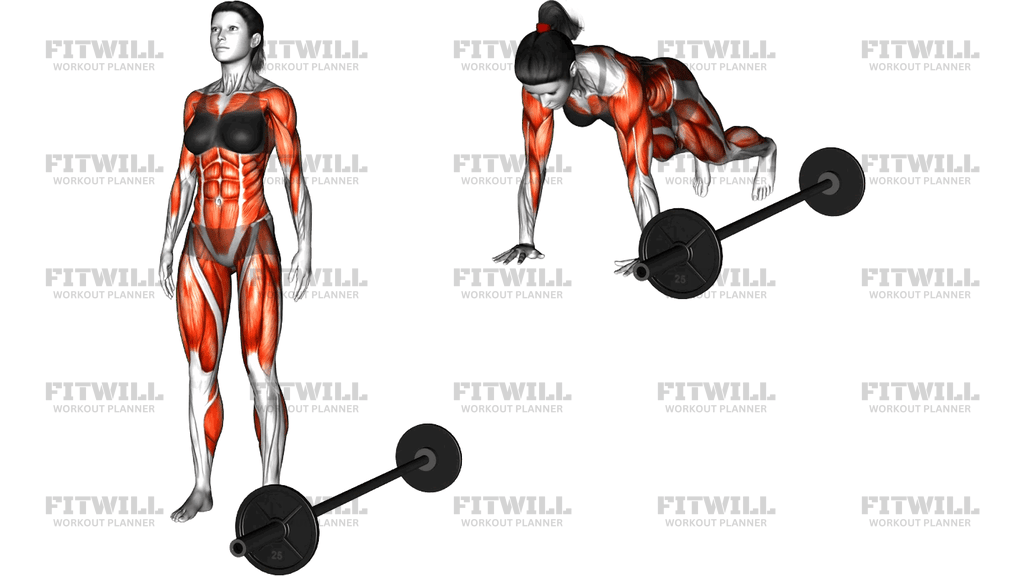
Instructions
- Place a barbell on the floor with plates on each end so it cannot roll, and stand sideways to it with about an arm's length of clear space on both sides.
- Set your feet roughly hip-width apart and let your arms hang naturally at your sides before you begin.
- Hinge at the hips and bend your knees to place both palms flat on the floor just inside shoulder-width, directly in front of your feet.
- Jump or step your feet back to land in a solid plank with your shoulders stacked over your wrists and your body in one straight line.
- Perform a push-up, keeping your elbows at about 45 degrees to your torso and your core braced so your hips do not sag.
- Jump your feet forward so they land just outside your hands, then immediately push off both feet laterally to jump sideways over the bar.
- Land on the far side on the balls of your feet with knees bent, then stand tall or rise directly into the next rep facing the opposite direction.
- Exhale as you push up from the floor and jump over the bar, and inhale as you lower into the burpee.
- Reset your foot position after each landing if you drift, and keep the bar on the same side relative to your start until the set is finished.
Tips & Tricks
- If your shins brush the bar on the side jump, you are drifting forward instead of jumping laterally — plant your feet square before the hop and push sideways, not diagonally.
- A common mistake is landing the side jump on one leg and stumbling; drive both feet over together and look at the floor spot where you intend to land.
- When your push-ups turn into a saggy hip snake, drop to your knees for the push-up portion or do the burpee without it rather than rehearsing bad positions.
- Keep your hands planted while your feet shoot back and in; letting them slide out wide lengthens the movement and steals your rhythm.
- Use plates large enough that the bar sits stable — a bare bar can spin or shift if you clip it with a foot.
- Pace the first third of your set at a speed you could hold for the whole round; Burpee Over The Bar punishes an all-out start faster than most burpee variations.
- If your calves and Achilles feel pounded, alternate a few reps stepping over the bar instead of jumping to reduce landing volume without stopping the set.
- Chalk or slightly damp hands help if your palms slip on the floor, especially on rubber or sweaty surfaces.
- Face a different direction every rep by design — the turn after each jump is part of the movement, so avoid the shortcut of shuffling around the bar instead.
Frequently Asked Questions
What muscles does Burpee Over The Bar work?
It hits nearly everything: chest, shoulders, and triceps during the push-up, quads, glutes, and hamstrings during the squat and jump, and calves with each landing. Your core works continuously to link the positions.
Does the weight on the barbell matter?
No, the bar is only a hurdle and should never be lifted. Use enough plates that the bar sits securely and does not roll, and pick a height you can clear comfortably.
Is Burpee Over The Bar suitable for beginners?
Beginners can do it with modifications: step back and in instead of jumping, skip the push-up or do it from the knees, and step over the bar laterally. Master that version before adding the two-foot lateral jump.
How is this different from a regular burpee?
The finish is a lateral jump over the bar rather than a vertical jump, which adds change of direction, a rotational turn on each rep, and extra demand on your ankles and balance.
Why do I keep clipping the bar with my feet?
You are likely jumping forward and across instead of straight sideways, or you are cutting the jump short because of fatigue. Set your feet square, push laterally, and give yourself a slightly higher knee lift until the pattern is automatic.
What can I use instead of a barbell?
Any low, stable, non-rolling obstacle works — a pair of dumbbells laid parallel, a low plyo box on its side, or a line of tape for an unweighted version. Match the substitute to the height you can clear safely.
How should I breathe during Burpee Over The Bar?
Exhale on the effort — the push-up and the jump over the bar — and inhale as you lower your hands to the floor. At high intensity your breathing will speed up; just avoid holding your breath through the jump.
Is it safe for my knees and ankles?
It is generally fine when you land softly with bent knees and your loads and volume are sensible. If you have a current knee, ankle, or Achilles issue, use the step-over version or choose a lower obstacle.
How many reps should I do?
For conditioning, work in timed sets of 20 to 60 seconds or rounds of 8 to 15 reps, adjusting speed so your form on the lateral jump holds up to the last rep.
Should I land facing the same direction each rep?
Yes — clearing the bar sideways naturally turns you to face the opposite direction, and that turn is part of the exercise. Keep your torso upright as you rotate rather than twisting mid-air.