Resistance Band Seated Squat Arms Circle
The Resistance Band Seated Squat Arms Circle combines two things that rarely get trained together: a deep, loaded squat hold and continuous overhead arm circling against band tension. You anchor a loop band under both feet, drop into a full squat, grip the band in each hand, and sweep your arms in wide circles from hip level up past your shoulders and overhead, then back down. Because your legs hold the bottom of the squat the entire time, your shoulders get the visible work while your glutes, quads, and trunk quietly do just as much.
This movement is especially useful for people who want to build shoulder mobility and endurance without pressing heavy weight. The band provides smooth, increasing resistance as your arms rise, so the top of the circle is the hardest point and your shoulders learn to stay stable through a large range. It is a common inclusion in warm-ups, shoulder rehab progressions, and mobility flows, and it works well as a low-impact finisher on lower body days.
The deep squat hold is not passive. Sitting at the bottom of your range with heels down and chest tall loads your glutes and quads isometrically, challenges ankle and hip mobility, and forces your core to keep you from tipping forward. Holding the band taut between your hands also keeps constant tension on the arms, so there is no rest at the bottom of each circle.
Setup matters more than it looks. If your stance is too narrow or your heels lift, the squat becomes unstable and the arm circles turn into a balancing act instead of a controlled shoulder exercise. Loop the band under the balls of both feet with even lengths on each side, and choose a band tension you can raise fully overhead while staying seated in the squat. A band that is too strong will pull you forward or make you shrug to finish the circle.
To execute well, sink into the squat first, brace your trunk, and only then start circling. Keep the circles wide and smooth rather than quick and jerky, and let the band guide a full arc overhead. Your torso should stay upright and quiet; if it starts rocking with each revolution, slow down or reduce the tension.
In practice, this exercise suits beginners building overhead confidence, lifters warming up their shoulders before pressing, and anyone with desk-tight shoulders who needs controlled movement through a big range. It also fits nicely into home workouts since it needs nothing more than a floor and a single loop band.
[ Workout Log & Planner ]
Put your next workout in Fitwill
Keep your plan and training log ready when you are.


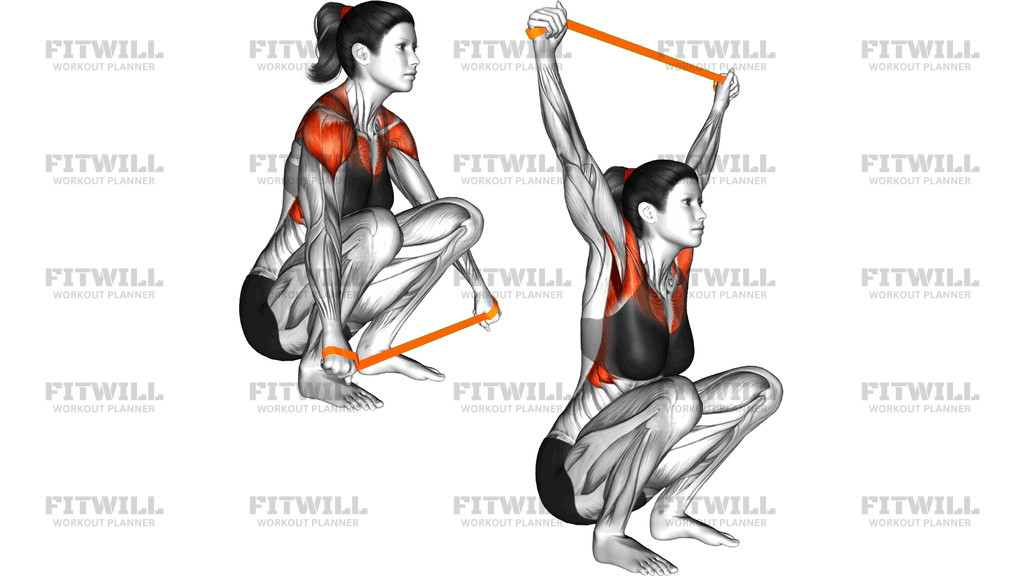
Instructions
- Place a loop resistance band flat under the balls of both feet, with even lengths of band extending to each side and your feet about hip-width apart.
- Sit down into a deep squat, heels flat on the floor, knees tracking over your toes, and let your torso lean slightly forward while staying tall through the chest.
- Grip one end of the band in each hand near your ankles, arms extended down and slightly outside your legs, with the band already under light tension.
- Brace your core and set your shoulder blades down and back before moving, so your shoulders are not shrugged up by your ears.
- Keeping the band taut, sweep both arms out to the sides and up in a wide circular path until they are fully extended overhead.
- Pause briefly at the top with arms straight and the band stretched, without letting your chest drop or your heels lift.
- Continue the circle in the same direction, bringing your arms back down along the same wide path to the starting position near your ankles.
- Breathe steadily throughout, inhaling as the arms lower and exhaling as they rise overhead.
- Complete all reps in one direction, then reverse the circle direction for the second set if desired.
- To finish, bring your arms down with control, release your grip on the band, and stand up out of the squat using your legs, not a forward flop.
Tips & Tricks
- If your heels rise when you squat down, widen your stance slightly or turn your toes out a few degrees; a wobbly base makes the arm circles impossible to control.
- A band that is too heavy is the most common problem here — if you have to shrug or lean back to get your arms overhead, switch to a lighter band.
- Keep your hands slightly wider than shoulder-width on the band; gripping too narrow shortens the circle and pinches the shoulders at the top.
- Do not let your lower back round at the bottom of the squat. Sit back into your hips and keep your chest lifted so the hold loads your legs, not your spine.
- If your shoulders click or feel pinched at the top, make the circles slightly smaller instead of forcing a full overhead reach.
- Speed is the enemy of this drill. Rushed circling lets momentum do the work and turns it into flailing; aim for two to three seconds per revolution.
- Your head should stay neutral. Watching your hands the whole way up encourages your chest to fall forward — pick a spot on the floor a few feet ahead of you.
- Keep constant tension on the band even at the bottom. If the band goes slack between circles, your hands are drifting inward and the shoulders lose the load.
- If the deep squat is your limiting factor, hold the bottom position only while the arms are moving, then stand and shake out your legs between sets.
Frequently Asked Questions
What muscles does the Resistance Band Seated Squat Arms Circle work?
The shoulders, especially the front and side delts, do most of the visible work as they circle the band overhead. Meanwhile your glutes and quads hold the deep squat isometrically, and your core stabilizes your torso throughout.
Why is this done in a deep squat instead of standing?
The squat hold removes momentum from the legs, keeps your center of mass low, and adds an isometric demand for the glutes, quads, and ankles. It also trains you to keep your shoulders mobile while your lower body is fatigued and locked in place.
Is the Resistance Band Seated Squat Arms Circle good for beginners?
Yes, as long as the band tension is light and the squat depth matches your mobility. Beginners can start with a shallower squat and smaller circles, then deepen both over time.
How deep should the squat be during this exercise?
Aim for the deepest squat you can hold with heels flat and a tall chest, which for most people means hips near or below the knees. If you cannot keep your heels down at full depth, squat slightly higher rather than rocking onto your toes.
Which direction should I circle my arms?
Either direction works, but a good habit is to do half your reps forward and half backward so the shoulders get balanced work through the full arc. Reversing direction mid-set also lets you keep going when one pattern fatigues.
What kind of band should I use for the Resistance Band Seated Squat Arms Circle?
A long loop band works best because it anchors under both feet and gives you enough length to reach overhead. Start with light tension; you should be able to complete the full circle without shrugging or leaning back.
Can I substitute this if I cannot squat that deep?
Yes. Sit on a low bench or box in a squat-width stance and loop the band under your feet, or perform the same arm circles standing if mobility is the limiter. You lose some of the leg and hip demand, but the shoulder work stays intact.
Is it a problem if my torso rocks with each circle?
Some lean is natural because the band pulls you around, but noticeable rocking means the band is too heavy or the circles are too fast. Slow the tempo down and lighten the resistance so the movement comes from the shoulders, not your trunk swinging.
How many reps should I do?
Time-based sets work well here, such as 20 to 40 seconds of continuous circling per direction, or 8 to 12 full revolutions. Since this is an endurance and mobility drill, stop when your circles get sloppy rather than chasing failure.
Is it safe for my knees and shoulders?
For healthy joints, yes — the band load is light and the squat is bodyweight. If you have a knee injury that limits deep flexion or a shoulder impingement that bothers overhead reaching, reduce the depth and the circle size, or clear the movement with a professional first.