Pilates Machine Overhead
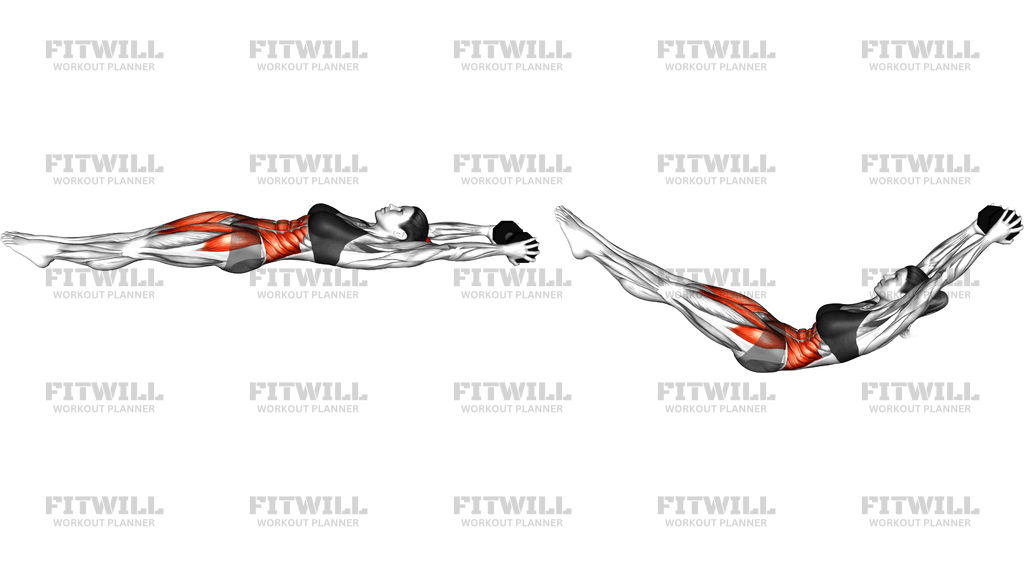
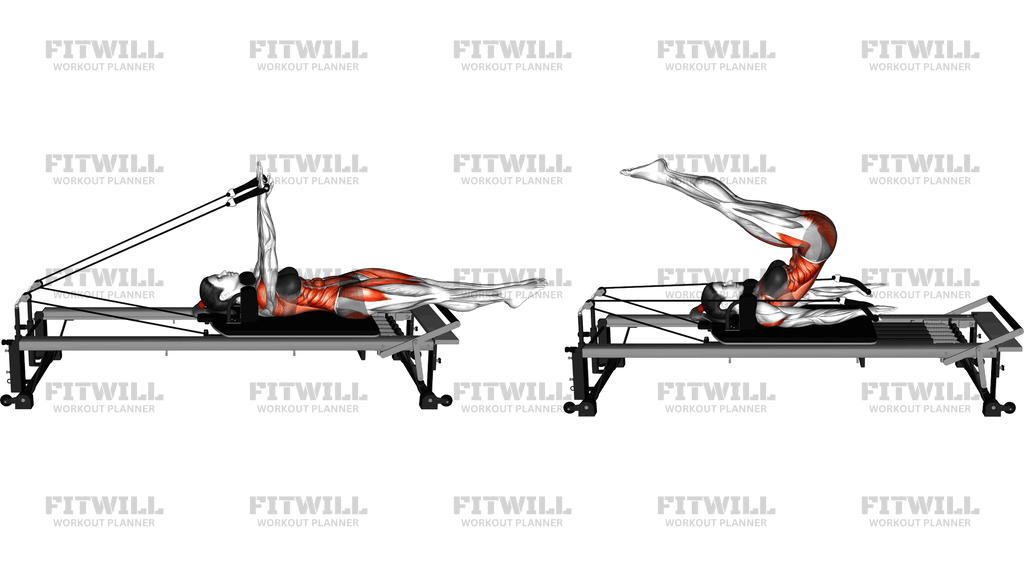
Pilates Machine Overhead is a reformer exercise that takes you from lying flat on the carriage into a full overhead position, with your legs tracing a long arc until your hips stack above your shoulders. You lie supine with your head near the shoulder rests, grip the straps or ropes attached to the pulleys, and use the tension of the machine as both resistance and guidance as your lower body travels over your head. It is one of the more demanding closing or mid-session movements in a reformer repertoire because it asks the trunk to move as one connected piece rather than folding at the waist.
The main work comes from the abdominal wall, especially the lower abs, which have to peel the pelvis off the carriage and control the descent back down. Your glutes and hamstrings extend the hips into the top position, while the shoulders and arms stay busy pressing the straps down to anchor the upper body and keep the carriage from drifting. Because the reformer's springs provide feedback through the whole range, you get a strong sense of where your spine is in space, which is hard to find on a mat.
This movement suits intermediate practitioners who already own a solid imprint, pelvic tilt, and controlled leg work on the reformer. Dancers and gymnasts use it to maintain deep hip flexor length and spinal articulation, while general clients often use it to build the eccentric core strength that everyday bending and lifting relies on. It also pairs well with short-spine or long-spine work in a sequence, since the shoulder and hip mechanics overlap.
Setup quality determines everything here. If your head is not cradled securely against the headrest or shoulder pads, or if your straps are uneven, the tension pulls asymmetrically and your spine will twist to compensate. Start with lighter spring tension than you think you need; heavy springs make the carriage the boss and encourage momentum instead of articulation.
To execute it well, think of the movement as rolling through the spine one vertebra at a time rather than swinging the legs. Press the arms down as the legs approach your torso, let the pelvis lift first, and continue until your hips are stacked over your shoulders with toes reaching toward the ceiling or slightly beyond. On the way down, resist the springs in the same order: upper back, mid back, waist, pelvis, then legs returning to the carriage.
Two safety points matter most. First, keep the neck neutral and never turn your head while the body is inverted, since the shoulders carry load in that position. Second, if you feel pressure building in your neck or lower back rather than your abdominals, shorten the range instead of forcing the full overhead position. Controlled partial range with a flat, supported lumbar spine beats a deep, wobbly jackknife every time.
[ Workout Log & Planner ]
Put your next workout in Fitwill
Keep your plan and training log ready when you are.


Instructions
- Lie supine on the reformer carriage with your head resting against the headrest or shoulder pads and your feet on the carriage or footbar area, legs extended.
- Reach both arms overhead and take hold of the straps or ropes, one in each hand, with even tension and your palms facing the ceiling.
- Draw your ribs down and gently imprint your lower back toward the carriage so your pelvis is neutral and your core is engaged before anything moves.
- Inhale to prepare, then exhale as you lift both legs together toward your chest, letting the pelvis begin to curl off the carriage.
- Press your arms down against the strap tension to anchor the shoulders as your hips continue to lift and your legs travel overhead.
- Continue articulating until your hips are stacked over your shoulders and your legs reach toward or slightly past vertical, keeping the neck long and still.
- Pause briefly at the top, holding the position with glutes engaged rather than letting the weight sink into the cervical spine.
- Exhale as you lower with control, returning the spine to the carriage in reverse order: upper back, mid back, waist, then pelvis.
- Let the legs return to their extended starting position on the carriage, re-set your neutral pelvis, and inhale before repeating.
Tips & Tricks
- If your chin juts or your neck lifts as the legs come over, shorten the range and stop where you can keep the back of the neck long.
- Common mistake: swinging the legs to gain momentum. The carriage will run away from you; slow the leg path down so the abs, not speed, do the lifting.
- Keep even pressure in both hands on the straps. Uneven grip tension is the usual cause of a twisted or diagonal overhead position.
- Do not let the pelvis dump into a deep arch on the way down. The eccentric lowering is where most of the lower ab strength is built.
- Start with one light to medium spring. Many people load too heavy, and the springs then pull the carriage instead of the core controlling it.
- Point your toes and reach them toward the ceiling at the top to lengthen the whole line; a floppy foot usually signals lost core connection.
- If your shoulders creep up toward your ears as you press the arms down, consciously slide the shoulder blades down your back before each rep.
- Warm up with pelvic curls or leg circles on the reformer first so the spine is articulating freely before it takes on the full overhead range.
- Place hands back on the straps deliberately between reps rather than grabbing quickly; fumbling the grip mid-set breaks the tension and the rhythm.
Frequently Asked Questions
Which muscles does Pilates Machine Overhead work the most?
The abdominals, particularly the lower abs and deep core, do the primary work of lifting and lowering the pelvis. The glutes and hamstrings extend the hips at the top, and the shoulders and arms stabilize by pressing down into the strap tension.
Is Pilates Machine Overhead suitable for beginners?
It is better treated as an intermediate exercise because it requires full spinal articulation and control while inverted. Beginners should build proficiency with pelvic curls, imprints, and reformer leg circles before attempting the full overhead range.
How much spring tension should I use for Pilates Machine Overhead?
Start lighter than you expect, often one light or medium spring, so the carriage does not overpower your control. Heavier tension makes it tempting to use momentum instead of articulating through the spine.
Why do I hold straps during the Pilates Machine Overhead?
The straps anchor your upper body and give the arms something to press against as the legs travel overhead. Without that anchor, the shoulders tend to lift and the carriage position becomes harder to control.
My neck feels strained at the top of Pilates Machine Overhead. What should I change?
Stop the range earlier, before your hips stack fully, and keep the weight of the trunk supported by the upper back rather than the cervical spine. Keep the head still and neutral, and never turn it while you are inverted.
What is the most common mistake in Pilates Machine Overhead?
Swinging the legs up with momentum instead of curling the pelvis first. This usually shows up as a folded position at the waist with a jammed lower back rather than a smooth spinal roll.
Can I substitute Pilates Machine Overhead if I do not have a reformer?
A mat-based jackknife or controlled roll-over works similar hip and spinal mechanics, though you lose the spring feedback of the machine. Adding a resistance band held under the hands can partially recreate the arm anchor.
How should I breathe during Pilates Machine Overhead?
Inhale to prepare, exhale as the legs lift and the pelvis curls up, then exhale again through the controlled lowering. Avoid holding your breath at the top, since pressure tends to build in the neck and face when you do.
How many repetitions of Pilates Machine Overhead should I do?
Three to five slow, precise repetitions is typical, since quality degrades quickly once the core fatigues. Rest fully between sets and end the set before your lower back starts taking over the movement.