Dumbbell Single Arm Shrug
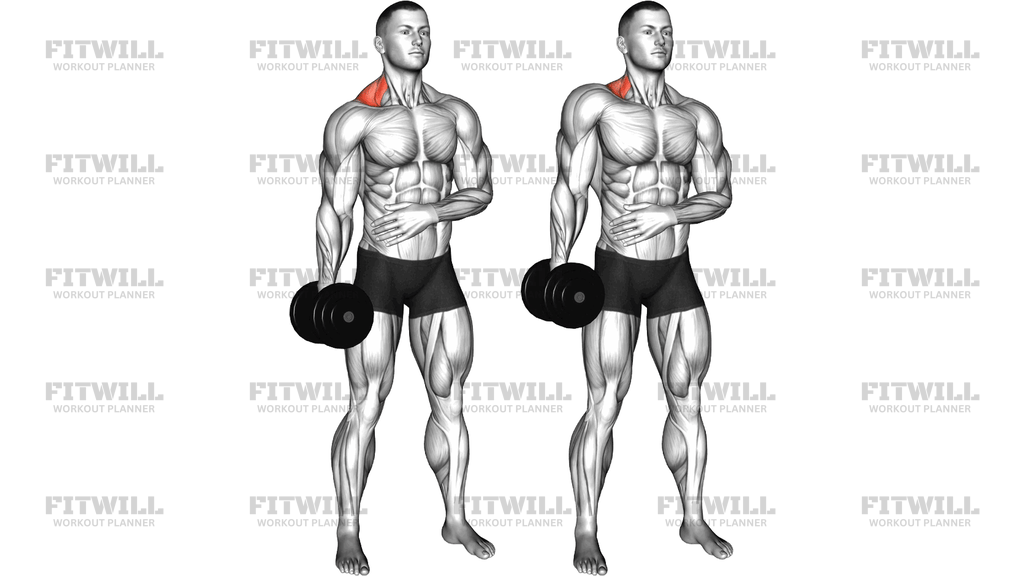
The Dumbbell Single Arm Shrug is a standing trap isolation exercise performed with one dumbbell working at a time while the free hand rests across your midsection for balance and body awareness. From a tall standing position, you simply elevate the loaded shoulder straight up toward your ear, pause at the top, and lower the dumbbell under control. The highlight of this movement is how cleanly it targets the upper trapezius on the working side, since the single-arm setup removes any chance of your stronger side compensating for the weaker one.
Because each side works alone, this variation is especially useful for lifters who have noticed a shoulder-height difference during barbell or dual dumbbell shrugs. It also fits well into rehabilitation-informed training around the neck and shoulder girdle, where controlled scapular elevation through a full range matters more than heavy load. Grip demands stay moderate since only one dumbbell is in play, which lets you focus on the quality of the shrug rather than fighting to hold onto two heavy weights.
The setup matters more than most people expect. Standing with one arm loaded means your torso wants to lean and rotate away from the weight, so bracing your core and keeping your spine neutral is what keeps the tension on the upper trap instead of leaking into your lower back. Your free hand can rest lightly over your stomach or across your ribs as a tactile cue to stay upright and square. Feet stay about hip-width apart with weight distributed evenly.
To execute well, let the dumbbell hang at full arm length with your shoulder relaxed and slightly stretched downward before you start. Drive the shoulder vertically toward the ear without bending the elbow, rolling the shoulder, or turning your head. The top position is a brief, deliberate pause where the trap is fully shortened, followed by a slow descent back to the stretched starting point. That stretch at the bottom is half the value of the exercise, so resist the urge to rush it.
This movement slots into back or shoulder days as an accessory, typically for 2 to 4 sets of 10 to 15 reps per side with a moderate weight. It pairs naturally with rows and pulls that already hit the mid-back, adding dedicated work for the upper fibers that those movements only partially cover. Keep the load honest: if you have to swing or lean to lift the dumbbell, the set is telling you the weight is too heavy for clean trap work.
[ Workout Log & Planner ]
Put your next workout in Fitwill
Keep your plan and training log ready when you are.


Instructions
- Stand with your feet about hip-width apart, holding one dumbbell in your right hand at your side with a neutral grip, palm facing your thigh.
- Place your left hand lightly over your stomach or across your lower ribs and set your feet flat on the floor with your weight evenly distributed.
- Stand tall with your chest up, ribs stacked over your hips, and brace your abdominals so your torso will not lean or twist during the set.
- Let the dumbbell pull your right shoulder down slightly so the upper trap feels a gentle stretch at the bottom before you lift.
- Exhale and shrug your right shoulder straight up toward your ear, keeping the elbow nearly straight and avoiding any shoulder rolling.
- Pause for a one-count at the top with the trap fully contracted and your head staying level, eyes forward.
- Inhale and lower the dumbbell slowly until your shoulder returns to the relaxed, stretched starting position.
- Complete all reps on the right side, then switch the dumbbell to your left hand and rest your right hand over your midsection for the second set.
- Set the dumbbell down on a bench or the floor between sets rather than holding it while fatigued, and reset your stance and brace before each new side.
Tips & Tricks
- A common mistake is bending the elbow to help lift the dumbbell, which turns the shrug into a partial upright row. Keep the arm long and let the shoulder blade do the lifting.
- Avoid rotating your torso away from the weight as the set gets hard. If your chest starts twisting toward or away from the loaded side, drop the weight slightly.
- Do not shorten the range by cutting the bottom half. The stretch when the dumbbell pulls the shoulder down is where much of the trap work happens.
- Resist the urge to roll the shoulders backward or forward in a circular motion. Straight up and straight down trains the upper trap without stressing the shoulder joint.
- Keep your head neutral and eyes forward; jutting the chin toward the working shoulder is a compensation that reduces the range the trap actually travels.
- Use lifting straps only if grip failure is cutting your sets short, but try without them first since the single-arm setup keeps grip demands reasonable.
- Match reps and tempo exactly between sides, and always start your sets with the weaker side so any imbalance works in your favor.
- If the dumbbell bangs into your thigh at the bottom, your arm is drifting forward. Let it hang slightly behind your hip line, aligned under the shoulder.
- Keep the working wrist straight and stacked over the dumbbell; a bent-back wrist under load fatigues the forearm and distracts from the trap contraction.
Frequently Asked Questions
Which muscles does the Dumbbell Single Arm Shrug work?
The upper trapezius on the working side is the primary muscle, with support from the middle trapezius and levator scapulae. Your forearms and grip also work isometrically to hold the dumbbell.
Why does the Dumbbell Single Arm Shrug use one arm instead of two dumbbells?
Training one side at a time lets you match strength and shoulder height between sides and prevents your dominant arm from taking over. It also allows a slightly larger range at the bottom since there is no second dumbbell limiting the stretch.
Is the Dumbbell Single Arm Shrug good for beginners?
Yes, it is one of the simplest shrug variations to learn because the path is short and the single dumbbell is easy to control. Start light, focus on the pause at the top, and add weight only when the movement feels smooth.
Should I rest my free hand on my stomach during the Dumbbell Single Arm Shrug?
Resting the free hand lightly across your midsection is fine and can help you feel whether your torso is twisting. Keep it passive so it does not push against your body or provide leverage.
How heavy should the dumbbell be for the Dumbbell Single Arm Shrug?
Choose a weight you can lift for 10 to 15 controlled reps per side without leaning, rotating, or bending your elbow. If you cannot pause for a full second at the top, the dumbbell is likely too heavy.
What is the most common mistake in the Dumbbell Single Arm Shrug?
The most common error is turning the shrug into a rolling or circular motion, which adds no trap benefit and can irritate the shoulder. Lift the shoulder straight up toward the ear and lower it straight back down.
Can I do the Dumbbell Single Arm Shrug if my grip gives out before my traps?
Yes, a lifting strap is a reasonable fix since the exercise targets the trap rather than the forearms. You can also switch to a dumbbell with a thicker or more comfortable handle to spread the load across your hand.
How does the Dumbbell Single Arm Shrug differ from a barbell shrug?
A barbell shrug trains both sides together and usually allows more total load, while the single-arm dumbbell version isolates each side and gives a freer, longer stretch at the bottom. Many lifters use both, with the single-arm version as the balance-focused accessory.
Is it safe to do the Dumbbell Single Arm Shrug with a history of neck tightness?
Move with light weight, keep your head level, and stay within a pain-free range if you have a history of neck issues. If the movement provokes discomfort, check with a qualified professional before continuing.
Where should the Dumbbell Single Arm Shrug fit in my workout?
Place it near the end of a back or shoulder session after your main rows and pulls, for 2 to 4 sets of 10 to 15 reps per side. Because it is a short-range movement, it works best as an accessory rather than your primary upper-back lift.