Chest Dip On Pull Up Bar
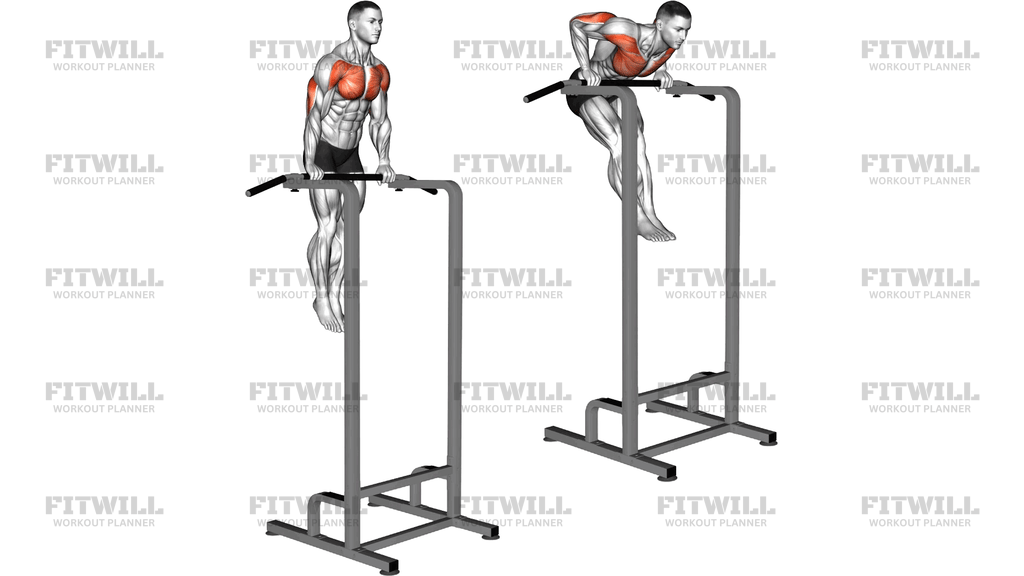
The Chest Dip On Pull Up Bar is a bodyweight pressing movement performed on the parallel dip handles of a pull-up bar station. Unlike a straight-up-and-down triceps dip, the chest version puts you in a forward lean so your torso acts like an incline press in reverse — the lower chest takes the brunt of the load while the triceps and front delts assist. The highlighted musculature in this movement is the pectorals, with visible support from the triceps along the back of the arm.
This exercise earns its place in a pressing routine because it loads the chest through a deep stretch under your full body weight, something push-ups and bench pressing don't always match. It suits intermediate lifters who can already handle their body weight on straight-arm support, and it's a staple for anyone training at home or in a gym with a power tower. If you can do push-ups comfortably but haven't yet dipped your toes into dipping, this is the progression worth building toward.
Setup matters more here than in most pressing exercises. Grab the bars with a firm, neutral grip, press yourself up to full elbow lockout, and let your legs hang with knees slightly bent or ankles crossed behind you. Before you descend, tilt your chest down and pull your shoulders back and down — that forward torso angle is what turns a triceps dip into a chest dip. If you drop into the rep bolt upright, you'll shift the work to the arms and squeeze the shoulder joint at the bottom.
From the top, lower yourself by bending the elbows and letting them drift out slightly, until you feel a solid stretch across the chest or your shoulders drop just below elbow level. Then drive through the bars and press back up to locked arms, keeping the same forward lean throughout. The path should feel like a slight arc: torso drifting forward and down, then back up and slightly behind the hands at the top.
The Chest Dip On Pull Up Bar is commonly used as a mass-builder for the lower chest, as a strength benchmark, or as a weighted progression once bodyweight reps get easy. Common use cases include pairing it with rows or pull-ups for balanced upper-body development, and using it late in a pressing day when the chest is pre-fatigued.
Treat the bottom position with respect. Descending too fast or going deeper than your shoulder mobility allows is the most common way this exercise goes wrong. Start with a moderate range, control the descent for two to three seconds, and only add depth or external weight as your strength and comfort on the bars grow.
[ Workout Log & Planner ]
Put your next workout in Fitwill
Keep your plan and training log ready when you are.


Instructions
- Stand between the parallel dip handles of the pull-up bar station and grip each bar with a closed, neutral grip, knuckles facing forward.
- Press down through the bars to straighten your arms and lift your body clear of the floor, letting your legs hang with knees softly bent or ankles crossed behind you.
- Draw your shoulders back and down, then lean your torso forward so your chest points toward the floor and your shoulders sit slightly ahead of your hands.
- Brace your core and squeeze your glutes lightly to stop your legs from swinging.
- Inhale, then bend your elbows and lower your body in a controlled arc, letting the elbows flare out a little as your chest travels down between your hands.
- Descend until you feel a deep stretch across the chest or your upper arms reach roughly parallel to the floor.
- Exhale and press hard through the bars, driving your body back up along the same arc until your elbows are fully extended.
- Hold the lockout for a moment with the forward lean preserved, then reset your brace before starting the next rep.
- Step down carefully or lower yourself to the floor when your set is finished — never drop from full lockout with tired arms.
Tips & Tricks
- Keep the forward lean constant from top to bottom; if you straighten up at the bottom of the rep, the tension shifts to the triceps and the chest loses its stretch.
- The most common fault is dropping fast and bouncing out of the bottom. Take two to three seconds on the way down so the chest, not momentum, controls the rep.
- If your shoulders roll forward at the bottom, you've gone past your comfortable range. Cut the depth a few inches and rebuild it gradually.
- Keep your wrists stacked over the bars rather than bent back; a broken wrist position wastes force and strains the forearms on heavy or weighted reps.
- Crossing your ankles and bending your knees slightly behind you gives you a more stable hanging position and makes it easier to hold the forward lean than straight, swinging legs.
- Don't shrug into your ears at the top — actively press the bars away and keep the shoulders packed down to protect the shoulder joint at lockout.
- If bodyweight reps are too hard, use an assisted dip machine or loop a resistance band over the bars and under your knees before switching to full reps.
- Once you can complete clean sets of ten or more, add weight with a dip belt between your legs rather than piling on excessive reps.
- Warm up the shoulders with a few straight-arm support holds and shallow partial dips before committing to full-depth reps.
Frequently Asked Questions
Which muscles does the Chest Dip On Pull Up Bar work?
The lower chest is the primary mover, with the triceps and front shoulders assisting throughout the press. The lats and stabilizers around the shoulder also work to keep your body controlled on the bars.
How is the Chest Dip On Pull Up Bar different from a regular dip?
The chest version uses a pronounced forward lean with elbows allowed to flare slightly, which shifts emphasis from the triceps to the pectorals. A regular dip keeps the torso more upright, loading the arms more heavily.
Can beginners do the Chest Dip On Pull Up Bar?
Absolute beginners often lack the pressing strength to control their bodyweight on the bars, so start with an assisted dip machine or a resistance band looped under the knees. Build to full bodyweight reps once you can perform slow, controlled assisted reps.
How deep should I go on the Chest Dip On Pull Up Bar?
Lower until you feel a strong stretch across the chest and your upper arms are roughly parallel to the floor. Going deeper only helps if you can keep your shoulders packed back and control the weight — otherwise it just loads the shoulder joint.
Why do my triceps fatigue before my chest on this exercise?
That usually means your torso is too upright. Commit to a stronger forward lean at the top, let your shoulders travel slightly ahead of your hands, and the chest will take over more of the work.
What can I use instead if my station has no dip handles?
Parallel dip bars, a dip station, or the corner of a sturdy kitchen counter can work, and a weighted push-up with feet elevated is a reasonable substitute. Rings are a harder alternative because they add instability.
Are dips bad for the shoulders?
Not when the range and control match your mobility — the problems come from bouncing out of a deep bottom position with shrugged shoulders. Keep the descent slow, limit depth to what feels like a chest stretch, and stop if you feel pinching at the front of the shoulder.
How should I breathe during the Chest Dip On Pull Up Bar?
Inhale as you lower into the dip and exhale forcefully as you press back up to lockout. Holding a braced breath through the descent helps keep the torso rigid, but don't hold it for multiple reps.
When should I add weight to my chest dips?
Once you can perform around ten clean, full-depth reps with a two-second descent, attach a dip belt with a plate or dumbbell. Adding load is more productive for strength than grinding out sets of twenty-five or more.