Barbell Pendlay Row From Deficit (Version 2)
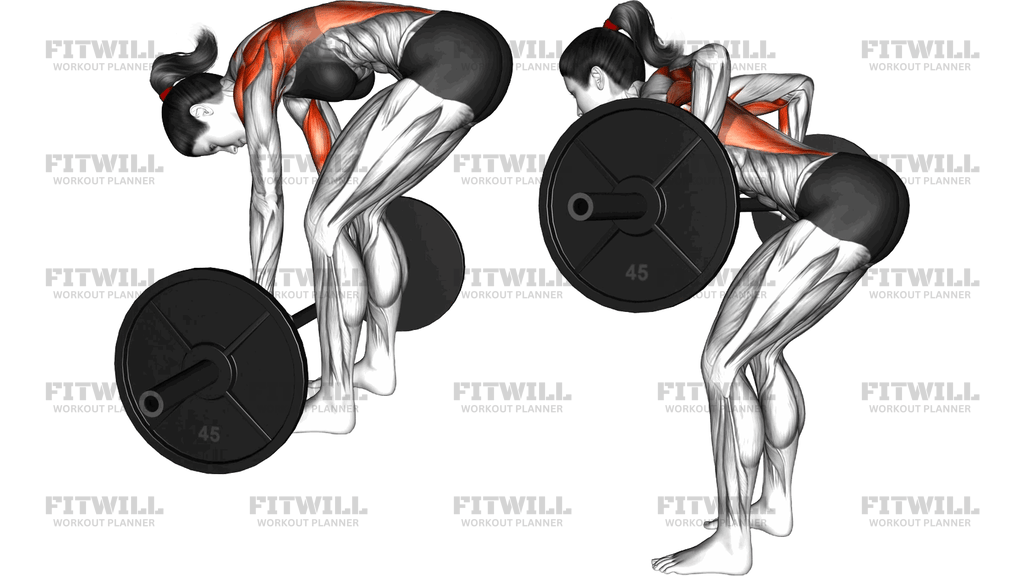
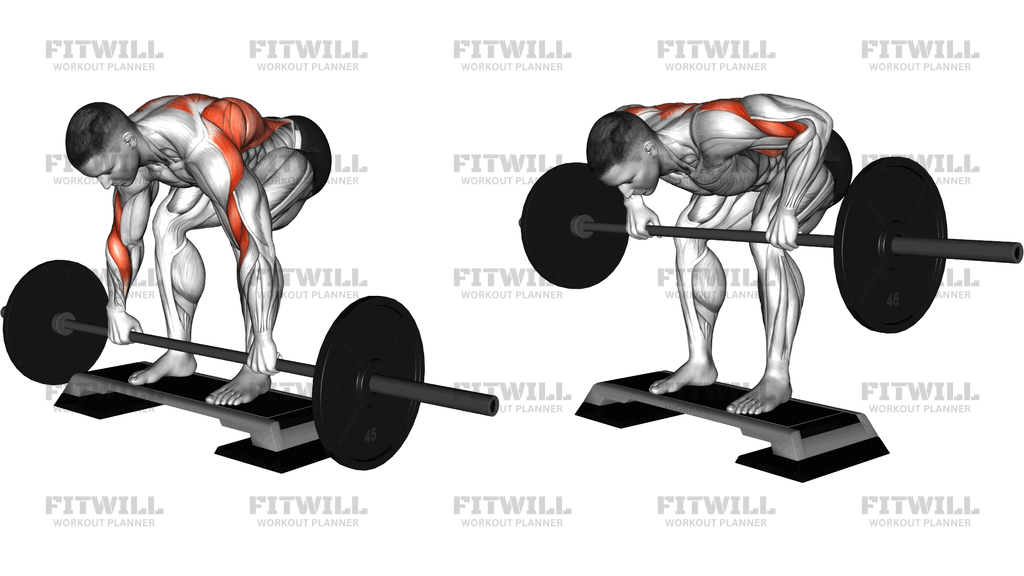
The Barbell Pendlay Row From Deficit (Version 2) is a strict, dead-stop row performed while standing on a low platform or step, which places the bar lower than it would be at floor level. Every rep starts from a complete stop on the ground, and the bar is pulled explosively up to the sternum before being returned and reset. The deficit simply lengthens the distance the bar has to travel, forcing a deeper hinge and a longer pull than a standard Pendlay row.
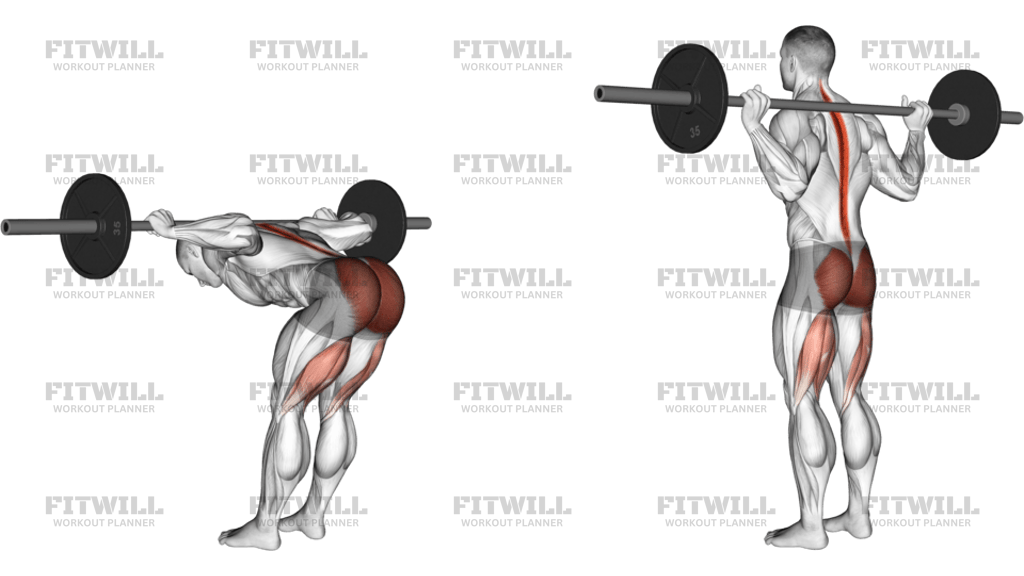
This movement is built around the upper back. The traps and rhomboids do most of the work at the top of the pull, with strong contributions from the rear shoulders and lats. Because you reset the bar on every rep, the lower back works hard isometrically to hold a hinged position, and the hamstrings and glutes anchor the hip position. The grip and forearms also get meaningful work since the bar is re-gripped and re-tightened each rep.
The setup is what separates this exercise from a loose bent-over row. Standing on the platform raises your body relative to the bar, so your torso must hinge lower to reach it. That deeper hinge gives you extra range of motion, but it also puts more demand on your hip hinge strength and spinal positioning. Lifters who rush this setup tend to lose their back position before the pull even starts, so treat the setup as part of the exercise.
Executed well, each rep is a short, explosive pull from a dead stop. The legs stay mostly static, the torso angle stays fixed, and the bar travels up toward the lower chest or upper abdomen with the elbows driving back. There is no bounce, no heave from the hips, and no lowering under tension in the way a traditional row uses. This makes it a useful tool for Olympic lifting backup strength, pulling power, and building thickness through the mid and upper back.
The Barbell Pendlay Row From Deficit (Version 2) suits intermediate lifters who already own a solid hip hinge and can hold a bent-over position without their lower back rounding. Use moderate loads at first, since the deficit and the dead stop both reduce how much weight you can move compared with a standard row. Keep reps in the 5 to 10 range, stop the set when your torso angle starts to creep upward, and step off the platform carefully between sets.
[ Workout Log & Planner ]
Put your next workout in Fitwill
Keep your plan and training log ready when you are.


Instructions
- Place a low step platform or flat deficit platform on the floor and set a loaded barbell in front of it, then stand on the platform with your feet about hip-width apart and the bar over the middle of your feet.
- Hinge at the hips and bend your knees slightly so your torso sits close to horizontal, then grip the bar slightly wider than shoulder-width with an overhand grip.
- Pull the slack out of the bar and brace your torso, taking a breath into your belly and tightening your lats so the bar feels locked to your body before it leaves the ground.
- Keeping your hips and torso angle completely still, pull the bar explosively off the platform and drive your elbows up and back toward your hips.
- Continue the pull until the bar touches or nearly touches your lower chest or upper abdomen, squeezing your shoulder blades together at the top.
- Lower the bar back down under control and let it settle fully dead on the floor, releasing tension briefly without letting go of the bar.
- Exhale at the bottom, re-brace, re-tighten your grip and lats, then start the next pull from the complete stop.
- Repeat for your target reps, then stand up fully before stepping off the platform, never stepping down while bent over the loaded bar.
Tips & Tricks
- Choose a deficit of roughly two to four inches. A taller platform pushes your torso even lower and makes holding a flat back much harder without adding much to the pull itself.
- If your hips rise as you pull, the weight is too heavy or your brace is loose. Reset the bar, drop the load, and re-tighten before the next rep.
- Do not let the bar drift away from your body as it comes off the floor. Keep it dragging up your shins and thighs; a bar path that swings forward shifts stress off the upper back.
- Pull to the sternum, not the neck. Rowing the bar too high tends to flare the elbows and turn the movement into a shrug.
- Use a hook grip or lifting straps on heavier sets, since re-tightening a plain grip from a dead stop is often the first thing to fail.
- Because every rep starts from rest, treat each one as its own lift. Pulling the first rep's rhythm into the second is how torso angle gets stolen rep by rep.
- Warm up your hinge with a few plain Pendlay rows from the floor before adding the platform, so the deeper bent-over position is not a surprise under load.
- If your lower back rounds in the bottom position, reduce the deficit or elevate the bar slightly rather than forcing the deeper range with a compromised spine position.
Frequently Asked Questions
Which muscles does the Barbell Pendlay Row From Deficit (Version 2) work?
The main drivers are the traps, rhomboids, and rear shoulders, with the lats assisting on the pull. The lower back, glutes, and hamstrings work statically to hold the deep hinge, and the forearms handle the gripping.
What does the deficit actually add compared to a regular Pendlay row?
Standing on a platform lowers the bar relative to your body, so you have to hinge deeper and pull through a longer range. That extra range increases the demand on your hinge position and the stretch on your upper back at the start.
Is the Barbell Pendlay Row From Deficit (Version 2) suitable for beginners?
It is better saved until you can hold a bent-over hinge with a flat back and have practiced standard Pendlay rows. The deeper starting position magnifies any weakness in bracing or hip hinge control.
How high should the deficit platform be?
Two to four inches is plenty for most lifters. If your lower back rounds or your hips shift when you reach the bar, the platform is too tall for your current mobility.
Why does the bar have to stop on the floor every rep?
The dead stop is the defining feature of the Pendlay style: it removes momentum and stretch reflex, so each pull is generated purely from the upper back and hips. It also gives you a brief reset to re-brace between reps.
What is the most common mistake with this exercise?
Turning it into a hip-driven cheat row. If your torso angle rises, your hips extend, or the bar bounces off the floor, the set has drifted away from the intent and the load is likely too heavy.
What can I substitute if I do not have a platform for a deficit?
A standard Barbell Pendlay Row from the floor trains the same dead-stop pattern with a shorter range. A heavy plates-only setup, where the bar sits lower on smaller plates, is another way to create a modest deficit.
Should I use an overhand or underhand grip?
Use an overhand grip slightly wider than shoulder-width, which is the standard for this movement and keeps both arms working evenly. An underhand grip invites biceps involvement and uneven pulling as the weight gets heavy.
How should I breathe during the Barbell Pendlay Row From Deficit (Version 2)?
Take a breath and brace before each pull, hold it through the rep, and exhale as the bar settles back to the floor. Because the bar rests between reps, you have a natural moment to reset your breath every single time.
How do I approach this movement safely?
Start lighter than your regular row, keep your spine neutral in the deep hinge, and never step on or off the platform while bent over the loaded bar. End the set as soon as your form changes, not when your grip gives out completely.