Pike Stand With Extended Leg
Pike Stand With Extended Leg is an inversion and shoulder-strength drill performed with the feet elevated on a sturdy box or step platform. You start in a high plank position with your toes on the box, then walk your hands back until your hips stack directly over your shoulders in a compressed pike. From there, you slowly extend one leg up toward the ceiling while the supporting leg stays planted on the box, holding the stacked, handstand-like line before switching sides.
This movement sits at the crossroads between pike push-up conditioning and true handstand work. Because the feet are elevated, you can practice the exact shoulder and hip stacking you need for a freestanding handstand without having to kick up or balance on your own. The extended leg adds a one-sided load that forces your shoulders, wrists, and trunk to resist rotation, which makes it a more demanding progression than holding a symmetrical pike.
The main work is done by the shoulders, triceps, and upper traps, which support your entire body weight at a steep angle. The deep core and obliques work hard to keep your hips square while one leg reaches up, and the hamstrings and calves of the standing leg take a strong stretch through the back of the hip. Elevating the feet matters because it shortens the distance your hands must travel back and lets you find vertical stacking at a level that matches your current mobility and strength.
To execute the movement well, keep your elbows straight and your shoulder blades pushing actively up toward the box the entire time. Move into the pike with small steps of the hands rather than one big jump, and only extend the top leg once your hips feel stacked and stable over your shoulders. The leg lift should be slow and controlled rather than a kick, since a fast swing tends to pull your shoulders behind your wrists and off the vertical line.
This drill is a natural fit for calisthenics and handstand progressions, and it also works well as a demanding finisher in general upper body training. Gymnasts, yogis, and anyone working toward handstand push-ups benefit from the overhead loading in a supported position. Start with a lower box to keep the angle manageable, and only raise the height as your compressed pike becomes comfortable. If you feel wrist pain or your shoulders drift toward your ears, step back down to an easier angle rather than pushing through it.
[ Workout Log & Planner ]
Put your next workout in Fitwill
Keep your plan and training log ready when you are.


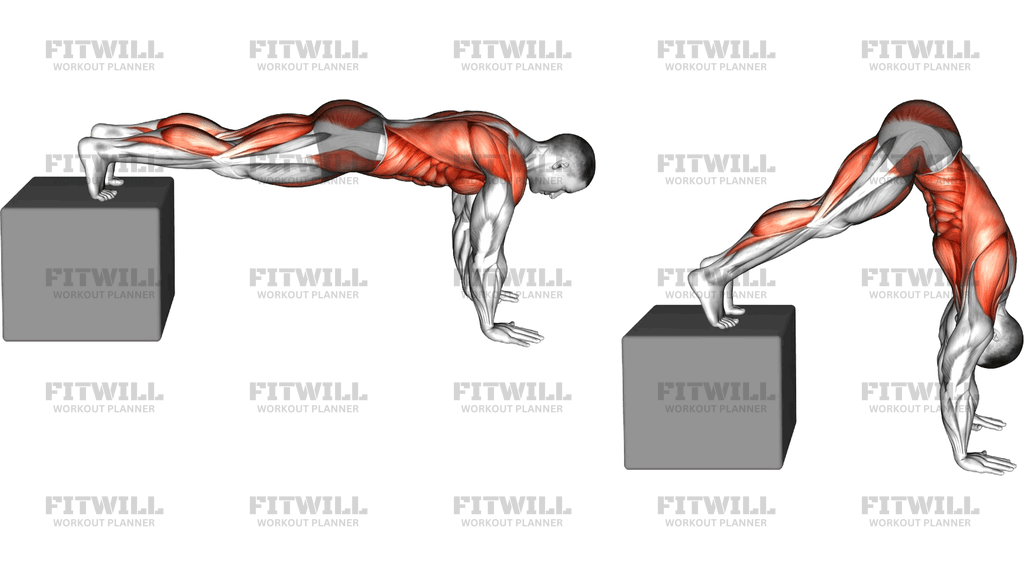
Instructions
- Place a sturdy box or step platform on a non-slip floor and set your toes on its edge so you are in a high plank with hands on the floor about shoulder-width apart.
- Walk your hands back toward the box in small steps, lifting your hips as you go, until your body forms a compressed pike with hips stacked over or slightly past your shoulders.
- Spread your fingers, grip the floor, and press firmly through the base of your knuckles and thumb to create a stable hand platform.
- Straighten your elbows completely and push the floor away so your shoulder blades elevate and your neck stays long between your arms.
- Brace your trunk, then slowly raise one leg straight up toward the ceiling, keeping the knee extended and the toes of that foot pointed toward the sky.
- Keep both hips square to the floor as the leg rises; resist the urge to open the chest or let the shoulders drift behind the wrists.
- Pause at the top with the extended leg as vertical as your mobility allows, holding for a slow breath or two while pressing hard through the supporting arm.
- Lower the extended leg back to the box under control, re-stabilize your pike, then repeat on the other side for the desired number of reps.
- Exhale as the leg lifts and inhale steadily as you hold; keep breathing rather than holding your breath through the extension.
- To finish, walk your hands forward in small steps until you are back in the high plank, then step one foot off the box at a time.
Tips & Tricks
- If your hips never reach vertical, the box is likely too low for your hamstring flexibility or the angle too shallow for stacking; raise the platform height before adding leg extensions.
- Bending the elbows is the most common breakdown point here. Once one arm softens, your shoulders rotate sideways. If that happens, hold the pike with both feet down and only lift the leg a few inches until you own the position.
- Do not let the shoulders slide forward past the wrists when the leg extends. If that happens, walk your hands an inch or two further back before lifting the leg again.
- Aim the extended leg at the ceiling, not out behind you. Reaching backward turns the drill into a balance trick and drops your shoulders out of the vertical line you are trying to train.
- Point the toes of the supporting foot slightly over the box edge and keep that knee fully straight; a soft standing leg lets your hips sag and shortens the pike.
- Warm up your wrists with rocks and circles before your first set, since the elevated angle places more load on the wrist extension than a standard pike on the floor.
- If your hips twist as the leg lifts, think about driving the standing heel up and back while pulling the lifted leg up, as if your hips were squeezed between two panes of glass.
- Film yourself from the side. What feels stacked from the inside is often a shallow pike, and the video will show you exactly how far to walk your hands back.
- Keep sessions short and high quality. This drill fatigues the shoulder stabilizers fast, and practicing it tired tends to ingrain the sinking-shoulder fault you are trying to eliminate.
Frequently Asked Questions
What muscles does the Pike Stand With Extended Leg work?
The shoulders and triceps carry most of your body weight, with the trapezius and shoulder stabilizers holding the vertical line. The core, especially the obliques, prevents twisting when one leg extends, and the hamstrings of the standing leg take a strong stretch.
How is the Pike Stand With Extended Leg different from a normal pike hold on the floor?
Elevating your feet on a box lets you walk your hands back further, so your hips can stack closer to a true vertical handstand line. Adding the extended leg also shifts your weight to one side, which demands much more anti-rotation control than a symmetrical pike.
Can beginners do the Pike Stand With Extended Leg?
Yes, if you scale it correctly. Start with a low box, hold the compressed pike with both feet down, and only lift the free leg a few inches until your shoulders and wrists feel secure in the stacked position.
How high should the box be for the Pike Stand With Extended Leg?
Choose a height that lets you walk your hands back until your hips sit at or slightly past your shoulders while keeping your back flat and legs nearly straight. If your hamstrings force a big bend in the knees or your hips never get over your shoulders, the box is too low.
Why do my wrists hurt during the Pike Stand With Extended Leg?
The elevated pike loads the wrists at a sharper angle than a plank, so insufficient warm-up or grip is the usual culprit. Spread your fingers, grip the floor actively, load the base of the palm, and if discomfort persists, reduce the box height or work on wrist mobility separately.
How long should I hold the extended leg position?
Two to five controlled breaths per side is plenty at first. This is a precision drill, so shorter holds with perfect shoulder stacking and square hips beat long holds where the position quietly degrades.
What should I do if my shoulders sink toward my ears in the Pike Stand With Extended Leg?
Push the floor away harder and think about elevating your shoulder blades toward the box while keeping the elbows locked. If you cannot maintain that push with the leg extended, lower the leg back to the box and rebuild the hold with both feet down.
What exercise can I substitute for the Pike Stand With Extended Leg?
A wall-supported pike hold or a feet-elevated pike with both feet down trains the same shoulder and core demand with less balance. Downward dog holds and box pike push-ups are also useful progressions along the same path.
Is the Pike Stand With Extended Leg safe for the lower back?
It is generally well tolerated because the lumbar spine stays in a flexed, rounded pike rather than an arched position. Keep the lift slow, avoid arching the back to chase leg height, and stop if you feel pinching in the hips or strain along the spine.
How does the Pike Stand With Extended Leg help with handstands?
It rehearses the two hardest elements of a handstand in a supported setup: stacking the hips over the shoulders, and holding that line while the legs are split. Once this position feels stable, the transition to wall and freestanding handstand work is much shorter.