Forearms Plank With Shoulder Protraction
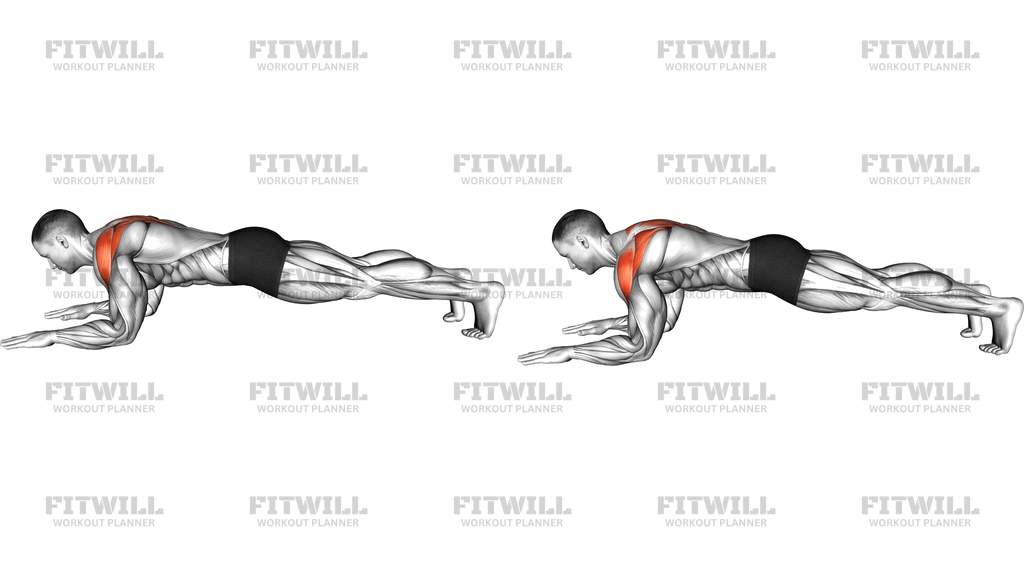
The Forearms Plank With Shoulder Protraction takes a standard forearm plank and adds a slow, deliberate forward push through the shoulder blades. From a stable plank on your forearms and toes, you drive your upper back toward the ceiling and let your shoulders drift forward past your elbows, then pull them back to the stacked start position. The movement is small — a few inches of travel — but it targets the serratus anterior, the fan-shaped muscle along the side of your ribcage that controls how your shoulder blade moves on your torso.
This exercise is useful for anyone who wants stronger, better-coordinated shoulder blades: push-up and press enthusiasts, desk workers whose upper backs tend to slump, and people rebuilding scapular control after long periods of imbalanced pressing. Because you hold a plank the entire time, your deep core, glutes, and legs work isometrically to keep your torso from sagging or rocking while your shoulders move.
Setup matters more here than in most core work. Elbows sit directly under the shoulders, forearms parallel on the floor, and the body forms one straight line from head to heels. If your elbows drift ahead of or behind your shoulders, the protraction becomes either too easy or a strain on the front of the shoulder. A mat under the forearms keeps the position comfortable enough to focus on the scapular motion rather than elbow pressure.
To execute it well, think of the floor pushing back at you. Round your upper back slightly by pressing the forearms down and spreading the shoulder blades apart — your torso should rise a touch and your chest shift toward your elbows. Pause there, then reverse the motion by letting the chest lower gently between the arms until the shoulder blades draw back together. Keep the hips level throughout; the movement comes from the upper back, not from hiking the pelvis or bouncing.
You will see this drill in warm-ups, shoulder-health circuits, and calisthenics progressions toward push-ups, planche work, and handstand training, all of which rely on a strong protracting position. Start with 6–10 slow repetitions and stop when your hips begin to shift or your lower back starts to arch — quality of the scapular glide always beats rep count.
[ Workout Log & Planner ]
Put your next workout in Fitwill
Keep your plan and training log ready when you are.


Instructions
- Place an exercise mat on the floor and set up on your forearms and toes with your elbows directly under your shoulders and your forearms pointing straight ahead, parallel to each other.
- Extend your legs behind you with your feet about hip-width apart, and form one straight line from your head through your hips to your heels.
- Brace your abdominals, squeeze your glutes lightly, and pull your shoulder blades slightly together so your chest sits tall between your arms — this is the starting position.
- Inhale, then press your forearms firmly into the floor and push your upper back toward the ceiling, letting your shoulders glide forward past your elbows so the shoulder blades spread apart.
- At the end of the push, your chest should sit slightly closer to your elbows and your upper back should look gently rounded; hold this protracted position for one to two seconds.
- Exhale as you slowly lower your chest back between your arms, allowing the shoulder blades to draw together until you return to the stacked starting position.
- Keep your hips level and your neck neutral the entire time — the only moving joints are the shoulder blades, not the spine or pelvis.
- Breathe steadily throughout, inhaling on the push forward and exhaling on the return, and complete 6–10 controlled repetitions per set.
- Between sets, drop to your knees and shake out your wrists and forearms, then re-set your elbow position before the next set.
Tips & Tricks
- The most common error is losing the plank as you push: if your hips rise or your lower back arches, reduce the range and think of the motion happening only at the shoulder blades.
- Do not let your head drop toward the floor as you protract — keep your neck long and your gaze slightly down so the upper back rounds, not the cervical spine.
- If your elbows wander forward during the push, mark their position with your eyes at setup and check them again on every rep; the elbows should stay glued under the shoulders.
- Move slowly enough that each rep takes three to four seconds total. Fast bouncing turns this into a momentum drill and removes most of the serratus stimulus.
- Feel the work along the side of your ribs under your armpit. If you only feel the front of your shoulders, you are likely shrugging upward instead of pushing the upper back toward the ceiling.
- Keep your weight spread evenly across both forearms. Dumping weight onto one side usually means the torso is rotating and the protraction is no longer symmetrical.
- If wrist or elbow pressure builds up, shift the forearms slightly wider or place a folded towel under them rather than shortening the hold.
- Start with fewer reps than you think you need — 6 clean reps with steady hips build more control than 15 sloppy ones.
- Pair this with regular forearm planks in the same session: hold a plain plank first to establish the brace, then add the protraction reps while the brace is fresh.
Frequently Asked Questions
Which muscles does the Forearms Plank With Shoulder Protraction work?
The primary mover is the serratus anterior, which pulls the shoulder blades forward around the ribcage. Your deep core, glutes, and legs hold the plank isometrically, while the triceps and muscles around the shoulder stabilize the arms.
How is this different from a regular forearm plank?
In a regular forearm plank the shoulder blades stay still and everything works isometrically. Here you actively push the upper back toward the ceiling and let the shoulders travel forward past the elbows, adding dynamic scapular movement on top of the plank hold.
Is the Forearms Plank With Shoulder Protraction suitable for beginners?
Yes, as long as you can hold a solid forearm plank for at least 20 to 30 seconds. Beginners should use a shorter range of motion and fewer reps, focusing on keeping the hips level while the shoulder blades move.
Why do my shoulders shrug up toward my ears during the movement?
That usually means the upper traps are taking over because the serratus is not driving the push. Cue yourself to press the forearms down and widen the shoulder blades apart, rather than lifting the shoulders upward, and slightly reduce the range until the shrug disappears.
Should my elbows move during the protraction?
No — the elbows stay planted directly under the shoulders for the entire set. All the travel comes from the shoulder blades gliding forward and back on the ribcage.
Can I do this exercise if push-ups bother my wrists?
Often yes, because you rest on your forearms instead of your palms, so the wrists stay unloaded. Keep the pressure across the forearms even and stop if you feel any discomfort at the elbows or front of the shoulders.
How does the Forearms Plank With Shoulder Protraction carry over to push-ups?
It trains the exact scapular position you need at the top of a push-up, where the serratus must keep the shoulder blades flat against the ribcage under load. Practicing the protracted hold builds that control without the full pressing demand.
How many sets and reps should I do?
Two to three sets of 6–10 slow repetitions works well, either as part of a warm-up or as accessory work. Prioritize a steady plank position and a full, smooth scapular glide over hitting higher numbers.
Is it normal for my chest to move closer to the floor on the return?
A slight lowering of the chest between the arms is expected as the shoulder blades come back together, but your hips and lower back should not move at all. If the midsection sags, re-brace the abdominals before continuing.