Plank With Feet Elevated
Plank With Feet Elevated is a front plank performed with your toes resting on a flat bench while your hands stay on the floor. Raising the feet shifts more of your body weight toward the shoulders and arms and increases the demand on the abdominal wall, since your torso now has to resist gravity along a steeper angle. The highlighted working area in this movement is the trunk itself, from the rectus abdominis through the deeper stabilizing layers, with the glutes and shoulder girdle working to hold a straight line.
This version suits anyone who has outgrown a standard floor plank and wants more challenge without adding external load. Because the feet are higher than the hands, the position also loads the shoulders in a flexed, weight-bearing manner, which carries over to push-up strength and overhead stability. It is a common progression in core training blocks, and it works well as a finisher after heavier compound lifts.
Setup matters more here than in a regular plank. The bench height determines the difficulty: a low bench or step keeps the angle manageable, while a taller bench pushes more weight into the shoulders and makes the core work harder. Your hands should be placed directly under your shoulders, and your feet should rest on the bench with the laces or toes down so the ankles stay neutral.
To execute it well, build tension before you need it. Squeeze the glutes, tuck the pelvis slightly so the lower back is long rather than arched, and press the floor away with the hands so the upper back does not sag between the shoulder blades. The goal is one straight line from the crown of your head to your heels, held with quiet, steady breathing.
The most common breakdown points are a sagging lower back as fatigue sets in, hips creeping upward into a pike, and the head dropping toward the floor. Any of these means the plank has stopped training the trunk the way it should. Shorten the set rather than holding a crooked position, and progress by adding a few seconds at a time or moving to a higher bench once longer holds feel easy.
[ Workout Log & Planner ]
Put your next workout in Fitwill
Keep your plan and training log ready when you are.


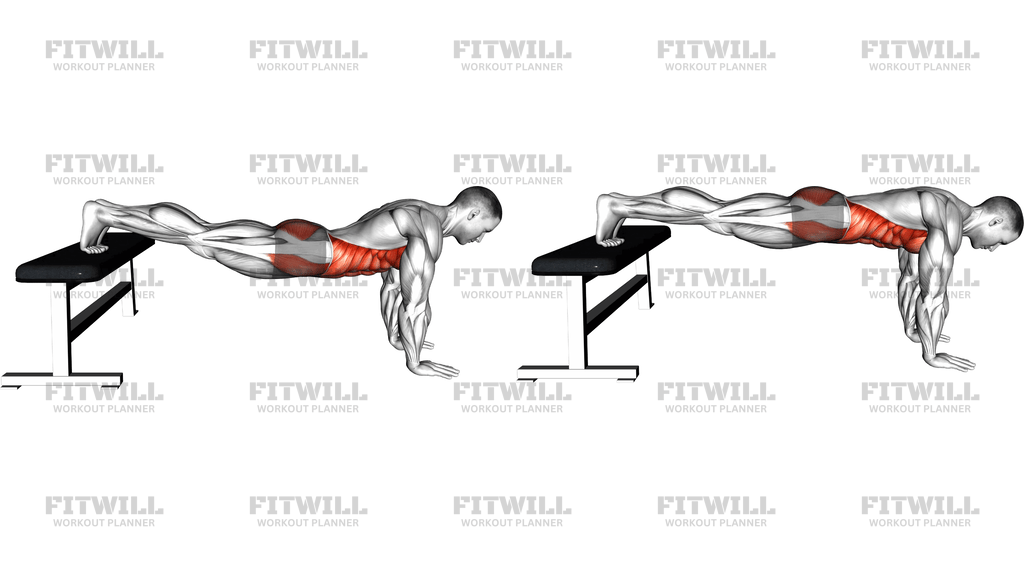
Instructions
- Set a flat bench behind you and kneel facing away from it.
- Place your hands on the floor slightly wider than shoulder width, directly under your shoulders, with fingers spread for a stable base.
- Step one foot back at a time and rest the tops of your toes or the balls of your feet on the bench, so your body forms a straight line from head to heels.
- Adjust your hand position until your shoulders sit directly over your wrists, then press the floor away so your upper back stays broad rather than sinking.
- Brace your abdomen as if bracing for a light punch, squeeze your glutes, and tuck the pelvis slightly to remove any arch in the lower back.
- Hold this straight-line position with your neck in line with your spine, eyes on the floor a short distance ahead of your hands.
- Breathe in a slow, controlled rhythm through your nose and mouth without letting the ribs flare or the belly relax.
- When your hips begin to sag or rise, lower your knees to the floor one at a time to finish the set.
- Rest briefly, then reset your brace and bench position before the next hold.
Tips & Tricks
- If your hips drop first, that is usually a brace problem, not a strength problem, so exhale fully and re-tighten the abdomen before every set.
- A bench around knee height is a good starting point; raising the feet higher too soon shifts the load to the shoulders and turns the set into a shoulder endurance test.
- Keep weight spread across the whole palm rather than dumping it into the heel of the hand, which strains the wrists over longer holds.
- Stop the hold the moment your lower back starts to arch, since an elevated position amplifies how much stress a sagging plank puts on the lumbar spine.
- If your toes feel uncomfortable on the bench edge, shift them back until the tops of the feet, not the toes alone, share the contact.
- Do not let the elbows lock hard and hang into the joints; a soft bend with active pressing keeps the shoulders engaged.
- Film yourself from the side once in a while, because from inside the hold a sagging pelvis is almost impossible to feel accurately.
- Progress by seconds, not minutes; moving from 30 to 40 clean seconds beats stretching a sloppy hold to 90.
- If the wrists bother you, use a mat or plank handles so the hands stay in a neutral position instead of extending back.
Frequently Asked Questions
Which muscles does Plank With Feet Elevated work?
It primarily trains the abs, including the rectus abdominis and the deeper trunk stabilizers, while the glutes hold the hips extended and the shoulders support the upper body. Because the feet are raised, the shoulders and arms carry more load than in a standard plank.
Why elevate the feet on a bench instead of doing a regular plank?
Elevating the feet increases the percentage of body weight the core and shoulders must support, making the same hold noticeably harder without any equipment besides a bench. It is a straightforward progression once a floor plank of 45 to 60 seconds feels comfortable.
Is Plank With Feet Elevated suitable for beginners?
It can be, but most beginners should start with a floor plank or use a very low step. If you cannot hold a straight line for at least 30 seconds on the floor, build that first before raising the feet.
How high should the bench be?
A standard flat bench around knee height works well for most people. The higher the surface, the more weight shifts onto the shoulders, so start low and only increase once your form stays solid for the full set.
What is the most common mistake in this exercise?
Letting the hips sag into an arched lower back as fatigue builds. On an elevated plank this loads the lumbar spine instead of the abs, so end the set or drop to a lower surface as soon as the line breaks.
How long should I hold Plank With Feet Elevated?
Aim for sets of 20 to 45 seconds with clean form, and rest fully between them. Long, wobbly holds teach poor positioning, so multiple shorter sets are more productive than one extended struggle.
Can I do this exercise if my wrists hurt during planks?
Yes. Place your hands on a folded mat, use push-up handles, or perform the hold on your forearms with the feet still elevated on the bench, keeping the elbows under the shoulders.
What can I use instead of a bench for Plank With Feet Elevated?
Any stable, knee-to-thigh-height surface works, such as a sturdy chair, a step platform, or a plyometric box. Avoid soft or wheeled surfaces that can slide out from under your feet.
Should my shoulders be directly over my hands?
Yes. Stacking the shoulders over the wrists keeps the upper body supported and prevents the shoulders from drifting behind the hands, which makes the hold harder on the joints and easier on the abs than intended.