Weighted Plate Side Up Squat
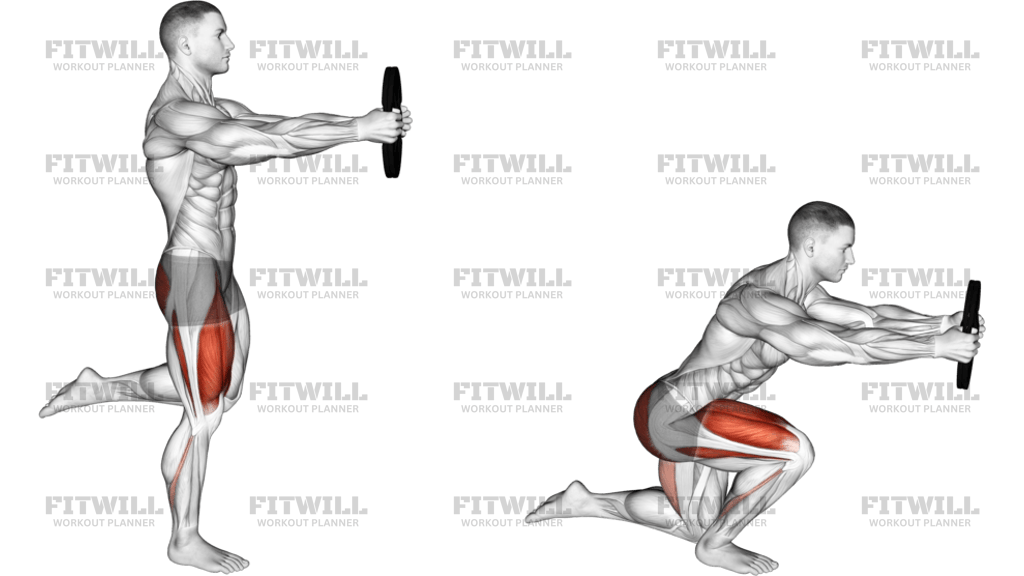
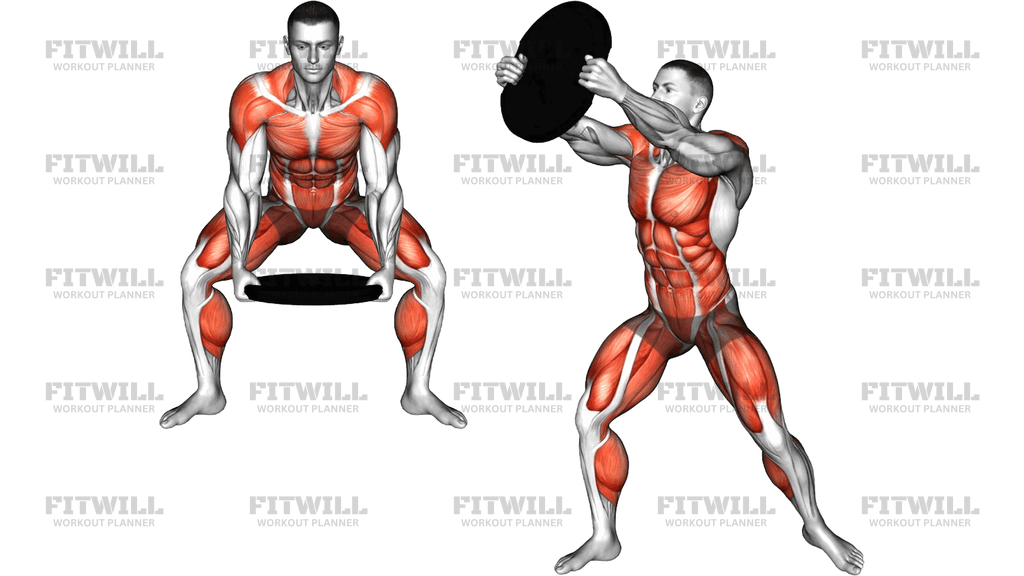
The Weighted Plate Side Up Squat is a full-body movement that combines a deep, wide-stance squat with an upward diagonal reach of a weight plate. You start crouched low with a plate held by its edges between your legs, then drive through your feet to stand while swinging the plate up and across your body so it finishes above your opposite shoulder with your arms extended. The result is one fluid rep that trains the legs, hips, trunk, and shoulders as a single connected chain rather than as isolated parts.
This exercise is a good fit for lifters who want a squat variation that also challenges rotation and overhead control, or for anyone training with minimal equipment, since a single plate is all you need. It suits general strength and conditioning programs, warm-up circuits, and conditioning finishers where you want a big range of motion and a heart-rate response without loading a barbell on your spine.
The legs do most of the obvious work: the quads and glutes drive you out of the deep squat while the adductors stabilize the wide stance. As you rise, the movement shifts upward — the shoulders, particularly the front delts, lift the plate along the diagonal path, and the core and obliques work to transfer force from your lower body through your trunk so the arms are not doing all the lifting on their own. Grip and forearm endurance get a steady demand too, because you are pinching the plate's edges for every rep.
Setup matters more than people expect here. The wide stance and the plate hanging between your legs put you in a deep bottom position, so your spine needs to stay long and braced rather than rounded as you reach down. Because the plate travels up and across your midline, any slack in your torso shows up immediately as a lean or a twist in the lower back — keeping the ribcage stacked over the pelvis is what makes the diagonal press smooth and safe.
To execute it well, think of the rep as one continuous drive: legs push, hips extend, and the plate rides that momentum up and across rather than being muscled up by the arms alone. On the way down, reverse the arc with control, let the plate settle back between your legs, and drop into the next squat with your chest tall. Because the plate ends up to one side, alternate which side you raise it toward from set to set, or alternate every rep, so the work stays balanced.
Common use cases include at-home sessions built around a single plate, athletic training that links lower-body power with rotational upper-body strength, and circuit workouts where you want one movement to cover a lot of ground. Keep the weight modest at first — the combination of depth, rotation, and reach makes this harder to control than a standard squat with a similar load, and the plate swinging close to your face at the top gives you a built-in reason to respect the tempo.
[ Workout Log & Planner ]
Put your next workout in Fitwill
Keep your plan and training log ready when you are.


Instructions
- Stand with your feet wider than shoulder width and your toes turned out slightly, holding a weight plate by its edges with both hands in front of your thighs.
- Push your hips back and bend your knees to sink into a deep, wide squat, lowering the plate so it hangs between your legs with your arms straight.
- Keep your chest up, spine long, and weight spread across your whole foot; brace your core before you begin the upward drive.
- Drive through your heels and midfoot to stand, and as your hips extend, guide the plate up and diagonally across your body toward one side.
- Finish with your arms nearly straight and the plate above and slightly outside the shoulder on that side, wrists stacked and eyes following the plate.
- Reverse the arc with control, bringing the plate back down across your body as you sink into the next deep squat, letting it settle between your legs.
- Exhale as you drive up and raise the plate; inhale as you lower back into the bottom position.
- Complete all reps raising toward one side, then switch sides for an even set, or alternate sides rep by rep.
- Reset your stance and brace between heavy sets rather than rushing from rep to rep with a rounded back.
Tips & Tricks
- The most common mistake is letting the lower back round at the bottom as the plate drops between the legs — bend from the hips and keep the chest lifted so the spine stays neutral in the deep squat.
- If your heels lift out of the wide squat, narrow your stance slightly or turn your toes out a little more; forcing depth you cannot own will dump stress into your knees.
- Drive the plate with leg and hip extension rather than pulling it up with your arms — if your shoulders are doing all the work, the weight is too heavy for the timing of the movement.
- Do not let the plate drift behind your head at the top; keep the finish position where you can see the plate in your peripheral vision and keep your neck relaxed.
- Pinch the plate's edges firmly throughout — a loose grip lets the plate swing and pulls your shoulders forward at the top of the rep.
- Control the descent instead of dropping into the bottom; catching the squat abruptly with a heavy plate between your legs is where most sloppy reps start.
- Work your weaker side first when training one side per set, and match the reps on the stronger side to keep the diagonal pattern even.
- Start with a light plate until the arc feels natural — the plate travels close to your face and shoulder at the top, so you want the path automatic before adding load.
- Keep your knees tracking over your toes on the way up; a collapse inward is a sign the adductors and glutes need a lighter load and more attention to the drive.
Frequently Asked Questions
What muscles does the Weighted Plate Side Up Squat work?
The quads and glutes do the primary work driving you out of the deep squat, while the adductors stabilize the wide stance. As you raise the plate across your body, the front shoulders lift the weight and the core and obliques transfer force through the diagonal path.
Is the Weighted Plate Side Up Squat suitable for beginners?
Yes, as long as you start with a light plate and can already perform a full-depth bodyweight squat with a neutral spine. Practice the arc without weight first, then add a small plate once the diagonal reach feels controlled.
How wide should my stance be for the Weighted Plate Side Up Squat?
Go wider than shoulder width — enough that the plate can hang between your legs at the bottom without touching the floor. Your knees should track over your toes; if they cave in or your heels lift, narrow the stance slightly.
How heavy should the plate be?
Choose a weight you can raise smoothly above your shoulder without arching your back or swinging the plate, usually much lighter than what you would squat. A 5–10 kg plate is plenty for most people starting out.
Should I alternate sides on the Weighted Plate Side Up Squat?
Either alternating every rep or completing all reps on one side before switching works. If you train one side at a time, start with your weaker side and match the reps on the other to stay balanced.
What is the biggest form mistake in this exercise?
Rounding the lower back at the bottom as the plate lowers between the legs. Reach down by pushing your hips back and bending your knees, and keep your chest lifted so the spine stays long through the whole rep.
Can I substitute the plate with something else?
A kettlebell held by the horns, a dumbbell cupped in both hands, or a medicine ball can all work. You want an object you can grip securely with both hands and swing along the same diagonal path.
Why does the plate travel across my body instead of straight up?
The diagonal path is what makes this more than a squat and press — it forces your obliques and trunk to transfer force across your midline, training rotation while your legs handle the load.
How many reps and sets should I do?
For strength and quality of movement, 3–4 sets of 6–10 reps per side works well; for conditioning, lighter weight for 12–20 continuous reps is common. Stop the set when the arc or your squat depth starts to break down.
Is it safe for my knees and lower back?
It is generally well tolerated when your knees track over your toes, your heels stay down, and your spine stays neutral at the bottom. If you have knee or back issues that limit deep squats, reduce the depth and load and clear the movement with a professional first.