Tuck Planche On Parallette
The Tuck Planche On Parallette is a foundational straight-arm strength skill where you support your full body weight on your hands, lean your shoulders well past your wrists, and hold your knees tucked tightly toward your chest with your feet off the floor. The parallettes matter here: elevating your hands gives your knees and shins clearance, spares your wrists the extreme extension a floor version demands, and lets you find the forward lean without your feet dragging the ground.
This is one of the classic progressions toward the full planche. It is most useful for calisthenics and gymnastics-strength trainees who already own solid support holds like the L-sit or advanced tuck variations and want to build the specific shoulder and core strength the planche family requires. Because the arms stay straight, the shoulders do most of the work, which makes the movement humbling even for strong pressers.
The main load lands on the front delts as they fight to hold your torso level while stacked far ahead of your hands. Your triceps and elbow joint structures work isometrically to keep the arms locked, the forearms and wrist stabilizers manage balance on the bars, and the deep core and hip flexors hold the knees pulled in and the pelvis tucked. The rounded upper back you see in the hold is deliberate protraction, driven by the serratus anterior, which keeps the shoulder girdle stable under load.
Setup is everything in this hold. Grip the parallettes about shoulder width, and think of leaning rather than lifting: your shoulders must travel forward past your wrists before your feet leave the ground. If you try to raise your hips without that lean, your weight stays behind your hands and the hold becomes impossible. Conversely, leaning too far too soon dumps you forward onto your face, so progress in small increments.
To execute well, press the bars away hard, push the floor apart with your hands, round your upper back, and let your shoulders drift forward over your fingertips as your knees rise toward your chest. Breathe shallowly but steadily, hold for short quality sets of three to eight seconds, and step your feet down under control rather than collapsing. Expect to work holds at the edge of your lean angle before the time under tension climbs.
Treat this as a skill-strength movement, not a burnout exercise. Practice it fresh, early in a session, with full rest between holds, and keep your elbows fully locked throughout. Any sharp wrist, elbow, or shoulder discomfort is a signal to reduce the lean angle or drop back to an easier progression like the frog stand.
[ Workout Log & Planner ]
Put your next workout in Fitwill
Keep your plan and training log ready when you are.


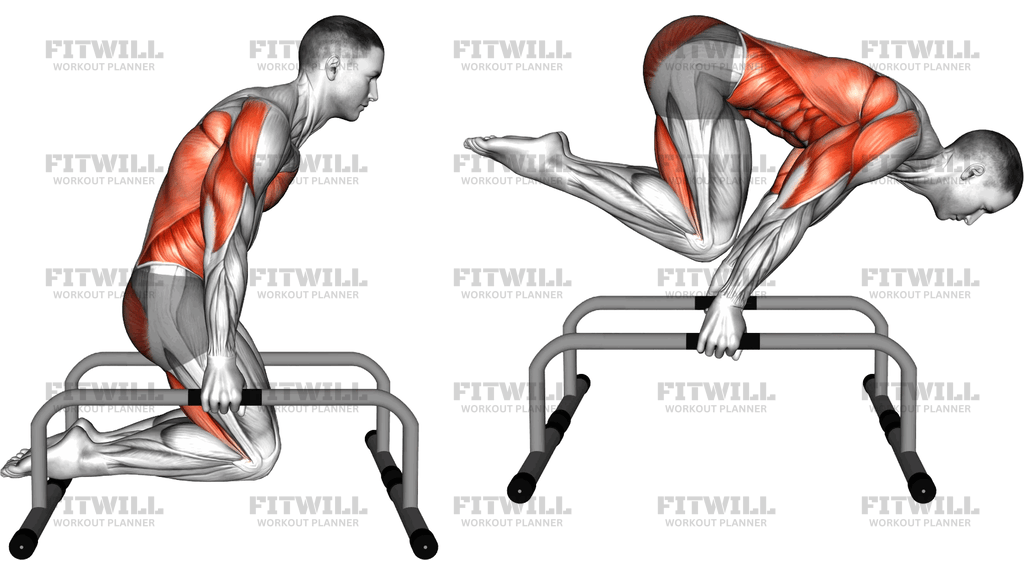
Instructions
- Place a sturdy pair of parallettes on a flat, non-slip surface, spaced roughly shoulder width apart.
- Kneel behind the bars and grip each handle firmly with a full wrap, knuckles facing forward, arms straight.
- Position one knee at a time so your shins rest just behind or between the bars, ready to lift.
- Press the handles down and slightly apart to elevate your torso and protract your shoulder blades into a rounded upper back.
- Exhale, brace your abs, and lean your shoulders forward past your wrists until your weight shifts over your hands.
- Lift both knees off the ground and pull them in toward your chest, tucking your hips under so your back rounds and your shins stay clear of the bars.
- Reach the end position with locked elbows, shoulders stacked well ahead of your hands, and your entire body weight balanced on the parallettes; hold for three to eight seconds.
- To exit, shift your weight back over your wrists and lower one foot at a time to the floor with control.
- Breathe shallowly and continuously during the hold instead of holding your breath.
- Reset your grip and posture fully between holds so each rep starts from the same deliberate setup.
Tips & Tricks
- Aim your shoulders at your fingertips, not just your wrists; the hold only balances once your center of mass moves in front of the bars.
- If your feet keep dropping back to the floor, the lean is too shallow, not the strength too low, so add a few centimeters of forward lean at a time.
- Keep your elbows completely straight; a soft elbow turns the hold into a pressing movement and stresses the joint differently.
- Round your upper back deliberately and push the bars away; a flat, sagging upper back makes the shoulders collapse toward each other.
- Pull your heels close to your glutes; a loose, dangling tuck lengthens the lever and makes the lower back work harder than it should.
- If your wrists ache, grip slightly deeper onto the handles and keep weight spread across the whole palm rather than dumping onto the heel of the hand.
- Warm up your wrists and elbows with straight-arm support holds on the parallettes before attempting the lean.
- Film yourself from the side; most trainees believe their shoulders are well past their wrists when they are still behind them.
- Keep holds short and sharp. Once form breaks and your hips drift back, end the set instead of grinding out extra seconds.
Frequently Asked Questions
What muscles does the Tuck Planche On Parallette work?
The front shoulders carry most of the load, supported isometrically by the triceps and forearms. The deep core and hip flexors hold the knees tucked, and the serratus anterior stabilizes the rounded shoulder blade position.
Is the Tuck Planche On Parallette suitable for beginners?
Not as a first exercise. You should be comfortable with parallette support holds, frog stands, and tuck L-sits before leaning your full weight over your wrists. Beginners can start with a frog stand and gradually increase the forward lean.
Why use parallettes instead of doing the tuck planche on the floor?
The raised handles give your knees and shins clearance, which lets you tuck tightly without your legs hitting the ground. They also reduce the amount of wrist extension required compared to a flat floor.
How long should I hold the Tuck Planche On Parallette?
Aim for sets of three to eight seconds at your maximum lean angle, resting fully between holds. Once you can accumulate 20 to 30 total seconds of clean holds, progress toward an advanced tuck by opening your hips slightly.
Why do my shoulders need to be past my wrists in this hold?
The balance point of the hold sits over your hands, so your center of mass must move in front of your wrists or your feet will fall back to the floor. The forward lean is what makes it a planche rather than a support hold.
What is the most common mistake in the Tuck Planche On Parallette?
Leaning too little and letting the hips drift back, which turns the skill into a struggle to hold weight that never shifts over the hands. Another frequent error is bending the elbows to fake a longer hold.
My wrists hurt when I lean forward. What should I change?
Make sure your weight is spread across the entire palm instead of sitting on the heel of the hand, keep pressing the bars away to reduce passive load on the joint, and build tolerance with shorter leans. Persistent pain is a cue to use an easier progression.
Can I substitute anything if I do not have parallettes?
A frog stand on the floor with hands turned out slightly is the closest substitute, though it demands more wrist extension. Two sturdy, stable low bars at about the same height and width as parallettes can also work.
How does the Tuck Planche On Parallette fit into a full planche progression?
It sits in the middle of the path: support holds and frog stands first, then the tuck planche, then the advanced tuck with open hips, followed by single-leg and straddle variations before the full planche.
Is it safe to practice this hold every day?
Daily practice is not necessary and can irritate the wrists and elbows since the load is continuous and joint-heavy. Two to four focused sessions per week, kept fresh and technically clean, progress better than frequent fatigued attempts.