Sitting Opposite Grab On A Chair
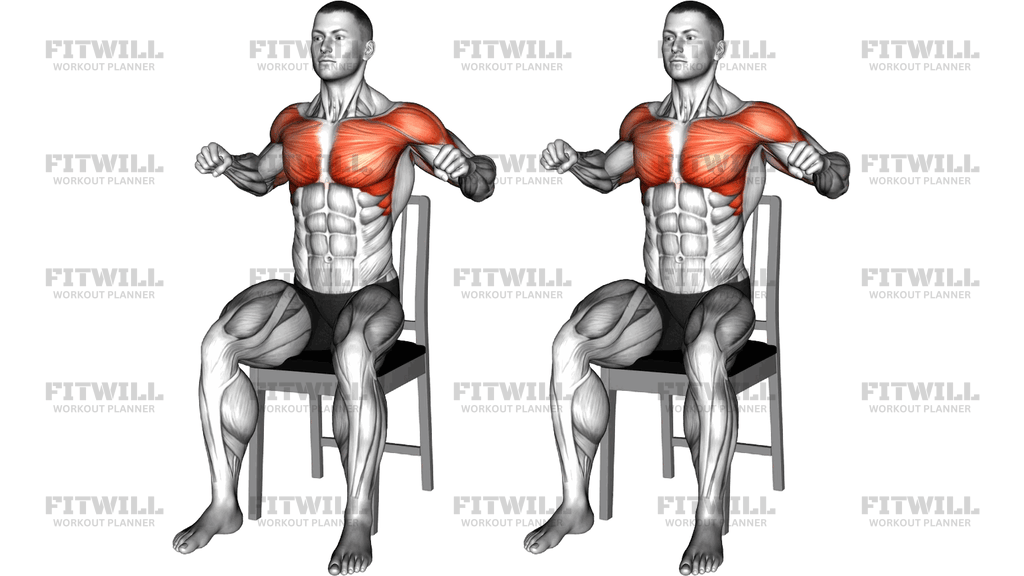
The Sitting Opposite Grab On A Chair is an isometric chest exercise you can do anywhere you have a sturdy seat. You sit upright, bring your fists together in front of your chest with each hand gripping the opposite fist, and then press your hands hard against each other. Because the resistance comes from your own opposing force rather than a weight, the tension is self-generated and can be scaled instantly from light to near-maximal.
The main muscle at work is the pectoralis major, which contracts hard to drive the pressing force across the front of the chest. The front delts assist the press, while the biceps, forearms, and grip muscles work statically to hold the clasp together. Your upper back and core also stay quietly busy keeping your torso upright and your shoulders from rolling forward as you push.
This movement is a good fit for people training without equipment, beginners learning to feel their chest working, office workers breaking up long sitting periods, or anyone rehabbing around shoulder discomfort who needs a low-load, joint-friendly contraction. It is also a useful teaching drill: many lifters struggle to feel their chest on pressing exercises, and a hard self-resisted squeeze builds that mind-muscle connection quickly.
Setup matters more than it looks. Sit tall on the chair with feet flat on the floor, ribs stacked over the hips, and elbows held out at roughly chest height. If you slump or let the elbows drift down, the press turns into a shoulder and arm effort and the chest stops doing the work. Keep the wrists firm and the clasp secure so the force travels through the chest rather than straining the fingers.
To execute it well, build the pressure gradually over a second or two rather than snapping into a maximum squeeze, then hold the effort steady while breathing normally. Most people do best with holds of five to twenty seconds and several repetitions. Release the pressure slowly instead of letting the hands fly apart.
Safety-wise, keep the intensity at a level you can sustain without holding your breath, and stop if you feel sharp pain in the shoulders, elbows, or wrists. Because the load is self-selected, this is one of the few chest exercises where you can train hard without any equipment, but the trade-off is that you must create the tension honestly — a loose press produces a loose workout.
[ Workout Log & Planner ]
Put your next workout in Fitwill
Keep your plan and training log ready when you are.


Instructions
- Sit upright on a sturdy chair with your feet flat on the floor, hip-width apart, and your back straight without leaning on the backrest.
- Raise both arms in front of you and clasp your hands together so each hand grips the opposite fist in a firm hold at chest height.
- Position your elbows out to the sides at about shoulder height, in line with or slightly below your hands.
- Brace your core and pull your shoulders back and down so your chest is open before you generate any force.
- Press your fists hard against each other, squeezing the arms inward as if trying to crush your hands together at the middle of your chest.
- Hold the maximum steady pressure for five to twenty seconds, keeping your elbows up and your torso still throughout the hold.
- Breathe steadily during the hold — inhale through the nose and exhale slowly instead of holding your breath.
- Release the pressure gradually over one to two seconds and let your arms relax without dropping your posture.
- Rest briefly, reset your clasp and elbow position, then repeat for the desired number of holds.
Tips & Tricks
- The most common mistake is letting the elbows sink toward the ribs as fatigue sets in — once they drop, the chest loses tension and the front delts take over, so check elbow height every few seconds.
- Build pressure in a wave rather than one max squeeze: ramp up over two seconds, hold the peak, then ease off, which keeps the chest working through the whole set.
- If your fingers or wrists ache before your chest does, grip fist-to-fist with the fingers of each hand wrapped around the opposite fist rather than interlacing fingers, which loads the hand joints less.
- Do not hold your breath during the press — breath-holding combined with a hard isometric spikes blood pressure and makes long holds uncomfortable.
- Lean slightly forward from the hips rather than slouching backward; a tall torso lets the pectorals shorten fully against the resistance.
- Vary the hand height across sets — one set at upper chest, one at mid-chest — to bias different fibers of the pectoralis major.
- Because there is no external load, the only way to progress is more pressure or longer holds; add five seconds per week before chasing harder squeezes.
- If you feel the work mostly in your biceps, you are pulling with the arms instead of pressing inward — think of driving the elbows toward each other through the chest.
- Use a chair without wheels or armrests so your torso stays stable and your elbows have room to flare to the sides.
Frequently Asked Questions
What muscles does the Sitting Opposite Grab On A Chair work?
The pectoralis major of the chest is the primary muscle, since it produces the inward pressing force. The front shoulders assist, while the biceps, forearms, and grip muscles work statically to hold the clasp.
How hard should I press during the Sitting Opposite Grab On A Chair?
Press at roughly 70 to 100 percent of a comfortable maximum for short holds, or around 50 percent for longer holds. Because resistance is self-generated, the effort only counts if you actually push hard rather than just resting your hands together.
Is the Sitting Opposite Grab On A Chair good for beginners?
Yes. It is one of the safest ways to learn what a chest contraction feels like because there is no external weight and the intensity is fully under your control. Beginners should start with lighter five-second holds before progressing.
Why do I feel this more in my arms than my chest?
That usually means your elbows have dropped or you are pulling with the arms instead of pressing inward. Lift the elbows back to chest height and focus on driving them toward each other so the pectorals generate the force.
How long should each hold last?
Five to twenty seconds works well for most people, with two to four sets. Shorter holds let you press harder; longer holds at moderate pressure build endurance in the chest and arms.
Can I do the Sitting Opposite Grab On A Chair every day?
Generally yes, because isometric work with no external load recovers quickly. If your chest or shoulders feel sore from a previous session, use lighter pressure or take a rest day.
What can I use instead of a chair?
Any stable seat works — a bench, sturdy stool, or even sitting on the edge of a bed. The key requirements are an upright torso position and enough room for the elbows to flare out to the sides.
Is it safe for my shoulders or wrists?
For most people it is very joint-friendly since there is no load and no movement through a range. Keep the wrists firm and the grip fist-to-fist to spare the hand joints, and stop if you feel sharp pain rather than muscle effort.
Can this exercise build real chest strength?
It builds a strong isometric contraction and improves your ability to activate the chest, but it does not replace loaded pressing through a full range. It works best as a warm-up, a teaching drill, or a no-equipment option alongside other chest training.
Should my back stay off the chair backrest?
Yes, sitting tall without leaning back keeps the chest open and lets the pectorals work in a stronger position. Slumping against the backrest rounds the shoulders forward and shifts effort away from the chest.