Seated Arm Crossover And Chest Out On A Chair
The Seated Arm Crossover And Chest Out On A Chair is a simple mobility and stretching drill for the chest and front of the shoulders. You sit upright on a chair with your arms extended out to the sides at shoulder height, then sweep them forward so they cross in front of your chest, round the upper back slightly, and open them wide again while pushing the chest out. The two positions act as opposites: the crossover rounds and closes the chest, while the open position stretches it under tension and retracts the shoulder blades.
This movement suits anyone who spends long hours sitting at a desk, driving, or working at a computer, because those habits tend to pull the shoulders forward and shorten the chest muscles. It is also a useful warm-up before pressing exercises like bench presses or push-ups, and a gentle cool-down after upper body training. Because it requires nothing more than a sturdy chair, it fits easily into office breaks, rehab-style routines, or morning mobility work for older trainees.
The main muscles involved are the pectorals, especially the sternal portion of the chest, along with the anterior deltoids at the front of the shoulders. As you open the arms wide and lift the chest, these muscles lengthen; as you cross the arms forward, you briefly shorten them and engage the upper back muscles that pull the shoulder blades together. The seated position removes demand from the legs and core, letting you focus entirely on the shoulder girdle.
Setup matters more than it looks. Sit tall on the front half of the chair with feet flat on the floor, and keep the ribs from flaring when you push the chest out. The arms should stay around shoulder height throughout, neither dropping toward the hips nor shrugging up toward the ears. Moving too fast turns this into a meaningless arm swing, so keep each crossover and each opening deliberate.
A good rep feels like a mild stretch across the chest and front shoulders in the wide position, with no pinching in the shoulder joint. If you feel a pinch at the front of the shoulder, lower the arms slightly or reduce how far back you open them. Ten to fifteen smooth repetitions are usually enough, either as a standalone break or as part of a longer upper body warm-up.
[ Workout Log & Planner ]
Put your next workout in Fitwill
Keep your plan and training log ready when you are.


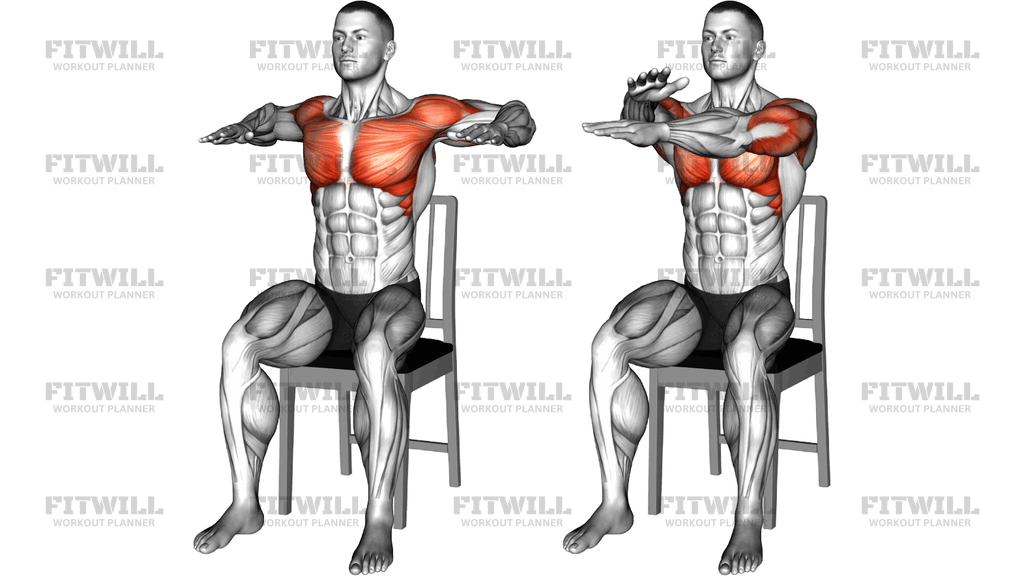
Instructions
- Sit upright on a sturdy chair with your feet flat on the floor about hip-width apart and your back not leaning against the backrest.
- Extend both arms straight out to your sides at shoulder height, palms facing forward or down, elbows fully but not forcefully straightened.
- Lift your chest and gently draw your shoulder blades back and down so you feel a stretch across the front of your chest.
- Keep your head level and your abdominal muscles lightly braced so the movement comes from the shoulders, not from arching the lower back.
- In one smooth arc, sweep both arms forward until they cross over each other in front of your chest, letting your upper back round slightly.
- Open the arms back out to the starting position at shoulder height, pushing the chest out again as the arms reach full width.
- Alternate which arm crosses on top with each repetition so both sides move through the same path.
- Breathe steadily throughout: inhale as the arms open wide, exhale as they cross in front of the chest.
- Complete 10-15 controlled repetitions, then lower the arms to your lap and reset your posture before the next set.
Tips & Tricks
- Keep the arms at shoulder height for every rep; letting them drift downward as you fatigue turns the stretch into a low-shoulder swing that barely reaches the chest.
- Push the chest out by retracting the shoulder blades, not by arching the lower back, if you want the stretch to land in the chest instead of the spine.
- If you feel a pinching sensation at the front of the shoulder during the wide position, angle the arms slightly lower or turn the palms to face up rather than forcing more range.
- Pause for one or two seconds in both the crossover and the open position; rushing through the middle of the range is the most common mistake with this drill.
- Alternate the top arm on every crossover so the stretch stays even from left to right, especially if one shoulder is stiffer than the other.
- Sit far enough forward on the chair that your back stays clear of the backrest, which gives your shoulder blades room to retract fully.
- Keep the neck relaxed and the chin level; lifting the chin or shrugging toward the ears signals that the upper traps are taking over the movement.
- Use this as a pre-pressing warm-up on bench or push-up days, or as an hourly reset during long desk sessions, rather than as a heavy loaded exercise.
Frequently Asked Questions
What muscles does the Seated Arm Crossover And Chest Out On A Chair work?
It primarily targets the pectorals, with the anterior deltoids at the front of the shoulders assisting. The upper back muscles work lightly as you retract the shoulder blades in the open position.
Is this a strength exercise or a stretch?
It functions mainly as a dynamic stretch and mobility drill for the chest and front shoulders. The chair provides support, so there is no meaningful resistance beyond your own arm weight.
Why should I sit on a chair instead of standing?
Sitting removes balance and lower body demands, making it easier to keep the torso tall and isolate the shoulder girdle. This makes the movement accessible for beginners, older adults, and office settings.
How far back should I open my arms in the wide position?
Open them only until you feel a comfortable stretch across the chest. If you feel pinching at the front of the shoulder, reduce the range rather than pushing through it.
Which arm should cross on top during the crossover?
Alternate arms with each repetition so both shoulders travel through the same path. Always crossing with the same arm on top can create an uneven stretch over time.
Is the Seated Arm Crossover And Chest Out On A Chair good for desk workers?
Yes, it directly counters the rounded-shoulder posture that comes from prolonged sitting and typing. A short set every hour or two can help keep the chest from feeling chronically tight.
How many reps should I do?
Ten to fifteen smooth, controlled repetitions work well, and you can repeat for two to three sets. Quality of the stretch matters far more than rep count here.
What is the most common mistake with this movement?
Rushing the arms back and forth like a jumping jack. Slow the tempo down, hold each end position briefly, and keep the arms at shoulder height throughout.
Can I do this exercise if I have shoulder pain?
Mild, pinch-free stretching is usually tolerable, but stop if you feel sharp pain, catching, or numbness. Check with a qualified professional before continuing if symptoms persist.
When is the best time to use this drill?
It works well as a warm-up before chest pressing exercises, as a cool-down after upper body training, or as a standalone movement break during the workday.