Dumbbell Lying Bench Pullover Leg Raise
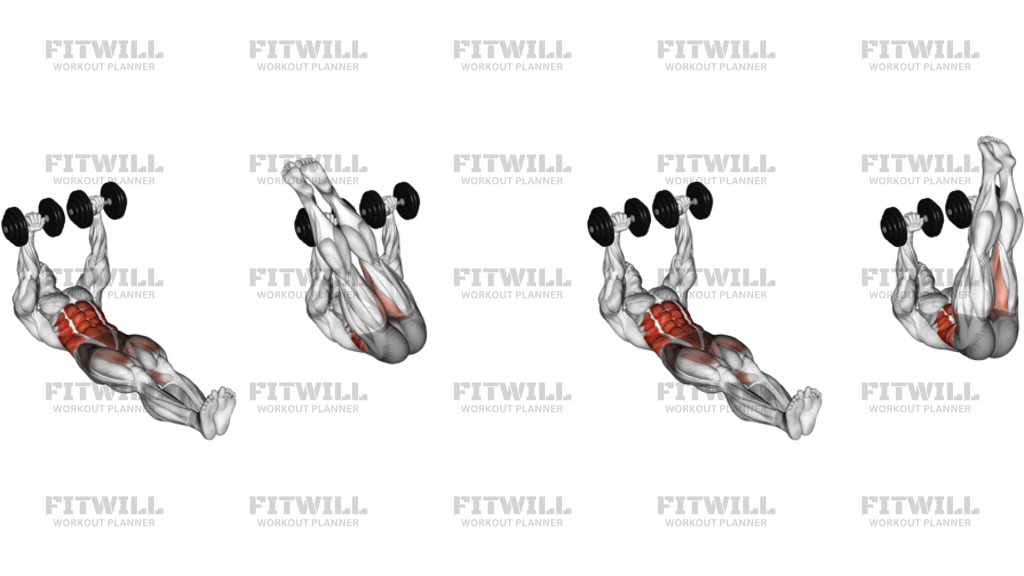
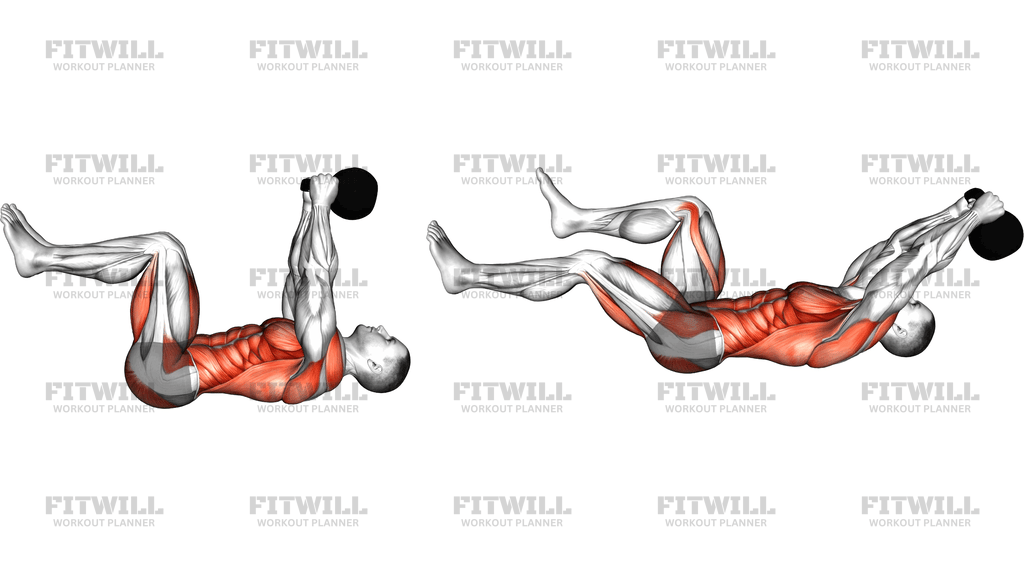
The Dumbbell Lying Bench Pullover Leg Raise is a hybrid core exercise that combines an overhead dumbbell hold with straight-leg raises off a flat bench. You lie lengthwise on the bench with a single dumbbell held in both hands, arms extended back behind your head, and raise your straightened legs from a lowered position up toward the ceiling. The dumbbell stays anchored overhead the whole time, which pins your upper body in a slightly stretched position and makes it much harder to cheat the leg raise with momentum.
This movement is aimed primarily at the lower portion of the rectus abdominis along with the hip flexors, which do the actual lifting of the legs. The overhead dumbbell hold adds a sustained stretch and light load to the lats and chest, similar to the bottom position of a pullover, and it forces the shoulders and trunk to stabilize throughout every rep. Because your arms are locked behind your head rather than gripping the bench beside your ears, you get less assistance from your lats pulling down and more demand on the abs to control the pelvis.
The setup on the bench is what separates this from a floor leg raise. Lying elevated with the dumbbell hanging behind you gives the legs a longer range at the bottom, since your hips sit near the edge and the legs can start below the level of the bench. That extended range means the hip flexors and lower abs work through a fuller arc, and the weight overhead slightly counterbalances your body so you stay settled on the bench instead of tipping.
This exercise suits intermediate lifters who already handle lying leg raises comfortably and want extra challenge without hanging from a bar. It fits well into ab-focused finishers, home gym sessions with minimal equipment, and programs that pair core work with upper body mobility, since the overhead hold doubles as a loaded lat stretch. People with tight shoulders may find the overhead position demanding at first, so a lighter dumbbell and a slightly bent elbow are reasonable starting points.
Execute it with slow, deliberate tempo. Raise the legs by curling the pelvis toward the ribs rather than just swinging the feet up, pause briefly at the top, and lower the legs under control before the next rep. Keep the dumbbell pressed back and stable behind you the entire time; if the weight drifts forward or your elbows flare, the set is drifting out of position.
The main safety concern is losing the dumbbell behind your head. Choose a weight you can hold securely for the whole set, check that it is properly collared, and keep a firm interlocked grip. If you feel your lower back arching off the bench or straining as the legs drop, reduce the range rather than pushing deeper.
[ Workout Log & Planner ]
Put your next workout in Fitwill
Keep your plan and training log ready when you are.


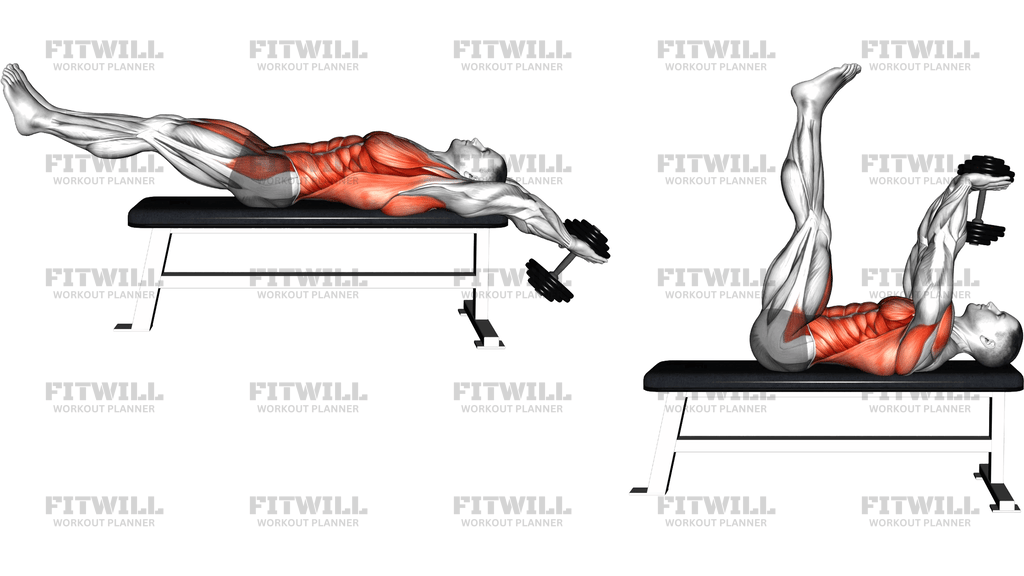
Instructions
- Place a single dumbbell at the head end of a flat bench, then sit on the bench and lie back lengthwise so your head is near the end where the dumbbell sits.
- Pick up the dumbbell with both hands, wrapping your fingers over the top of the inner head of the dumbbell so your hands interlock around the handle, and press your arms straight back overhead until the dumbbell hangs just off the end of the bench behind you.
- Scoot your hips toward the edge of the bench so your glutes are partly supported and your straight legs can hang off the opposite end with your feet below bench level.
- Brace your abdominal wall and press your lower back gently toward the bench before the first rep begins.
- Keeping the dumbbell and arms fixed overhead, raise your straight legs by flexing the hips and curling the tailbone slightly off the bench until the legs reach vertical or just past it.
- Pause for a moment at the top with the legs stacked over the hips and squeeze the lower abs.
- Lower the legs slowly back down to the starting position below bench level, resisting the pull of gravity instead of dropping them.
- Exhale as you raise the legs and inhale slowly as you lower them, keeping your ribcage down throughout.
- Keep your head relaxed on the bench and your elbows only softly bent so the dumbbell stays stable behind you.
- Complete the set before sitting up; bring the legs down first, then carefully sit forward with the dumbbell still held against your chest.
Tips & Tricks
- If the dumbbell slides or feels loose behind your head, switch to a hex or rubber-coated dumbbell and grip the inner head with overlapping hands rather than just pinching the handle.
- The most common mistake is bending the knees as fatigue sets in; bent knees shorten the lever and shift work toward the hip flexors, so lower the legs less deeply instead and keep the knees straight.
- Do not let the dumbbell travel forward as the legs rise; if your arms drift toward a press position, you are losing the pullover hold that makes this exercise distinct.
- Swinging the legs up from the bottom is a sign the range is too long for you; bend the hips slightly at the start and rebuild the full range over a few weeks.
- If your lower back lifts or arches as the legs descend, stop the descent earlier and add a small posterior pelvic tilt before each rep to keep the lumbar spine flat on the bench.
- Tight shoulders can make the overhead hold uncomfortable; warm up the shoulders first or use a lighter dumbbell with a slight elbow bend rather than forcing a heavy stretch.
- Slow the lowering phase to about three seconds; most of the difficulty in this movement comes from the eccentric control of the legs, not the lift itself.
- Check that the bench is stable and the dumbbell collars are tight before you lie back with weight overhead; resetting mid-set is not practical in this position.
- Pair this with hanging knee raises or decline sit-ups in the same session rather than stacking it after other heavy hip flexor work, when form tends to break down quickly.
Frequently Asked Questions
Which muscles does the Dumbbell Lying Bench Pullover Leg Raise work?
The lower abs and hip flexors do the lifting of the legs, while the lats, chest, and shoulder stabilizers work isometrically to hold the dumbbell overhead in the pullover position.
How is this different from a regular lying leg raise?
The dumbbell held behind your head adds a pullover-style stretch to the lats and chest, removes the option of gripping the bench for leverage, and the elevated bench position lets the legs start below the bench for a longer range.
Can beginners do the Dumbbell Lying Bench Pullover Leg Raise?
It is better suited to intermediates who already control lying leg raises. Beginners should start with bent-knee raises on a flat bench or floor, then add the dumbbell hold once they can keep their lower back flat.
How heavy should the dumbbell be?
Choose a light weight you can hold securely for the entire set, often in the 5 to 10 kg range. The dumbbell is there for the stretch and stability demand, not to be pressed or swung.
Why do my legs start off the end of the bench?
With your hips near the edge, the legs can hang below the level of the bench at the start, which extends the working range of the hip flexors and lower abs before the legs travel up to vertical.
Should my hips leave the bench at the top?
A small pelvic curl off the bench at the top is fine and helps the lower abs finish the movement, but avoid thrusting the hips high, which turns the rep into momentum rather than controlled flexion.
My shoulders feel cramped holding the dumbbell overhead. What should I change?
Use a lighter dumbbell, allow a slight bend in the elbows, and spend a few sessions gradually increasing how far back the arms reach before loading the position fully.
What can I substitute if I do not have a suitable dumbbell?
You can perform the same straight-leg raise on a flat bench while gripping the bench behind your head, or hold a light plate or medicine ball, though a dumbbell is the easiest to grip securely with both hands.
Is it safe to hold weight behind my head during leg raises?
It is safe as long as the dumbbell is properly collared, your grip is interlocked and firm, and the weight is light enough that your arms never tire before your abs do. Stop the set if you feel the dumbbell shifting.
How many reps should I aim for?
Because the movement is hard to cheat, moderate sets of 8 to 15 controlled reps with a slow lowering phase give most people plenty of stimulus without form breakdown.