Seated Single Leg Half Circle
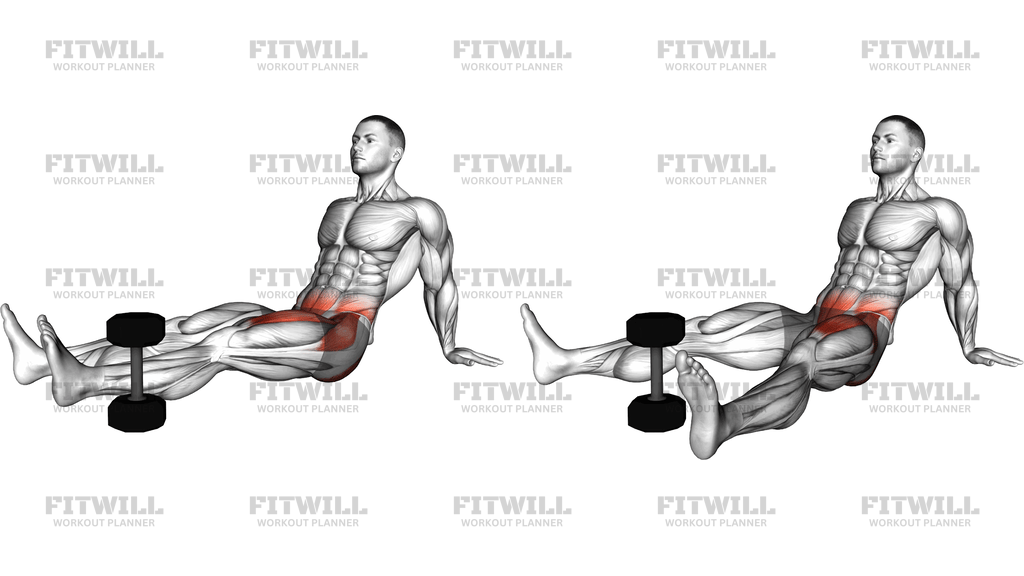
The Seated Single Leg Half Circle is a seated hip drill where you support yourself on your hands behind your hips, extend both legs in front of you, and sweep one leg through a wide half-circle arc while the other stays planted. An upright dumbbell placed beside your legs acts as a fixed obstacle, forcing the moving leg to travel over and around it with intent instead of drifting through an uncontrolled arc. The highlighted work in this movement sits at the front of the hip and across the outer hip, with the deep abdominals bracing hard to keep your torso still while the leg moves.
This drill earns its place in a warm-up or hip-strength block because it trains hip flexion, abduction, and controlled rotation all in one path. Most people have no problem lifting a leg straight up, but tracing a deliberate half circle around an object exposes the weaker corners of the range, especially the transition from lifting the leg to sweeping it outward. That makes it useful for runners, lifters with stiff or poorly controlled hips, and anyone rebuilding coordination after long periods of sitting.
The setup is what separates this from a random leg swing. Sitting tall with your hands planted behind you gives your shoulders and triceps a stable base, and leaning back slightly lengthens the hip flexors of the moving leg so it has to work through a longer range. The upright dumbbell sets the height and width of the arc: your foot must clear it on the way out and on the way back, so a lazy or low sweep becomes obvious immediately.
To execute it well, keep the moving leg long with a soft knee, hover the heel just off the floor, and let the hip do the steering rather than swinging from the lower back. Your torso should stay quiet; if you notice your hips rocking or your chest collapsing each time the leg sweeps out, that is the signal that the core is giving way and the range is too big for right now.
Expect to feel this on the front of the hip of the moving leg and along the outer hip as the leg travels wide, with a steady bracing sensation through the lower abs the entire time. Because the load is body weight plus the precision demand, the goal is crisp, repeatable arcs rather than speed or height.
Keep the reps modest and the tempo slow, especially on the return half of the circle, and switch sides before form degrades. If the floor is hard on your sitting bones or palms, a mat makes the setup far more comfortable without changing the movement.
[ Workout Log & Planner ]
Put your next workout in Fitwill
Keep your plan and training log ready when you are.


Instructions
- Sit on the floor with your legs extended in front of you and place an upright dumbbell on the floor beside your lower legs, roughly in line with your ankles, so it stands about shin height.
- Plant your palms on the floor just behind your hips with fingers pointing forward or slightly out, and lean back until your weight settles into your hands and sitting bones.
- Lengthen both knees, flex your feet back, and brace your lower abs as if preparing for a light puff of air to the stomach.
- Keep one leg fully extended and still on the floor; this is your anchor leg for the entire set.
- Hover the heel of the other leg an inch or two off the floor and lift it just high enough that it will clear the top of the upright dumbbell.
- Sweep that leg outward and around in a smooth half circle, passing over and around the dumbbell until your foot reaches the far side at roughly hip width or slightly wider.
- Reverse the arc with the same control, carrying the leg back over the dumbbell to the starting hover position without letting the heel touch down.
- Exhale as the leg travels out and away, inhale as it returns, and keep the breath steady rather than holding it.
- Complete all reps on one side, then reset the hover, lower the leg fully to rest, and switch to the other leg.
- Keep your chest up and shoulders down away from your ears throughout; if your hips start rocking to help the leg around, shrink the arc.
Tips & Tricks
- The most common mistake is driving the arc from the lower back instead of the hip, which shows up as your pelvis rolling each time the leg sweeps wide. Imagine your hips are bolted to the floor and only the ball-and-socket of the hip is moving.
- If your foot keeps clipping the dumbbell, the issue is usually lift height at the start of the arc, not flexibility. Raise the hovering knee slightly before you begin the sweep so the foot has clearance over the top.
- Tension in the anchor leg matters: press that heel and the back of the knee down into the floor. A loose anchor leg lets your whole body slide toward the moving side.
- Keep the moving knee soft but not bent. A sharply bent knee shortens the lever, makes the arc easier to fake, and reduces the work at the front of the hip.
- If your wrists or shoulders complain about supporting you, walk your hands a little further behind your hips so your forearms sit more vertical, or drop to a mat and use fists instead of flat palms.
- Control the second half of the circle, the return over the dumbbell. Most people rush the way in after spending their attention on the way out, and that is exactly when the heel drops and the arc collapses.
- Do not judge the set by how wide the arc gets. A narrower half circle done with a silent torso builds more usable hip control than a big sweep that rocks your whole body.
- Point your toes gently forward rather than letting the foot flop, and reach with the inner edge of the foot as it crosses the dumbbell. This keeps the ankle quiet and the arc consistent.
- If you feel pinching at the front of the hip at the top of the arc, back the height off slightly and think about drawing the circle with your heel rather than your toes.
Frequently Asked Questions
What muscles does the Seated Single Leg Half Circle work?
The primary work comes from the hip flexors at the front of the hip and the outer hip muscles that steer the leg through the arc. The deep core and lower abs work isometrically to hold your torso still while one leg moves.
Why is there a dumbbell standing upright next to my legs?
The upright dumbbell is an obstacle that sets the height and width of the arc. Your moving foot has to clear it on the way out and on the way back, which turns a vague leg swing into a precise, measurable path.
Is the Seated Single Leg Half Circle a strength or mobility exercise?
It sits in between, but the seated support and hovering leg make it primarily a controlled strength and coordination drill. It is often used as a warm-up before squats, lunges, or running.
I am a beginner and my hips rock every rep. What should I change?
Shrink the arc and lower the height so the foot barely clears the dumbbell, and slow the tempo down. Once your torso stays quiet through the smaller circle, gradually widen and raise it over several sessions.
Can I do this exercise without a dumbbell?
Yes. Any small upright object of similar height, such as a foam roller section or a water bottle, works the same way. The obstacle is what matters, not the load.
How many reps and sets should I do per side?
Start with 5 to 8 slow arcs per leg for 2 sets, finishing each side before switching. Because the demand is precision, stop the set as soon as your heel touches down or your hips start rocking.
My wrists hurt from supporting myself behind my hips. What can I do?
Lean back a little less so less weight sits in your hands, or make fists and support on your knuckles on a mat. You can also place your hands slightly wider to give your shoulders more room.
Why does the front of my hip pinch at the top of the arc?
That usually means the leg is lifting higher than your current hip control allows. Draw the circle with your heel, reduce the height slightly, and keep the knee soft rather than forcing a bigger range.
Should the anchored leg stay completely flat on the floor?
Yes. The extended leg is your base, so press the back of that knee and heel down and keep it motionless. If it lifts or slides, you are leaking force from the anchor into the moving side.
Can I use the Seated Single Leg Half Circle to rehab a hip issue?
It is a low-load, controllable drill that many people tolerate well, but any rehab use should be cleared by a qualified professional who knows your specific situation. If it produces sharp pain rather than muscular effort, stop and get it assessed.