Weighted Sandbag Military Press
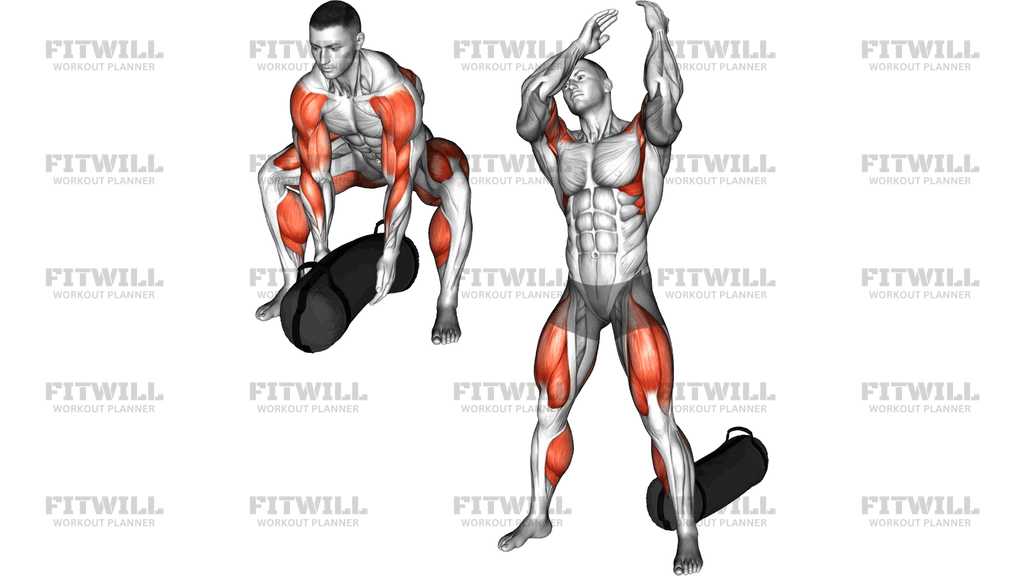
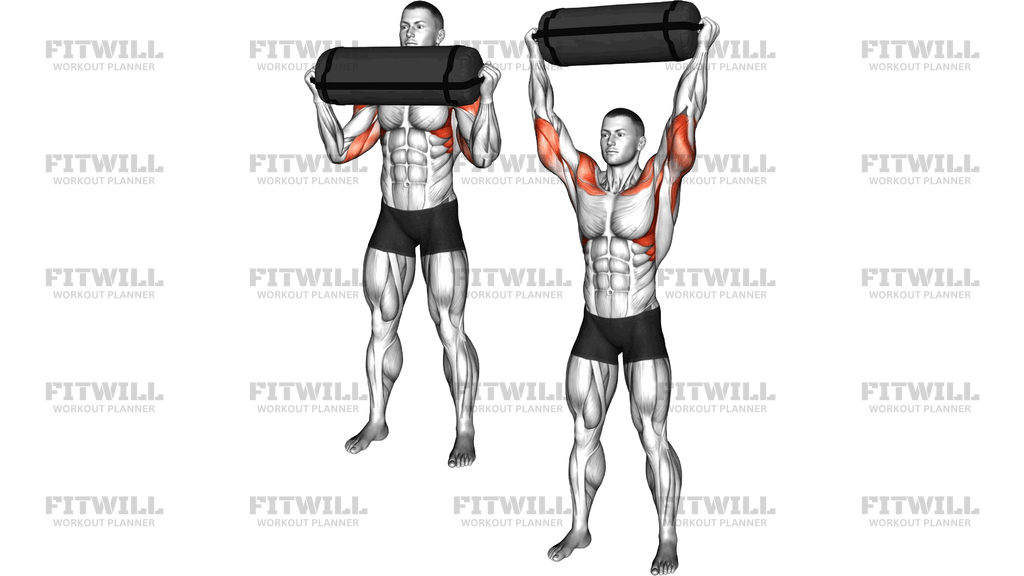
The Weighted Sandbag Military Press is a standing overhead press performed with a sandbag held horizontally across your upper chest and shoulders. Instead of a barbell or dumbbells, you press a long, cylindrical bag filled with sand from collarbone height to full lockout overhead. The bag's length forces a wider-than-normal grip, and its shifting fill challenges your shoulders, arms, and midsection in a way rigid implements never quite do.
This movement is particularly useful for lifters who train at home or outdoors with minimal equipment, as well as grapplers, strongman-style athletes, and general strength trainees who want pressing power that transfers to real-world objects. Because the sandbag has no fixed handle position and the sand redistributes as you press, your forearms, grip, and trunk stabilizers work overtime to keep the bag level and under control.
The primary work comes from the front and side delts and the triceps, which extend the arms to lockout. The upper chest assists on the drive, while the traps and upper back stabilize the shoulder girdle as the bag travels overhead. Your core, especially the abs and lower back, bracing isometrically the entire time to stop the bag from pulling you backward or twisting you to one side.
Setup matters more than most people expect. The bag should rest across your upper chest and shoulders, not down on your forearms, and your elbows should stay slightly in front of or under the bag rather than flared out behind it. Your feet are set about hip to shoulder width with the weight balanced through the whole foot. If the bag sits too low or your elbows drop behind your torso, the press becomes a front raise and your lower back absorbs stress it should not.
To execute well, brace your trunk, take a breath, and press the bag straight up, allowing your head to move back slightly as the bag passes your face. Press until your arms are fully extended and the bag is directly over the middle of your head, not out in front. Lower it under control back to your chest, reset your grip and brace, and repeat. The soft, awkward nature of the bag means the path will never look perfectly robotic, and that is part of the training value.
A practical safety point: because the bag is heavy, floppy, and sits close to your face and neck, err on the side of a lighter bag while you learn the movement. If you cannot keep the bag level or feel it drifting toward your head on the descent, drop it to the floor rather than catching it in an ugly position. The sandbag is one of the few implements you can bail from completely safely.
[ Workout Log & Planner ]
Put your next workout in Fitwill
Keep your plan and training log ready when you are.


Instructions
- Fill and position your sandbag so it is an even, cylindrical shape, and set it on a rack, box, or your thighs if it is too heavy to lift comfortably from the floor.
- Stand with your feet about hip to shoulder width apart, toes pointing slightly out, and grip the bag with your hands roughly shoulder width to slightly wider along the top of the bag.
- Clean or slide the bag up so it rests across your upper chest and front delts, with your elbows tucked slightly in front of the bag rather than flared wide behind it.
- Squeeze your glutes, brace your abs as if preparing for a light punch, and pull your chin back a touch to clear a path for the bag.
- Press the bag straight up overhead in one smooth drive, letting your head move back just enough for the bag to clear your face.
- Continue pressing until your arms are fully extended and the bag is balanced directly over the crown of your head, with your biceps near your ears.
- Pause briefly at lockout, keeping the bag as level as possible so one side does not dump weight onto the other hand.
- Lower the bag under control back to your upper chest, exhaling as it comes down, and let your elbows settle back under the bag.
- Reset your grip and re-brace before each rep rather than bouncing the bag off your chest.
- When finished, lower the bag to the floor by dropping it or hinging at the hips, keeping your back straight.
Tips & Tricks
- Keep the bag resting on your upper chest between reps. Holding it on your forearms turns every rep into a front raise and burns out your arms before your shoulders get anything.
- If the bag twists or one end sags as you press, squeeze both ends harder and focus on pressing both hands at identical speeds. Uneven sand is normal, but you control it with grip, not by leaning.
- Do not lean your torso backward to finish a heavy press. If your hips push forward and your back arches, the weight is too heavy or your brace has failed, so cut the set.
- Keep your wrists relatively straight over your forearms. Letting them bend back under the bag's weight strains the wrists and makes the lockout shaky.
- Your stance should stay planted throughout. If you find yourself stepping or splitting your feet to finish reps, the bag is shifting too far in front of you at the start of the press.
- Wear a shirt with sleeves or rough material over your shoulders; sandbags drag on skin and can rub raw across the delts during higher-rep sets.
- Use your breath deliberately: big inhale and brace at the chest, exhale through the sticking point or at lockout. Re-breathing between reps with a heavy bag on your chest is inefficient.
- If your shoulders feel pinched at the bottom, raise your elbows slightly so the bag sits higher and your forearms stay more vertical, or reduce the bag weight.
Frequently Asked Questions
Which muscles does the Weighted Sandbag Military Press work the most?
The front delts and triceps do most of the pressing work, with the side delts and upper chest assisting. Your traps, upper back, and core stabilize heavily because the shifting sand constantly tries to pull the bag off balance.
Is the Weighted Sandbag Military Press good for beginners?
Yes, but start with a light bag and focus on keeping it level and pressing it over the middle of your head. The forgiving, soft implement is actually safer to fail with than a barbell, but the awkwardness takes a few sessions to learn.
How wide should my grip be on the sandbag?
About shoulder width to slightly wider along the top of the bag. Because the bag is long and horizontal, your hands sit wider than they would on a barbell, so find the position where you can press both ends evenly without one hand drifting.
Why does my lower back ache when I press the sandbag overhead?
This usually means the bag is sitting too low on your chest or your torso is leaning back as you press. Rest the bag higher on your front delts, squeeze your glutes, and brace harder before each rep.
Can I substitute a barbell or dumbbells for the Weighted Sandbag Military Press?
A barbell or dumbbell overhead press trains the same basic pattern, but neither replicates the shifting load and wide, awkward grip. Sandbag handles are an option, though you lose some of the instability that makes this version valuable.
Should my head move during the press?
Yes, slightly. Pull your chin back as the bag clears your face, then let your head return to neutral as the bag moves over the top of your head. Keep your torso upright and avoid leaning your whole body backward.
How heavy should the sandbag be for this exercise?
Choose a weight you can press for clean, level reps without arching back or stepping. For most people this is noticeably less than their barbell overhead press, since the sandbag's instability and awkward grip make the same weight feel much harder.
Is it safe to drop the sandbag if I fail a rep?
Yes. Unlike a barbell, a sandbag can be dropped forward or to the side safely as long as you clear your feet and face. If the bag starts drifting toward your head on the descent, push it away and step back rather than catching it awkwardly.
Should I re-grip the sandbag between reps?
Yes. The sand shifts during each rep, so take a moment at your chest to even out the load and reset your hands on the bag before pressing again. Rushing reps with a lopsided bag is the most common cause of sloppy form.