Lying Floor Negative Half Dragon Flag
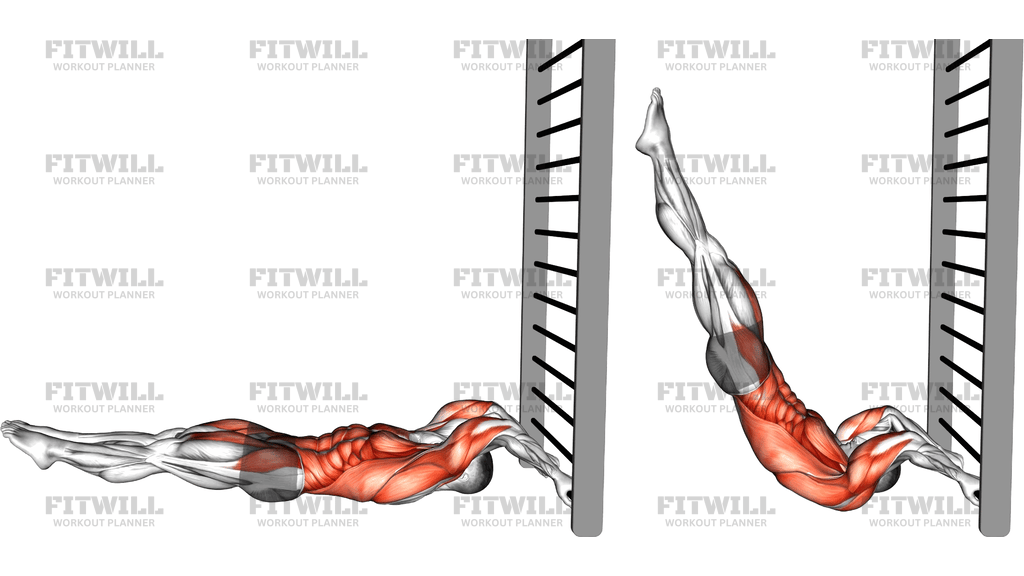
The Lying Floor Negative Half Dragon Flag is a floor-based core exercise built around one thing: a slow, controlled lowering of straight legs from vertical down toward the floor while you grip a fixed point behind your head. Unlike the full dragon flag, your hips and upper back stay planted on the floor the entire time — only the legs pivot at the hip joint. The word "negative" tells you where the work happens: the lowering phase is deliberately stretched out so your abdominals fight gravity through their longest, hardest range.
The setup is simple but specific. You lie flat on your back on the floor with your head closest to stall bars, a sturdy rack upright, or any low fixed rung you can reach with straight arms. Reaching overhead and gripping that anchor locks your shoulders down and gives your lats and grip something to do, which stops you from sliding around as the legs travel. From there, the legs stay glued together and fully straight, knees locked, toes pointed, moving as one rigid lever.
What this exercise trains is the ability of the anterior core to control hip extension under load. As your legs lower away from vertical, the distance between the weight of your legs and your abs grows, and the leverage against your midsection climbs fast. The lower abs, deep core, and obliques have to brace hard to keep your lower back from arching off the floor, while the hip flexors work eccentrically to slow the descent. The grip and lats contribute isometrically the whole time.
This is a great choice for anyone building toward a full dragon flag, since the hardest part of that movement is controlling the descent. It also suits lifters who want serious abdominal loading without flexing the spine repeatedly, and calisthenics trainees who need straight-leg hip hinge strength for movements like hanging leg raises, levers, and strict toes-to-bar. Because the floor supports your trunk, it is far more forgiving than the hanging or bench versions while still demanding real strength.
Execution quality comes down to tempo and honesty about range. Lower the legs over three to five seconds, stop when your heels are just above the floor — or earlier, the moment your lower back starts to peel away — then either lift back to vertical under control or reset for the next rep. If your heels touch down or your back arches, the set is over as far as quality is concerned. Start with a range you can own, shorten it if needed, and expand it as your control improves.
A few practical points keep this safe and productive. Never let the legs drop fast; the whole value is in the resistance to gravity, not the distance covered. Keep the knees locked and legs together so the lever stays rigid — bent knees quietly shorten the demand and turn it into a different exercise. And because the anchor is behind your head, check that whatever you grip cannot move before you commit to the set.
[ Workout Log & Planner ]
Put your next workout in Fitwill
Keep your plan and training log ready when you are.


Instructions
- Lie flat on your back on the floor with your head positioned about an arm's length from a stall bar, squat rack upright, or other low fixed rung.
- Reach both arms overhead and take a firm overhand grip on the lowest rung or bar you can reach, keeping your elbows fully extended and your shoulders pressed down.
- Straighten your legs completely, press them together, and point your toes so your body forms one rigid line from hips to heels.
- Brace your abs and press your lower back gently into the floor before the legs move at all.
- Raise your straight legs up until they are vertical over your hips; this is the start of every rep.
- Slowly hinge at the hips and lower your legs as one unit toward the floor over three to five seconds, keeping the knees locked the entire way.
- Stop the descent when your heels hover just above the floor, or earlier if your lower back begins to lift or arch away from the ground.
- Lift the legs back up to vertical under control, or if the lowering was heavy, bend the knees, tuck, and reset to vertical before the next rep.
- Exhale steadily through the lowering phase and inhale as you return the legs to vertical; never hold your breath through the whole rep.
- Finish the set before your lower back position degrades — release the grip one hand at a time and sit up carefully.
Tips & Tricks
- The most common breakdown point is the lower back arching off the floor as the legs pass roughly 45 degrees. Stop the rep there rather than forcing the heels all the way down.
- If you feel the work shifting into your hip flexors with a hollow abdomen, re-brace by pulling your ribs down toward your hips before you start lowering.
- Sliding away from the anchor mid-set is a sign your grip is failing before your abs do — chalk your hands or wear grips, or use a thicker rung.
- Bent knees are the quietest form error here; they shorten the lever and cut the load drastically. If you cannot keep the knees locked, reduce the range instead of softening the legs.
- Count your lowering tempo out loud or in your head. If your three-second descent turns into a one-second drop by rep five, the set has run past your control.
- Keep your head neutral on the floor rather than craning forward to watch your feet; lifting the head tends to pull the shoulders off their position and loosen the anchor grip.
- A useful regression is to lower only to 45 degrees and return. Progress the range week by week rather than chasing the floor on day one.
- Because this is a negative-heavy movement, expect more next-day soreness than the rep count suggests — keep the first few sessions short, around three to four sets.
- Do not let the legs drift apart or split as they descend; squeezing the thighs and heels together keeps the demand symmetrical across both sides of the core.
Frequently Asked Questions
What muscles does the Lying Floor Negative Half Dragon Flag work?
The rectus abdominis, especially the lower fibers, does most of the work as it controls the legs' descent. The obliques and deep core stabilize your trunk, the hip flexors work eccentrically, and your lats, shoulders, and forearms hold the isometric grip on the anchor.
Why does the Lying Floor Negative Half Dragon Flag keep the hips on the floor instead of lifting like a full dragon flag?
With the trunk supported on the floor, the movement isolates the hinge at the hips and removes the shoulder-stability and full-body tension demands of the full version. That makes it an ideal stepping stone: you build straight-leg lowering control first, then add the body pull later.
Can beginners do the Lying Floor Negative Half Dragon Flag?
Yes, as long as they shorten the range. Lowering from vertical only to about 45 degrees and returning is demanding enough for most people new to the movement, and the floor support makes it safer than hanging or bench variations.
How slow should the negative phase be in the Lying Floor Negative Half Dragon Flag?
Aim for three to five seconds per lowering phase. If you cannot slow the descent that much without your lower back arching, the legs are dropping too far or your abs need more time to develop the eccentric strength.
What can I use as the anchor if I do not have stall bars for the Lying Floor Negative Half Dragon Flag?
Any low, immovable point you can grip with straight arms while lying down works — a rack upright, a heavy dumbbell handle secured under a bench leg, or a low pull-up bar. Test that it cannot shift before you start the set.
Why do my hip flexors cramp during the Lying Floor Negative Half Dragon Flag?
Cramping usually means the hip flexors are lowering the legs while the abs have stopped bracing. Pause the descent, re-tighten your midsection by pressing the lower back into the floor, and shorten your range so the core stays loaded throughout.
Should my heels touch the floor at the bottom of each rep?
No — the rep ends with the heels hovering just above the floor, or earlier if your back position breaks. Touching down unloads the tension and turns the hardest part of the range into a rest.
How does the Lying Floor Negative Half Dragon Flag carry over to the full dragon flag?
The full dragon flag is essentially this same straight-leg hinge with the entire trunk peeled off the floor, so eccentric control learned here transfers directly. Once you can lower slowly through the full range with a stable lower back, you have built the core strength the full version demands.
Is it safe for the lower back to do the Lying Floor Negative Half Dragon Flag regularly?
It is generally well tolerated because the floor supports the spine and the trunk is not repeatedly flexed. The main risk is letting the lower back arch under fatigue, so stop each set as soon as you cannot keep it pressed toward the floor.
Where should the Lying Floor Negative Half Dragon Flag go in my workout?
Treat it as a high-effort core skill and place it early in your core work, while your grip and bracing are fresh. Two to four sets of three to six slow negatives is plenty given how demanding the eccentric phase is.